
How to Prevent a Spending Relapse After a Reset

Slipped on impulse spending, or afraid you will? Learn the warning signs, triggers and a simple plan to stop a spending relapse and recover fast if it happens.
How to Prevent a Spending Relapse After a Reset
You prevent a spending relapse by knowing your triggers before they hit, putting friction between the urge and the purchase, and deciding in advance what you will do when you slip. Willpower is the weakest of these. A written plan with a few small systems works better, and it keeps one bad Friday from turning into a bad quarter.
This guide is for anyone who has cut back on impulse buying, subscriptions or emotional spending and wants the change to last. It covers what a relapse looks like, the situations that set one off, a plan you can build in an afternoon, and what to do the day after an overspend.
TL;DR
- A spending relapse is a return to old, automatic spending patterns. One unplanned purchase is not a relapse. A pattern of buying to cope, then hiding or regretting it, is.
- Stress, boredom, loneliness and celebration are the usual triggers. Name yours and write an if-then response for each.
- Add friction: remove saved cards, unsubscribe from marketing emails and set a 24-hour wait on non-essential purchases.
- If you overspend, replace shame with data, restart the next day and skip the extreme frugality.
- If spending feels out of control or debt causes panic, talk to a credit counselor or a mental health professional.
Table of Contents
- What a spending relapse actually is
- Warning signs your old habits are coming back
- The triggers behind most relapses
- Build your relapse prevention plan
- If you are paying down debt or building an emergency fund
- What to do the day after you overspend
- A relapse-proof weekly routine
- Our perspective
- Keep the reset going with a structured plan
- When to get outside help
- FAQ
- Sources
What a spending relapse actually is
The word "relapse" comes from addiction recovery, and the borrowing is not perfect. Most people who overspend do not have a clinical disorder. But the mechanics of relapse prevention, which are triggers, coping skills and a plan for lapses, fit spending habits well.
A useful distinction is between impulsive and compulsive buying. Impulsive buying is more reactive to external triggers, while compulsive buying tends to be planned and used to cope with internal distress. That matters for prevention. If a flash sale gets you, you need friction. If a bad day gets you, you need a different way to handle the bad day.
Here is a practical way to tell a lapse from a relapse:
| | Lapse | Relapse | |---|---|---| | What happened | One unplanned purchase or a short spree | Old habits back in daily routine for weeks | | How it feels | Mild regret, quick recovery | Guilt, hiding purchases, avoiding statements | | What it needs | A reset the next day | A review of triggers and your plan, maybe outside help |
A lapse is normal. A lapse you never talk about, track or learn from is how relapse starts.
Warning signs your old habits are coming back
Relapse rarely arrives as a big purchase. It shows up as small behaviors first. Watch for these:
- Shopping as the first response to a hard day. Experts quoted by Psychology Today describe using spending or hunting for a dopamine hit as the first reaction when you are struggling, along with guilt or anxiety after you look at a card statement.
- Buying and not using. Tags still attached, forgotten orders and duplicates of things you already own are signs the purchase was about the buying, not the item.
- Hiding or justifying. If you tuck packages away or rehearse an explanation for your partner, treat that as a flag.
- Going over budget and piling up clutter faster than you can use or organize it.
- Treating leftover paycheck money as money that must be spent. Mental Health America lists feeling you must spend whatever is left in your paycheck, feeling better when buying and feeling anxious on days you do not shop among its warning behaviors. It also lists paying only the minimum on credit cards while continuing to charge.
One or two of these on a stressful week is information. Several at once, for weeks, is a signal to act on the plan below.
The triggers behind most relapses
Spending urges tend to follow emotional states more than shopping opportunities. Common ones include stress or overwhelm, loneliness, boredom, low self-esteem, celebration moments and arguments. Compulsive buying patterns are associated with tension before a purchase and relief afterward, then guilt, which is a loop worth recognizing.
Build your own trigger list in three columns: the situation, the feeling, and the usual purchase. For example:
- Sunday night dread, anxious, late-night scrolling and cart-filling. See our piece on stopping doomscroll shopping.
- Payday, relieved, "I deserve this" purchases.
- Hard week with the kids, exhausted, delivery apps and grocery overbuying.
- A sale email, tempted, impulse add-to-cart.
The list takes ten minutes and does more than any amount of resolve. A trigger you have named is one you can plan for.
Build your relapse prevention plan
A good plan has four parts: friction, replacement, support and a recovery script. Write it down. A plan in your head disappears exactly when you need it.
Add friction between the urge and the purchase
The goal is to make buying slightly harder than not buying. U.S. Bank's financial education team suggests removing saved credit card details, unsubscribing from marketing emails and enforcing a 24-hour wait on non-essential purchases. The same guidance makes the point that controlling impulse spending is not all about willpower: small systems that interrupt the urge help.
A starter friction checklist:
- Delete saved cards from browsers, phone wallets and shopping apps.
- Unsubscribe from promotional emails and turn off retailer push notifications.
- Log out of shopping apps after each use, or move them off your home screen.
- Put a 24-hour wait on anything non-essential. Keep the item in your cart or on a list and look again tomorrow.
- Shop groceries with a list, and consider pickup so you skip the aisles built for impulse.
Replace the habit with a planned response
Cognitive behavioral approaches work well here. The Beck Institute describes if-then plans, such as taking a 10-minute walk or calling a friend when you are bored and tempted to browse. It also describes urge surfing: notice and label the urge, rate its intensity, and watch it peak and recede over 10 to 15 minutes without buying.
Try writing one if-then plan per trigger:
- If I feel lonely and open a shopping app, then I text one person before I do anything else.
- If payday lands and I feel flush, then I move my savings transfer first, before I look at what is left.
- If I am stressed and want a treat, then I make tea and step outside for ten minutes.
Pick replacements you can actually do in the moment. A plan that needs a gym and an hour will lose to a phone and a thumb.
Check your mood before you check out
NPR's mindful shopping guide recommends asking whether you are buying because you are upset or because the item solves a real problem. Make this a one-line habit at the checkout page: "What am I feeling right now, and what do I hope this does?" If the answer is a feeling, not a need, the 24-hour rule applies.
Cut the leaks that make relapse easy
Subscriptions are the quiet version of relapse. They charge you whether or not you feel tempted. A simple method is to export 30 days of transactions and circle the subscription leaks. Cancel what you do not use, and put the rest on a calendar reminder to review every quarter. Our guide to expenses to cut first can help you decide what goes.
Line up support
Tell one person your plan, and give them a specific job: "If I text you the word cart, ask me what I am feeling." For households, a short script for money conversations beats a vague promise to do better. If you share finances, agree on a personal spending amount that needs no explanation, so small purchases never turn into secrets.
If you are paying down debt or building an emergency fund
Relapse risk is highest when money is tight and you feel deprived. Deprivation tends to produce rebound spending. A gentler order of operations helps. One recovery-focused guide suggests covering essentials and minimum debt payments first, setting one small savings goal, and putting extra debt payments last. A small starter buffer protects you from the next surprise bill, which is a common trigger for credit card relapse.
If you are carrying card balances, watch the minimum-payment pattern in particular. Paying the minimum while continuing to charge is one of the behaviors Mental Health America flags, and our post on the minimum payment trap explains why the balance barely moves. If the whole budget feels like too much, start with a simple budget method or read about budget overwhelm.
For parents trying to hold the line on groceries, a plan for the store itself matters. We cover it in grocery shopping with kids during a no-spend month.

What to do the day after you overspend
The most damaging part of a slip is usually what comes next: shame, then "I already blew it," then a spree. Interrupt that chain.
- Look at the numbers, not at yourself. Recovery guidance suggests replacing shame with data and avoiding extreme frugality. Write down what you spent, when, and what you were feeling.
- Find the trigger. Was it a stress spike, a sale, a bad night? Add it to your trigger list.
- Fix the plan, not the person. If the 24-hour wait failed because the card was saved in your phone, remove the card.
- Restart tomorrow. Do not wait for Monday or the first of the month. One day of old behavior does not erase the days you have built.
- Return or cancel what you can. Then move on without a penance budget.
After a holiday or a long low-spend stretch, the rebound can be bigger. Our posts on the post-holiday money reset and conscious spending after a low-buy year walk through easing back without swinging to either extreme.
A relapse-proof weekly routine
Prevention works best as a light routine, not a crisis response. Here is one that takes about 20 minutes a week:
- Check in (5 minutes). Scan the week's transactions. Mark anything you would not buy again.
- Review triggers (5 minutes). Rate your stress, boredom and loneliness from 1 to 5. High scores mean the week ahead needs extra friction.
- Pre-decide (5 minutes). Write the one purchase you plan to make this week on purpose, so the "treat" has a place.
- Subscription glance (5 minutes). Look for new charges, trial conversions and renewals.
Planned spending is a real part of prevention. A budget with zero room for wants tends to break, and a planned treat takes the edge off the urge.
Our perspective
We built the 30-Day Zero-Spend Reset around one idea: a spending reset fails when it depends on willpower and guilt. People do not slip because they are weak. They slip because the trigger arrives faster than the plan.
That is why our program is a daily system rather than a lecture on budgeting. Each day gives you one small behavioral challenge, a tracker to see your patterns, and tools for the moments that usually derail people: subscription audits, meal planning for the grocery-bill spiral, and social scripts for money conversations at home or with friends.
The 30 days matter less than what they teach you. By the end, you know your triggers by name and have replacement habits already tested in real life. That is the foundation of staying reset, and it is why we pair the workbook with a private webapp you can come back to when old patterns tug at you.
Omar
Keep the reset going with a structured plan
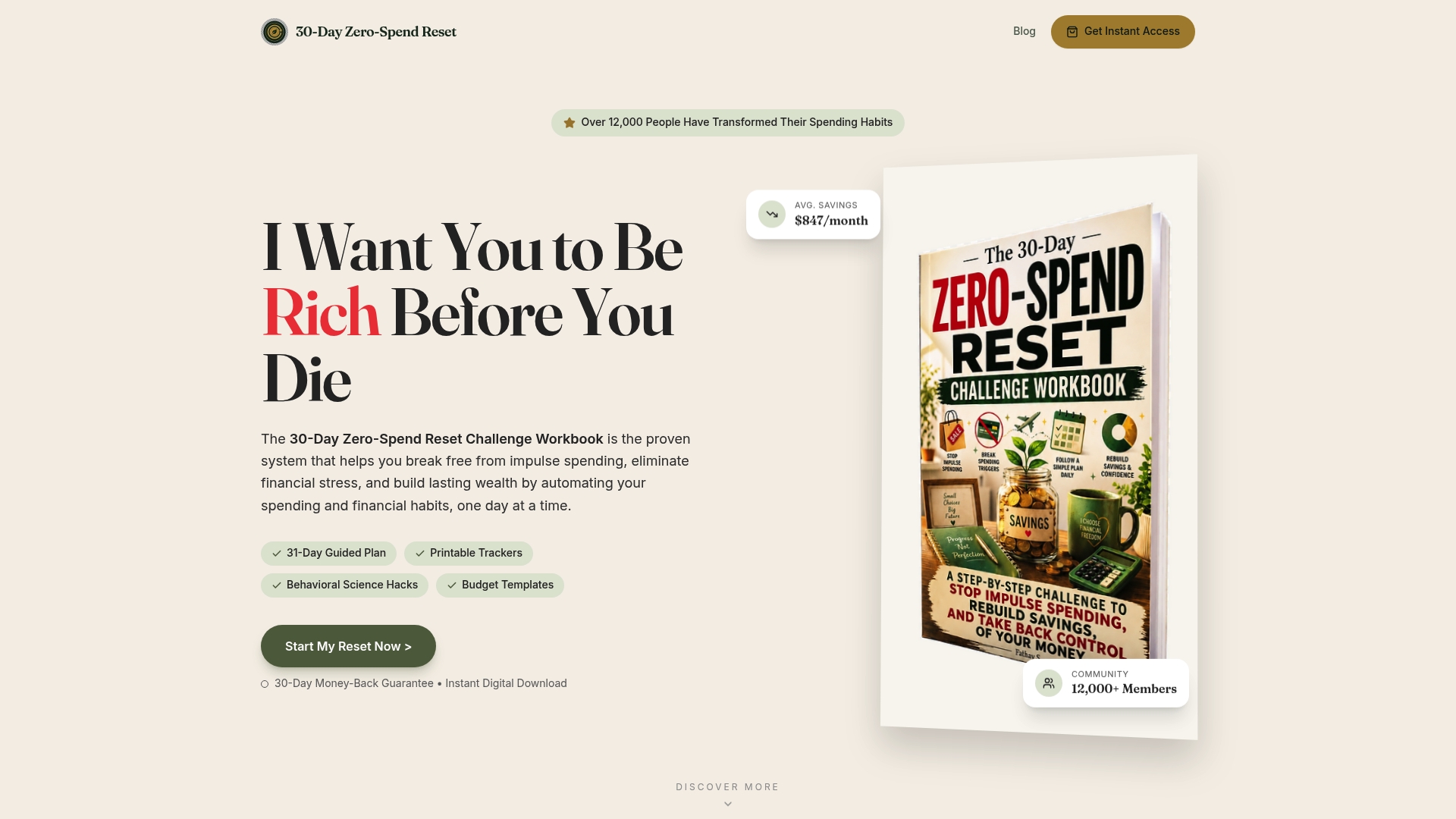
If you want the steps above laid out day by day, the 30-Day Zero-Spend Reset Challenge Workbook gives you daily behavioral challenges, printable trackers, budget templates, meal planning guides and subscription audits in one place. It is designed to help you spot impulse, subscription and emotional spending and replace them with habits you can keep.
The companion webapp keeps your tools within reach, and the Zero-Spend Accelerator Vault adds extra resources for people who want to go further. Our zero spend guide is a good place to see how the approach works before you start.
When to get outside help
Self-guided plans have limits, and knowing them is part of staying safe. Mental Health America says that if you agree with most of its compulsive-buying statements, it may be time to seek help. Consider talking with a licensed therapist or your doctor if shopping brings a rush followed by guilt you cannot shake, or if you cannot stop despite real damage to your finances or relationships.
Other situations call for extra support: facing eviction, utility shutoff or legal threats, or debt that triggers panic you cannot manage. For debt specifically, the Consumer Financial Protection Bureau notes that credit counseling organizations are usually nonprofits whose certified counselors can help you build a budget and a debt management plan. The same page points to the National Foundation for Credit Counseling, the Financial Counseling Association of America and a Department of Justice list of approved counselors as places to start.

FAQ
Is a spending relapse the same as a shopping addiction?
Not necessarily. A spending relapse describes sliding back into habits you were trying to change, such as impulse buying or emotional spending. Compulsive buying is a more serious pattern, often planned and used to cope with internal distress. If you suspect the second, talk with a mental health professional.
What are the four D's of relapse prevention for spending?
The four D's are usually given as delay, distract, deny and decide (or distance), and versions vary by program. Applied to spending, delay means the 24-hour wait, distract means a walk or a call, and distance means removing saved cards and promotional emails. Use the version your therapist or program teaches if you are working with one.
How long should I wait before buying something?
For an urge in the moment, a 10 to 20 minute pause helps it peak and fade, as in urge surfing. For any non-essential purchase, a 24-hour wait is a common rule. Essentials like medication and rent do not need to wait.
What should I do right after I overspend?
Write down the amount, the time and the feeling, then find the trigger and adjust your plan. Skip punishing yourself with extreme cuts. Restart the next day, because one slip does not undo your progress.
Sources
- Impulsive Buying vs. Compulsive Shopping, Verywell Mind
- How to Stop Buying Things You Don't Actually Need, Real Simple
- Risky Business: Compulsive Buying, Mental Health America
- Emotional Spending: Identifying and Overcoming Your Triggers, Simply Psychology
- ADHD and shopping addiction, Understood
- Why emotions drive you to spend and how to stop the habit
- Should I buy it? A handy guide for shopping mindfully, NPR
- Break the Impulse Buying Habit with CBT, Beck Institute
- How to stop impulse buying, U.S. Bank
- Financial Recovery After Addiction: Rebuild Money
- How to Stop Living Paycheck to Paycheck
- What is credit counseling? Consumer Financial Protection Bureau
Recommended
Ready to reset your spending?
Get the 30-Day Zero-Spend Reset Workbook and turn these ideas into a daily action plan.
Start the 30-Day ResetThis article is part of the 30-Day Zero-Spend Reset method. Explore the complete day-by-day system behind these ideas.
Read the full guideKeep reading


Join the conversation
Be the first to share your thoughts on this article.