
Wishlist Strategy: How to Stop Impulse Buys and Fund Your Goals

A wishlist strategy puts a pause between wanting and buying. Learn how to set it up, what to log, how long to wait and how to rank wants against debt.
Wishlist Strategy: How to Stop Impulse Buys and Fund Your Goals
A wishlist strategy means you never buy a nonessential item the moment you want it. You write it down with the date and the reason, wait a set period, and buy only if it still matters and fits your budget. The list is not a shopping tool here. It is a pause button, and a structured 30-day reset like our 30-Day Zero-Spend Reset Challenge Workbook turns that pause into a daily habit instead of a good intention.
TL;DR
- Log every nonessential want with the date and the reason, then revisit it after a waiting period of 48 hours to two weeks.
- If the want has faded, you saved the money. If it hasn't, buy it only when it fits your means.
- Split a second list into short-, medium- and long-term goals so debt payoff and an emergency fund rank above casual wants.
- Pair the list with a monthly look at subscriptions and groceries, where small leaks add up fastest.
- A written routine beats willpower. Put the steps on paper and run them for 30 days.
Table of Contents
- What a wishlist strategy actually is
- Why impulse spending needs a system
- How to set up your wishlist, step by step
- Build a second list: goals, not just wants
- Where debt and an emergency fund sit on the list
- Use the list on subscriptions and groceries
- Make it a monthly plan without feeling deprived
- Common ways the wishlist strategy fails
- Our perspective
- Start your 30-day reset
- FAQ
- Sources
What a wishlist strategy actually is
Most people know a wishlist as a place to park products for a birthday. As a money tool, it works the other way around. Per NerdWallet's December 2024 guidance, you put each nonessential thing you want on a list with the date and the reason you want it. Then you revisit it after a set period: 48 hours, two weeks, or whatever works for you. By then it may no longer be a priority. If it still is, you can buy it when it is within your means.

That last clause matters. The strategy does not ask you to give up wants. It asks you to buy them on purpose, with a clear head, instead of on a feeling.
The reason it works is timing. The same NerdWallet analysis points out that one-click ordering and fast free shipping let you acquire a want within hours. Putting time between wanting and buying lets you see whether the appeal wears off before the money leaves your account.
Why impulse spending needs a system
This is not a small problem. A NerdWallet and Harris Poll survey of 2,090 U.S. adults, conducted October 1 to 3, 2024, found that 22% had made impulse purchases that significantly affected their finances in the prior 12 months.
For many people the trigger is emotional. NerdWallet's April 2025 piece on retail therapy suggests adding the item to a wishlist instead of hitting "buy", so you still get the rush of choosing but review the decision later with a clearer mind. It also suggests two companions: a "dopamine menu" of enjoyable things to do besides shopping, and a few end-of-day reflection questions to spot what set off the urge.
If your triggers live in your feed, our guide on how to stop doomscroll shopping covers that specific pattern.
How to set up your wishlist, step by step
You can start in a notes app, a spreadsheet or a printed page. What matters is that every entry has the same fields.
Step 1: Capture the want the moment it appears
Write the item, the price and the date. Then close the tab. The goal is to make adding to the list easier than checking out, so the urge has somewhere to go.
Where it goes wrong: leaving the item in an online cart. A cart is a purchase waiting for one more click. A list in a separate place breaks that link.
Step 2: Write the reason
One honest sentence: "Because it was on sale," "because I had a rough day," "because my current one broke." The reason is the most useful column on the page. Patterns show up quickly, and a line like "bad day at work" three times in a week tells you more than any budget category.
Our workbook includes daily behavioral challenges and habit-retraining tools built around this kind of trigger awareness, so you are not left to invent the prompts yourself.
Step 3: Choose a waiting period
NerdWallet's range is 48 hours to two weeks. A rule of thumb that keeps it simple: the bigger the price, the longer the wait. Here is one way to set it up as a personal rule.
| Price of the want | Waiting period | |---|---| | Under $25 | 48 hours | | $25 to $100 | 1 week | | Over $100 | 2 weeks |
These tiers are an illustration, not a standard. Pick numbers you will actually follow, and write them at the top of the list. If you like having a rulebook, our spending rules list gives you ready-made ones to choose from.
Step 4: Review on the date, not on a mood
When the date arrives, ask three questions:
- Do I still want it as much as I did?
- Is it within my means this month, after bills, debt payments and savings?
- Does it move me toward or away from a goal that ranks higher?
If the answers are yes, yes and no, buy it and enjoy it without guilt. Otherwise, cross it off and note the amount you did not spend. That running total is motivating, and it is also real money you can redirect.
Here is what a short list might look like in practice. The items are made up for illustration:
| Date added | Item | Price | Reason | Review date | Decision | |---|---|---|---|---|---| | Mar 3 | Wireless earbuds | $79 | Saw an ad after a stressful day | Mar 10 | Crossed off | | Mar 4 | Winter boots | $120 | Current pair has a hole | Mar 18 | Bought | | Mar 6 | Meal-kit trial | $60 | Too tired to cook | Mar 8 | Crossed off, planned three simple dinners |
Two of three never left the list, and the one that did was a real need. That is the strategy working as designed.
Build a second list: goals, not just wants
A wishlist of items handles impulses. A wishlist of goals handles direction. The Consumer Financial Protection Bureau's savings booklet suggests listing things to save for, such as travel, electronics, home, transportation, emergencies, education, debt and medical expenses. Then sort them into short-term (the next few months), medium-term (the next year) and long-term (the far future).
To rank them, Virginia Cooperative Extension's guide suggests scoring each value 1 (most important), 2 (somewhat important) or 3 (not very important). It then turns goals into SMART goals: specific, measurable, adaptable, realistic and time-bound. Its example is $20,000 in savings by retirement at 65, funded by monthly deposits of $75.31.
Once a goal has a target amount and a date, the monthly figure is simple division plus a bit of growth. A savings goal calculator shows how much to set aside each month for a goal you have put on the list.

Where debt and an emergency fund sit on the list
If you are paying down debt or have no cushion, this part decides whether the wishlist helps or just reshuffles your spending.
Morningstar's goal-setting guide by Christine Benz suggests a hierarchy: high-interest debt paydown and an emergency fund come first, tied, then retirement savings, college savings, and finally other short- and intermediate-term goals. The same piece says personal wishes should inform your priorities, while giving plenty of weight to what makes financial sense.
In practice, that means a new gadget sits below the credit card balance. When you review an item, one extra question is worth asking: would this money do more good as an extra debt payment or in my emergency fund?
How big should the fund be? Federal Reserve economists Neil Bhutta and Lisa Dettling note that planners often recommend three to six months of expenses in liquid savings, which can help families avoid costly borrowing or missed payments. Using 2016 Survey of Consumer Finances data, they found about 60% of U.S. families lacked three months of expenses. If you are in that group, you are not alone, and the first target can be much smaller.
The CFPB's tax-time report cites a 2019 Federal Reserve study showing that 39% of American adults would have difficulty covering a $400 emergency from liquid savings. A starter goal of $400 is therefore a meaningful first line on your goals list.
If minimum payments are keeping you stuck, read our post on the minimum payment trap alongside this one.
A simple order of operations
- Essentials and minimum debt payments.
- A starter emergency cushion, then high-interest debt.
- Longer-term goals such as retirement.
- Wants that survived the waiting period.
The wishlist is how wants earn a place at step 4 instead of cutting the line.
Use the list on subscriptions and groceries
Impulse spending is not only shopping carts. Recurring charges are impulses that renewed themselves.
An Ohio State University Live Healthy Live Well article from September 2025 reports that 80% of U.S. adults had at least one subscription in the past year, subscribers pay about $90 a month on average ($1,080 a year), and people spend more than $200 a year on unused ones. It also found that 48% forgot to cancel a free trial or subscription. Its advice is to set reminders before trial end dates and to watch for automatic renewals, which may appear monthly or as one large annual charge.
Turn that into a wishlist habit:
- Treat every new trial as a want. Log it with the date, the reason and the cancel-by date.
- Audit what you already pay for. Utah State University Extension's expense guide recommends reviewing memberships and subscriptions every six months and canceling the ones you don't use.
- Cut the sources of new wants. Marketing emails feed the list. Our walkthrough on unsubscribing from marketing emails removes a steady stream of triggers.
Groceries work the same way. The same Utah State guide recommends splitting the monthly grocery budget by week, and says switching to generics can save many families $20 a week, $80 a month or $1,040 a year. Before you add the "nice extras" to the cart, put them on the list for the following week. If you shop with children, our post on grocery shopping with kids during a no-spend month shows how to keep the trip short and the list firm.
Make it a monthly plan without feeling deprived
A waiting rule feels easy for a week and heavy by week three if it has no payoff. The fix is to connect it to a plan you can see.
The CFPB's spending tracker tool says that tracking spending for a month, rather than just a week or two, can reveal small expenses that add up and may not match your priorities. If a full month seems too hard, it suggests trying one or two weeks. It also notes that recurring monthly items are often needs and obligations, while spending you can eliminate or cut back is generally wants.
That gives you three buckets to work with:
- Needs and obligations: rent, utilities, minimum debt payments, basic groceries.
- Goals: emergency fund, extra debt payments, long-term savings.
- Wants: everything on your wishlist.
Give wants a small, guilt-free line of their own, even $20 or $50 a month. When an item passes its waiting period and fits that line, you buy it. This is what keeps the plan from feeling like deprivation: the wishlist is not a list of refusals, it is a queue. If you want a simple way to lay out those buckets, see our simple budget method and our list of expenses to cut.
Common ways the wishlist strategy fails
- The list becomes a second cart. If you review it daily and buy as soon as the timer ends without asking the three questions, you have only delayed the impulse. Keep the review date and the questions.
- No reason column. Without it you lose the trigger data that makes the habit stick.
- Waiting periods that are too short for big items. Scale the wait to the price.
- Ignoring goals. A list of wants with no ranking against debt or savings turns into a polite way to keep spending.
- Skipping the tracking. If you never total what you crossed off, you never see the win.
Our perspective
We built our program around one observation: the hardest part of changing spending is not knowing what to do, it is doing it on an ordinary Tuesday when you are tired. A wishlist works because it moves the decision from the moment of craving to a calmer moment you choose in advance.
That is why our 30-Day Zero-Spend Reset Challenge Workbook is a day-by-day system instead of a list of tips. Each daily challenge targets a specific pattern, such as impulse buying, subscription creep or emotional spending, and the printable trackers, subscription audits and habit-retraining tools are designed to make the pause automatic. Our approach rests on behavioral psychology and is designed so you don't need willpower or guilt to follow it.
The companion webapp and the bonus meal plans and social scripts for money conversations cover the places where plans usually break: the grocery aisle, the group dinner, the family discussion about what to cut. Thirty days is long enough to turn a wishlist from a one-time trick into how you decide.
Omar
Start your 30-day reset
If you want the wishlist habit built for you rather than assembled from scratch, the 30-Day Zero-Spend Reset Challenge Workbook gives you daily challenges, printable trackers, budget templates and subscription audits in one place. It also includes a private interactive webapp for working through the days.
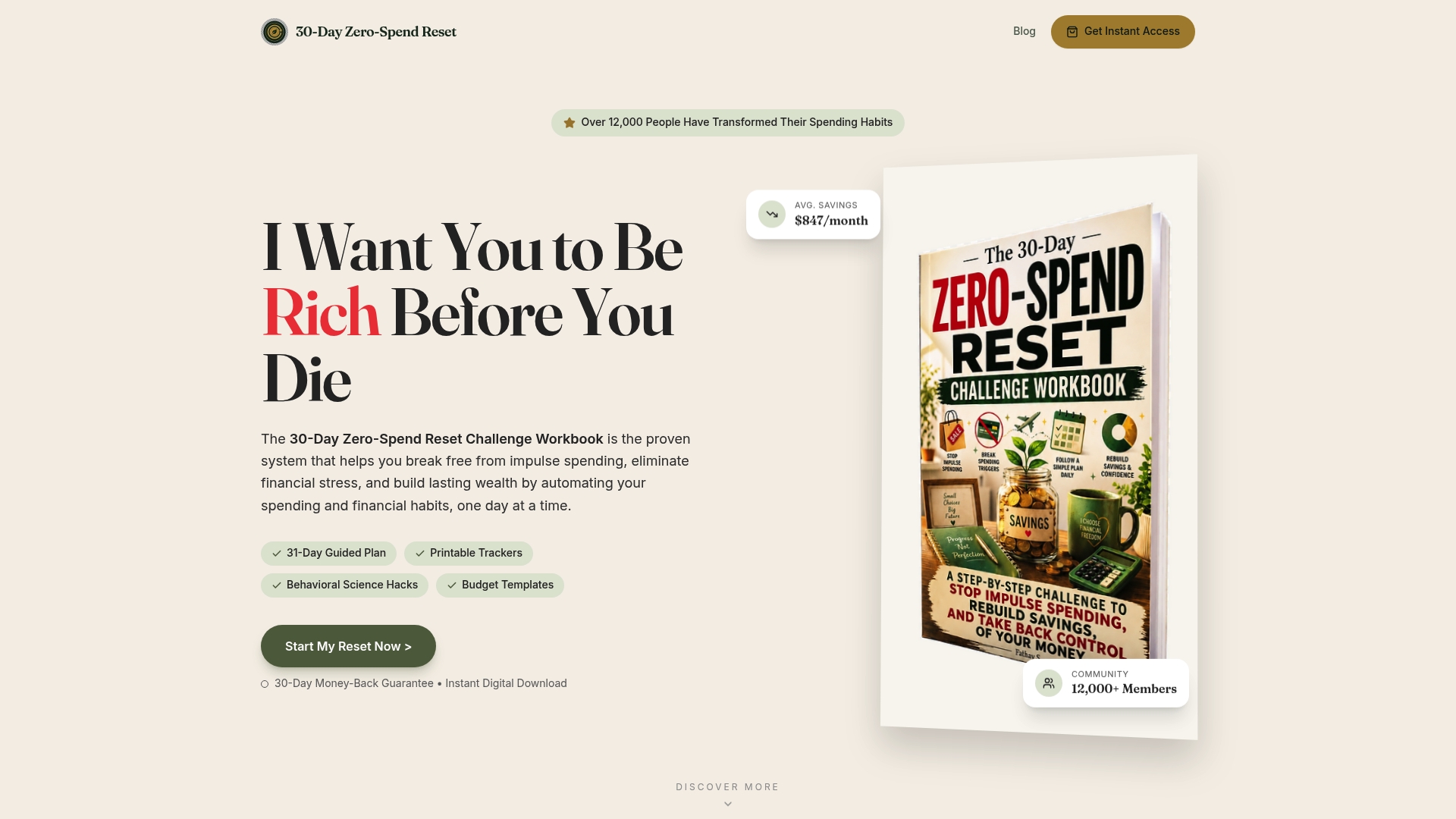
The Zero-Spend Accelerator Vault adds more resources for readers who want to go further, and the Zero Spend Guide explains how the program fits together.
FAQ
What is the point of a wishlist?
In personal finance, the point is to create a gap between wanting and buying. You record the item, the date and the reason, then decide later when the urge has cooled. Many wants fade, and the ones that remain are easier to buy without regret.
How long should I wait before buying something from my wishlist?
NerdWallet suggests anywhere from 48 hours to two weeks, depending on what works for you. A practical approach is to scale the wait with the price: a couple of days for small items, one to two weeks for bigger ones. Choose a rule you will actually follow.
Should I keep a wishlist if I'm paying off debt?
Yes, and it matters more then. The wishlist lets you decide each purchase against your debt goal instead of by mood. Morningstar's suggested hierarchy puts high-interest debt paydown and an emergency fund ahead of other goals, so a want has to clear that bar first.
What should I put on a financial wishlist?
Keep two lists. One holds nonessential items you are tempted to buy, each with a date and reason. The other holds savings goals such as an emergency fund, debt payoff, travel or a home project, sorted into short-, medium- and long-term, as the CFPB's savings booklet suggests.
Can a wishlist help with subscriptions and groceries?
It can. Log every free trial and new subscription as a want with a cancel-by date, and review your existing ones every six months. For groceries, move extras to next week's list and keep to a weekly budget.
Sources
- NerdWallet: Survey on impulse buys and Americans' finances (December 2024)
- NerdWallet: Data on retail therapy and how to curb it (April 2025)
- CFPB: Building your savings? Start with small goals
- Virginia Cooperative Extension: How to Make Your Money Go Further
- Morningstar: Quantify and Set Financial Goals
- Federal Reserve: Money in the Bank? Assessing Families' Liquid Savings
- CFPB: Tax Time, an opportunity to start small and save up
- Ohio State University: The Cost of Subscriptions
- Utah State University Extension: Cutting Expenses
- CFPB: Spending tracker tool
Recommended
Ready to reset your spending?
Get the 30-Day Zero-Spend Reset Workbook and turn these ideas into a daily action plan.
Start the 30-Day ResetThis article is part of the 30-Day Zero-Spend Reset method. Explore the complete day-by-day system behind these ideas.
Read the full guideKeep reading


Join the conversation
Be the first to share your thoughts on this article.