
Behavior First Simple Budget Methods for Beginners: Automate Savings

Behavior first simple budget methods for beginners: automate savings, try a one number or 50/30/20 plan, make budgeting a low effort habit.
Behavior First Simple Budget Methods for Beginners: Automate Savings
For most beginners, the one-number method or a 50/30/20 split, paired with an automated savings transfer, works best because it removes daily math and relies on habit instead of willpower. Zero-based budgeting is a solid alternative if you like more control over every dollar. Set up one automated transfer to savings today, then figure out your single discretionary number or your 50/30/20 percentages.
TL;DR:
- Automated savings transfers should be established immediately to ensure consistent progress and reduce decision fatigue.
- The 50/30/20 rule works best for steady income households without significant debt or irregular cash flow.
- For impulse spenders or irregular-income earners, a one-number or zero-based budget provides better control and clarity.
- Keeping emergency funds in high-yield, FDIC-insured savings accounts and automating small transfers accelerates building a safety net.
- Pairing simple budgeting with behavioral challenges, like the 30-Day Zero-Spend Reset, significantly improves savings follow-through and habit formation.
Table of Contents
- The Simplest Budgeting Methods Beginners Should Try
- How Do You Pick the Right Simple Budget Method?
- How to Set Up Your Simple Budget in Month One
- Which Behavioral Tactics Make a Budget Stick?
- How Big Should Your Emergency Fund Be?
- What Tools Actually Help You Stick to a Simple Budget?
- Why Behavior-First Budgeting Beats Willpower-Based Advice
- What Beginners Get Wrong About Simple Budgeting
- Ready to Turn a Simple Budget Into a Habit?
- Sources
- FAQ
The Simplest Budgeting Methods Beginners Should Try
Every effective simple budget method shares one trait: it reduces how often you have to make a decision. The methods below differ mainly in how much structure they give you, not in how well they work.
- 50/30/20 rule. Split take-home pay into 50% needs, 30% wants, 20% savings and debt payoff. It's the easiest framework to explain to a partner or teenager because the math stays at three numbers, and it works best for people with a steady paycheck and no major debt crisis to solve.
- One-number budget. Add up fixed costs and your automated savings transfer, subtract that total from income, and whatever's left is your one number to track for the month. It reduces decision fatigue by consolidating every discretionary choice into a single running total instead of a dozen category limits.
- Zero-based budgeting. Assign every dollar of income a job on paper before the month starts, then reconcile actual spending against that plan at month end. It takes more setup time than the other methods here, but it gives you the clearest picture of where money actually goes.
- Envelope system. Divide cash or digital sub-accounts into spending categories and stop spending in a category once its envelope is empty. It's the strictest of the four, and that rigidity is exactly why it works well for impulse spenders who need a hard stop rather than a soft guideline.
- Pay-yourself-first / automated savings. Move money to savings the moment income arrives, before a single bill gets paid. This isn't really a separate method so much as the ingredient that makes the other four actually work, since stepwise budgeting guides consistently list automating savings before tracking expenses.
Notice what's missing from this list: complicated category trackers with 15 line items. FDIC and CFPB guidance both point the same direction. Systems that stay simple and low-maintenance outperform complex ones for beginner retention, mostly because complexity is what makes people quit in week three.
How Do You Pick the Right Simple Budget Method?
You don't need a financial advisor to choose a starting method. You need four honest answers about your own money habits.
- How stable is your income? A steady paycheck supports 50/30/20 cleanly. Irregular income, common for freelancers and gig workers, fits better with a one-number budget scaled to whatever hits your account each pay period.
- How much debt are you carrying? If you're paying down credit cards or a personal loan, take the 20% savings slice in 50/30/20 and push more of it toward debt until the balance drops.
- Do you struggle with impulse spending? If yes, skip the honor-system methods entirely and go straight to the envelope system, physical or digital, since the hard stop does the work your willpower can't.
- How complex is your household? Shared accounts, kids, and multiple income streams often call for one-number budgeting at the household level rather than per-person category splits.
Pro Tip: If you're not sure which method fits, run the one-number method for 30 days. It's the fastest way to see your real spending pattern without committing to a rigid category system first.
Watch for red flags that mean your current approach isn't working: missed bill payments, repeated overdrafts, or a savings transfer you keep canceling. Any of those means it's time to switch strategies, not try harder at the same one.
How to Set Up Your Simple Budget in Month One
Getting a simple budget running takes less than an hour once you have your numbers in front of you.
- List your income and fixed bills. Write down every paycheck source and every recurring payment, rent, insurance, subscriptions, minimum debt payments, for the month.
- Calculate your fixed-expense total. Add up everything from step one. This number doesn't move month to month unless a bill changes.
- Set your savings amount and discretionary number, or build your zero-based plan. If you're using the one-number method, subtract fixed expenses and savings from income; that remainder is your number. If you chose 50/30/20, calculate your three percentages. If you're going zero-based, assign every remaining dollar a category before the month starts.
- Automate the transfer and pick one weekly check-in signal. Schedule your savings transfer for the day after payday, then choose one simple thing to glance at weekly, your checking balance or your one-number tracker. A practical anchor combination that budgeting practitioners recommend pairs an automated transfer with a ten-minute weekly balance check, light enough to sustain, thorough enough to catch problems.
- Reconcile at month end. Compare what you planned against what actually happened. If you overspent in one area two months running, that's your signal to adjust the number, not to abandon the method.
Small adjustments beat total overhauls. If your one-number budget keeps running short by $50, raise it by $50 rather than starting over with a new system entirely.
Which Behavioral Tactics Make a Budget Stick?
Willpower is not a budgeting strategy. It's the thing that runs out by Thursday. What actually moves the needle is removing the moment where you'd have to resist temptation in the first place.
- Automate everything you can. Automating savings transfers and bill payments cuts the number of times you have to make a spending decision, and the data backs this up hard: choice architecture and default savings options increased savings rates by about half among low-to-moderate-income households during tax-refund periods.
- Use pre-commitment. Split your paycheck at the payroll level if your employer allows it, so a portion never touches your checking account at all.
- Try mental time travel. Writing a short note to your future self, or picturing a specific goal like a paid-off card or a vacation fund, has been shown in experiments on future-self visualization to increase saving intentions and follow-through.
- Add small nudges. Check your balance before a nonessential purchase, set a weekly reminder, or tell a friend your number so someone besides you knows it.
If a budget requires perfect memory or constant math, it's designed to fail. The methods that survive real life are the ones that work while you're not paying close attention.
How Big Should Your Emergency Fund Be?
Start smaller than you think you need to. The FDIC recommends a starter emergency fund of $500 to $1,000 for immediate emergencies, a flat tire, a broken appliance, a smaller medical bill. That number is deliberately modest so it feels achievable in a few months, not a few years.
Once you hit that starter goal, the longer-term target shifts to three to six months of living expenses. That range gives you room for a job loss or a bigger financial shock without touching credit cards.
Where you keep the money matters as much as how much you save.
- Use an FDIC-insured high-yield savings account, not your regular checking account, so the money is separate from spending temptation but still liquid.
- Avoid parking emergency cash in a CD unless you've checked the early-withdrawal penalty; locked-up money defeats the purpose of an emergency fund.
- Automate small, recurring transfers, even $10 to $25 a week adds up faster than waiting for a "good month" to save a lump sum.
- Direct windfalls, tax refunds, bonuses, cash gifts, straight into the fund to accelerate it past the starter goal.
What Tools Actually Help You Stick to a Simple Budget?
You don't need a subscription to a budgeting app with 40 features to make any of these methods work. Most beginners do fine with what's already in their banking app.
Your bank's mobile balance and a single dedicated discretionary account cover the one-number method entirely. A basic spreadsheet, or even a note on your phone with one running total, handles zero-based tracking without extra software.
Three account structures cover almost every simple method: one checking account for fixed bills, one account or card for discretionary spending, and one separate savings account for your emergency fund and goals. Resist the urge to split further. Ten sub-accounts create ten things to monitor, which defeats the entire purpose of choosing a simple method in the first place.

If you want a starting worksheet rather than building one from scratch, the zero-spend guide walks through a behavior-first setup with printable trackers. For a shorter step-by-step version built around five concrete actions, the 5-step family budgeting method covers similar ground for household budgets specifically.
Why Behavior-First Budgeting Beats Willpower-Based Advice
Most budgeting content still treats discipline as the missing ingredient. It isn't. The research on automation and default choices makes a stronger case for structure than for motivation, and that's the gap most beginner guides miss entirely.
Omar has spent time building the 30-Day Zero-Spend Reset Challenge Workbook around exactly this idea: daily behavioral challenges instead of another spreadsheet to maintain. The workbook's trackers and prompts are designed to work alongside any method above, whether you land on 50/30/20 or the one-number approach. Reported outcomes from people who've completed the 30-day reset include meaningful drops in impulse spending and stronger follow-through on savings goals, exactly the kind of behavior change that a percentage split on paper can't create by itself. Pair the daily challenges with whichever simple method fits your income pattern, and the tracking burden nearly disappears.
What Beginners Get Wrong About Simple Budgeting
Most budgeting advice still leads with categories and percentages, as if the math is the hard part. It isn't. The math takes ten minutes. The hard part is doing the same thing automatically for six months without renegotiating with yourself every payday.
That's where the conventional advice falls short: it treats a budget like a document you build once, instead of a habit you have to protect from your own future decisions. The behavioral research here is blunt about it. Automated defaults beat manual tracking by a wide margin, and a short note to your future self does more for savings follow-through than another category spreadsheet ever will.
If you're starting today, prioritize one thing above all else: get a savings transfer automated before you spend another hour picking the "perfect" method. The method matters less than most guides claim. What you automate on day one is what still exists on day ninety.
, Omar
Ready to Turn a Simple Budget Into a Habit?
Picking a method like 50/30/20 or the one-number budget solves the math problem. It doesn't solve the habit problem, and that's the gap the 30-Day Zero-Spend Reset Challenge Workbook was built to close.
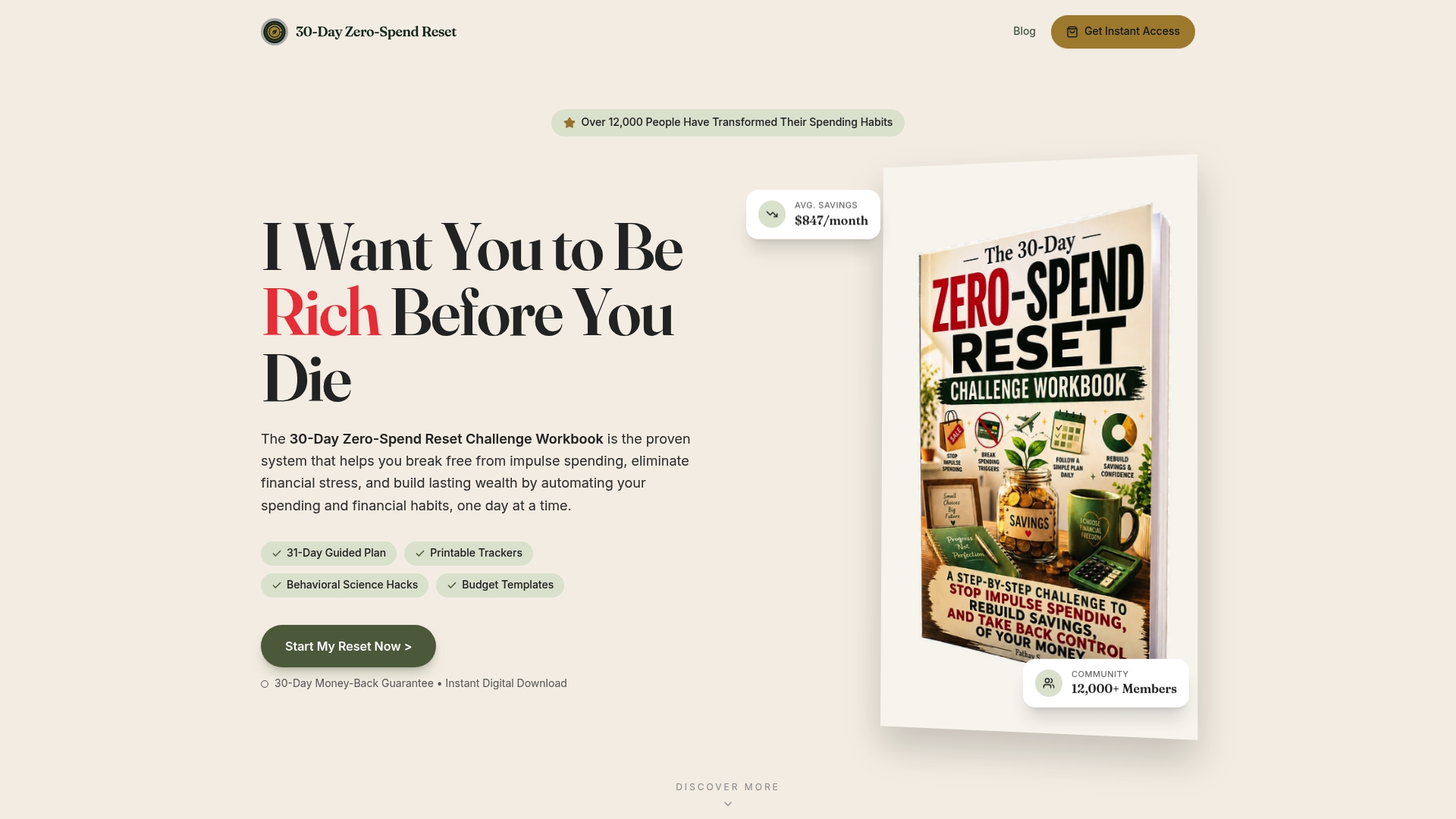
The workbook pairs daily behavioral challenges with printable trackers, budget templates, and a companion app that walks users through subscription audits and impulse-spending triggers day by day. It is intended for beginners dealing with impulse buying or subscription creep, common patterns that can undermine a "simple" budget over time. If you tend to blow through your discretionary number by the third week, the structured daily format gives you a check-in point that a spreadsheet alone can't. For readers who want more depth after the 30 days, the Zero-Spend Accelerator Vault adds further templates and extended webapp access.
Not sure you're ready to commit to the full 30 days? Start with the free zero-spend guide first, then head to Nospendreset when you're ready for the complete daily system.

This article is general information, not a substitute for advice from a qualified financial advisor. Consult a qualified financial professional about your own circumstances before acting on anything here.
Sources
- Saving for the unexpected and your future | FDIC
- Research on behavioral interventions and savings | Washington University open scholarship
- Back to the present: How direction of mental time travel affects thoughts and behavior
FAQ
What Is Dave Ramsey's 50/30/20 Rule?
The 50/30/20 rule isn't originally Dave Ramsey's framework, it splits take-home pay into 50% needs, 30% wants, and 20% savings and debt repayment. It works best for people with steady income who want a simple percentage split without tracking individual categories.
How Can I Save $5,000 in Three Months?
Saving a large emergency fund quickly requires aggressive weekly savings and often means cutting discretionary spending hard or adding income on top of automating transfers. A more sustainable pace for most beginners is building toward the FDIC's $500 to $1,000 starter emergency fund first, then scaling up automated transfers from there.
What Is the 70/20/10 Money Rule?
The 70/20/10 rule allocates 70% of income to living expenses, 20% to savings, and 10% to debt payoff or giving, a slightly different split than 50/30/20 for people who want more of their income flexible for daily spending. Definitions of this rule vary across sources, so treat the percentages as a starting framework rather than a fixed formula.
How Do I Budget $1,000 a Month?
Start by listing every fixed bill, rent, utilities, minimum debt payments, and subtract that total from your $1,000. Whatever remains becomes either your 50/30/20 split or your one-number discretionary amount, whichever method matches your income stability and spending habits best.
What's the Fastest Simple Budget Method to Start Today?
The one-number budget is the fastest to set up because it requires only three inputs: income, fixed costs, and your automated savings amount. Once you subtract fixed expenses and savings from income, the remainder is the single number you track, no categories required.
Recommended
Ready to reset your spending?
Get the 30-Day Zero-Spend Reset Workbook and turn these ideas into a daily action plan.
Start the 30-Day ResetThis article is part of the 30-Day Zero-Spend Reset method. Explore the complete day-by-day system behind these ideas.
Read the full guideKeep reading


Join the conversation
Be the first to share your thoughts on this article.