
Stop Holiday Debt Fast: CFPB Backed 30 Day Post Holiday Money Reset

CFPB backed, behavior first 30 day plan to audit holiday spending, cut interest, rebuild savings with a $500 starter fund, and prevent rebound splurges.
Stop Holiday Debt Fast: CFPB Backed 30 Day Post Holiday Money Reset
Pull your last two months of statements, pause every nonessential subscription and purchase, put any extra cash toward your highest-interest holiday balance, and start a small emergency fund with whatever is left. This combination works faster than cutting everything at once, and it holds up because it follows CFPB guidance on assessing spending before setting new rules. A guided 30-day program can help if you want daily structure instead of figuring it out alone.
TL;DR:
- Tracking expenses over 60 days reveals hidden spending patterns that can inflate holiday costs, especially from small subscriptions or frequent online orders.
- Paying more than the minimum on at least one credit card early reduces interest accumulation, with specific strategies like snowball or high-interest prioritization.
- Building a small emergency fund with automated weekly transfers of $15 to $25 is effective and sustainable, reaching $500 in roughly 25 weeks.
- Short, focused no-spend periods on one category outperform month-long bans, which often trigger rebound spending after the challenge ends.
- Setting clear, actionable goals with specific amounts and deadlines helps sustain progress, avoiding the treadmill of vague resolutions and preventing holiday overspending from recurring.
Table of Contents
- Your first 30 days: a step-by-step action plan
- How to audit your holiday spending without the guilt trip
- Practical ways to pay down holiday debt and cut the interest
- Restarting savings while you're still paying off debt
- Build habits that stick instead of a no-spend month that backfires
- Setting goals for the rest of the year that you'll actually keep
- Avoiding the trap of "replacing" what the holidays took
- Planning ahead so next year's holidays don't repeat this one
- The emotional side of recovering from overspending
- Why a steady reset beats an extreme one
- A guided way to run your reset: the 30-Day Zero-Spend Reset Challenge
- Where to go for more guidance
- Sources
- FAQ
Your first 30 days: a step-by-step action plan
The point of the next month is not to fix everything. It is to stop the bleeding, see the real numbers, and build momentum without burning out.
- Today: pull your last 60 days of bank and card statements and tag every holiday-related charge (gifts, travel, food, décor).
- Today: list every recurring subscription on those statements and circle anything you forgot you had.
- Within 3 days: cancel or pause at least two nonessential subscriptions or services.
- Within 7 days: build a bare-bones budget for the next 30 days covering only housing, utilities, food, transportation, and minimum debt payments.
- Within 7 days: pick one holiday balance (usually the highest interest rate) and set a specific extra payment amount for this month.
- Within 14 days: open or designate a savings account and automate a small weekly transfer, even $10, toward a starter emergency fund.
- Within 30 days: if it feels realistic, run a one or two week no-spend window on a single category, like dining out or online shopping.
Each step builds on the last. Skipping the audit and jumping straight to a no-spend challenge is why so many resets stall by week two.
How to audit your holiday spending without the guilt trip
You cannot fix what you have not measured, and most people overspend more than they realize because gift purchases get scattered across weeks and payment methods. The fix is a quick, judgment-free sort, not a line-by-line confession.
- Export or screenshot the last 60 days of transactions from every bank and credit card app you use.
- Sort each charge into five buckets: gifts, travel, food, subscriptions, and one-off purchases.
- Add up each bucket and write the total next to the category name.
- Circle any subscription or recurring charge you do not remember signing up for.
- Cancel or pause the ones you do not use weekly.
A one-week spending log backed by the CFPB's tracking approach often reveals patterns a monthly total hides, like three small food delivery charges that add up to more than a planned gift. The CFPB recommends this kind of short tracking exercise specifically because a week of logged spending shows habits that a bank statement alone does not explain.
Subscription creep deserves its own pass. Streaming services, app upgrades, and box subscriptions purchased or gifted during the holidays often auto-renew in January at full price. Go through your statements a second time looking only for charges under $20 that repeat monthly. Those are usually the easiest wins.
Practical ways to pay down holiday debt and cut the interest
Once you know the size of the problem, the repayment method matters less than starting immediately, since interest compounds daily on most credit cards.
- Pay more than the minimum on at least one card this month, even by $25, since minimum payments are calculated to stretch repayment for years.
- Use the snowball method (smallest balance first) if you need quick wins to stay motivated, or the highest-interest-first method if you want to minimize total interest paid.
- Call your card issuer and ask about hardship programs or a temporary lower rate before you miss a payment, not after.
- Get any payment plan or rate change confirmed in writing before you send money, and keep a copy.
- Only transfer a balance to a lower-rate card after checking the transfer fee, which can run 3% to 5% of the amount moved.
CFPB guidance on debt repayment specifically recommends negotiating with lenders using a written budget and a clear, specific offer of what you can realistically pay each month. If a card issuer will not work with you, a nonprofit credit counselor can often negotiate on your behalf at no cost.
Pro Tip: Call your card issuer in the morning on a weekday when hold times are shortest, and have your account number and a one-sentence hardship explanation ready before you dial.
Restarting savings while you're still paying off debt
You do not have to choose between paying down holiday debt and rebuilding savings. The CFPB's financial empowerment toolkit recommends starting with a small, specific target rather than an intimidating one.
- Start with $500 as a starter emergency fund before anything else.
- Once you hit $500, move the goal to $1,000.
- After debt is under control, work toward 3 to 6 months of essential expenses.
- Automate a fixed weekly transfer, even $15 to $25, so the habit does not depend on willpower.
- Apply any tax refund or windfall directly to the next savings milestone instead of spending it.
A $20 weekly automated transfer reaches a $500 starter fund in 25 weeks, and the CFPB's toolkit frames this kind of small, automated saving as more sustainable than irregular lump deposits. Keep the fund in a high-yield savings account separate from your checking account so it is accessible but not one tap away from your debit card.
Build habits that stick instead of a no-spend month that backfires
Cutting out all spending for 30 days sounds disciplined, but total deprivation often triggers a rebound of impulse purchases once the month ends. NerdWallet's reporting on no-spend challenges found that people who succeed tend to run shorter, repeated windows, like a single week or month focused on one category, rather than an all-or-nothing ban.
- Unsubscribe from retail marketing emails before you start, since inbox temptation undoes willpower fast.
- Set a wishlist-and-wait rule: anything over $50 sits on a list for seven days before you buy it.
- Try cupboard-first meal planning for a week to cut food delivery spending without a grocery budget overhaul.
- Keep a short social script ready for group spending invitations, like "I'm on a spending pause this month, let's do something free instead."
- Mark your no-spend window on a calendar with a clear start and end date.
Our guide to why restrictive resets backfire covers the allowable exceptions that keep a no-spend window realistic instead of punishing.
Pro Tip: Schedule your automated savings transfer the same day your paycheck lands, so the money moves before you see it in your checking balance.
Setting goals for the rest of the year that you'll actually keep
A post-holiday reset works best when it connects to a goal bigger than "spend less this month." Pick two or three specific targets for the next 11 months instead of a vague resolution to budget better.
A useful structure: one debt target (pay off a specific balance by a specific month), one savings target (hit your $1,000 emergency fund by a set date), and one spending target (cut one recurring category, like dining out, by a set amount). Write each goal with a number and a date attached. "Save more" is not a goal you can check progress against. "Add $20 a week to savings until I reach $1,000 by June" is.
Revisit these goals monthly, not daily. Checking in too often turns a long-term plan into a source of daily anxiety, and the point of a reset is to reduce financial stress, not add a new one. If a goal feels off track by February, adjust the number rather than abandoning the plan. A slower emergency fund target is still progress.
Avoiding the trap of "replacing" what the holidays took
One of the most common post-holiday mistakes is treating the slower pace of January as an excuse for a reward purchase. The logic sounds reasonable: "I was careful all December, I deserve this." That thinking is exactly how a recovery month turns into another month of overspending.
Watch for a few specific patterns. Buying discounted holiday decor or gifts for next year because they are on clearance is one of the most common, even though the money spent is no different from the money you are trying to recover. Treating a tax refund as free money instead of debt or savings fuel is another. And "I'll start the reset next week" is often a sign that a purchase is about to happen first.
The fix is friction, not willpower. Put a 48-hour rule on any purchase over $30 for the rest of January. Remove saved payment methods from shopping apps you tend to browse out of boredom. If clearance sales for next year's holiday are the trigger, unfollow retailer accounts on social media until at least March.

Planning ahead so next year's holidays don't repeat this one
The surest way to avoid another January reset is to start planning for the next holiday season while this one is still fresh. Open a dedicated holiday savings account now and set a modest automatic transfer, even $15 a week, so next December is funded instead of financed.
Set a total holiday budget in writing by October, broken down by person or category, and stick to a cash or debit-only rule for holiday purchases. Credit cards make overspending easy to rationalize in the moment, since the bill does not arrive until weeks later. A written budget removes that gap.
If gift-giving pressure within family or friend groups is a repeat driver of overspending, this is the year to raise it. A simple conversation in the fall, like "I'd like to do a gift exchange with a $25 cap this year," prevents the kind of escalating spending that leads to January regret. Our piece on handling emotional spending triggers includes scripts for exactly this kind of conversation.

The emotional side of recovering from overspending
Guilt is often the biggest obstacle to a successful reset, more than the math itself. Many people respond to holiday overspending by avoiding their statements entirely, which only lets the balance grow quietly in the background. Financial planners quoted in CNBC's coverage of no-spend challenges warn that overly restrictive, shame-driven resets tend to be unsustainable, and that small, repeatable habit changes produce better outcomes than a punishing all-or-nothing approach.
Separate the spending from your sense of discipline. One overspent December does not undo months of otherwise reasonable money habits, and treating it as a moral failure makes it harder to look at the numbers clearly. The audit step matters here too: once you see the actual total, it is almost always smaller and more specific than the vague dread suggested. A number you can see is a number you can plan around.
Why a steady reset beats an extreme one
Most people try to fix holiday overspending with a punishing month of total restriction, and most of them quit by week two. The behavioral research on no-spend challenges backs this up: short, structured windows paired with planned exceptions outperform blanket bans, because deprivation without a release valve tends to produce a rebound of spending once the window closes. A reset built on daily, small, trackable actions holds up better than one built on willpower alone. That is not a failure of discipline. It is how habit change actually works.
, Omar
A guided way to run your reset: the 30-Day Zero-Spend Reset Challenge
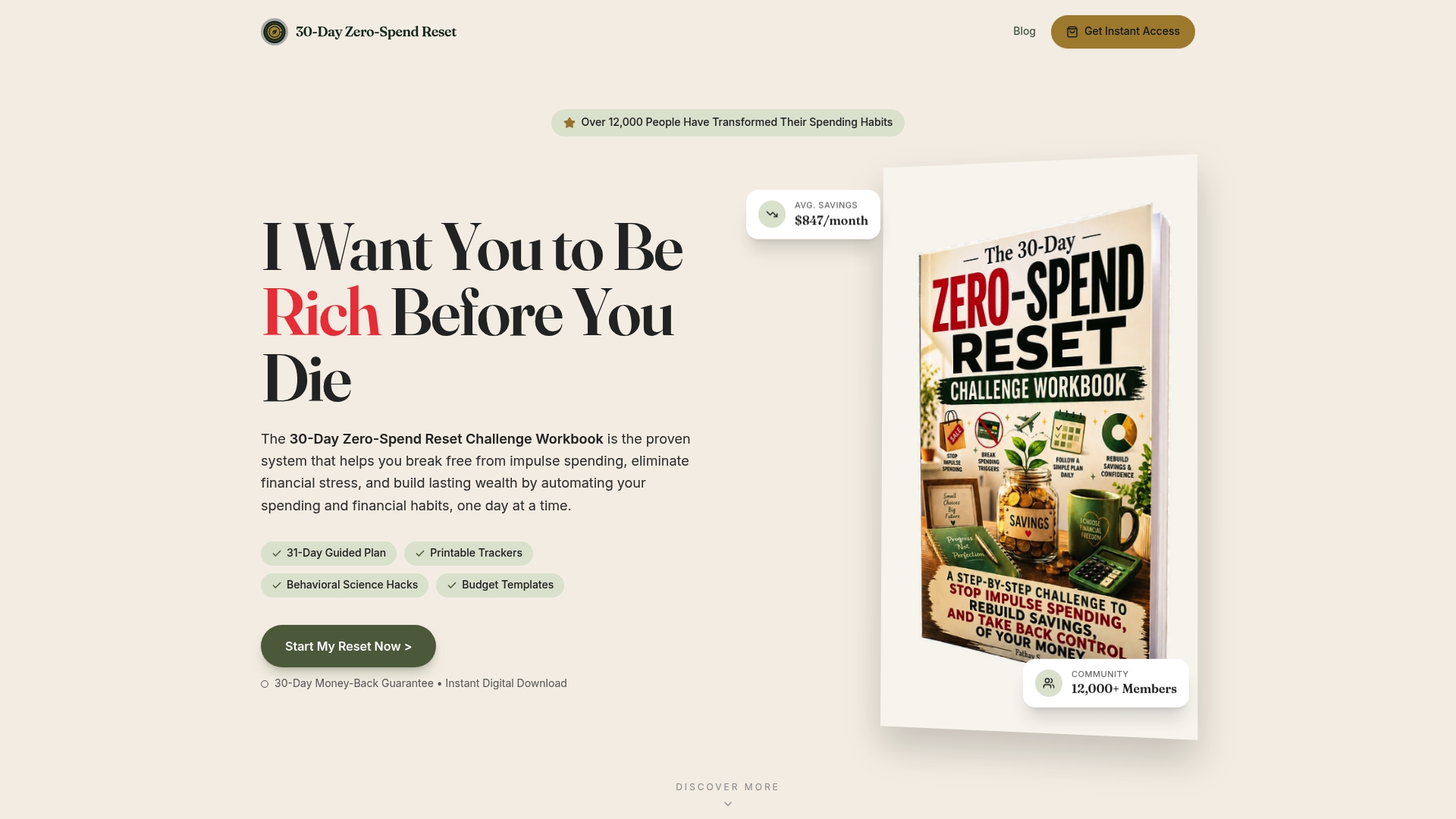
If you would rather follow a structured daily plan than build one from scratch, the 30-Day Zero-Spend Reset Challenge Workbook gives you exactly that: a day-by-day system instead of a single resolution to "spend less." It is built for anyone coming out of a high-spending stretch who wants daily structure, not another generic budget spreadsheet.
- Daily behavioral challenges that target impulse buying, subscription creep, and emotional spending one habit at a time.
- Printable trackers and budget templates to run the audit and weekly savings steps covered above.
- A built-in subscription audit tool to catch recurring charges before they renew again.
- Meal planning guides to cut food spending without a strict grocery budget.
- Access to a companion webapp for interactive daily check-ins.
For readers who finish the 30 days and want to keep building the habit, the Zero-Spend Accelerator Vault adds expanded templates and tools for longer-term habit work. Start with the 30-Day Zero-Spend Reset Challenge Workbook to put today's action plan on a guided daily track.
Where to go for more guidance
- CFPB debt and budgeting guidance: assessment steps, worksheets, and negotiation tips.
- CFPB financial empowerment toolkit: starter emergency fund worksheets.
- Federal Reserve household credit report: current credit balance trends.
- NerdWallet no-spend study: data on repeated no-spend windows.
- Bfil: a simple three-step post-holiday reset overview.
This article is general information, not a substitute for advice from a qualified financial advisor. Consult a qualified financial professional about your own circumstances before acting on anything here.
Sources
- Resolve to take control of your debt in the new year | Consumer Financial Protection Bureau
- YOUR MONEY, YOUR GOALS: A financial empowerment toolkit | CFPB
- Why ‘No Spend January’ Has Become My Annual Tradition - NerdWallet
- Economic well-being of U.S. households in 2025: credit | Federal Reserve
FAQ
How do I reset my finances after the holidays?
Start by pulling your last 60 days of statements to see exactly what you spent, then pause nonessential subscriptions, put extra money toward your highest-interest holiday balance, and start a small emergency fund with whatever is left. The CFPB recommends this assessment-first approach rather than jumping straight into strict new rules.
Is a no-spend month actually effective?
Short, repeated no-spend windows, like a single week or a focused month, tend to work better than long blanket bans, because NerdWallet's reporting on no-spend challenges found that successful savers pair limited windows with wishlist-and-wait rules rather than total restriction. Financial planners also caution that overly strict resets can trigger rebound spending.
How much should my starter emergency fund be?
The CFPB's financial empowerment toolkit suggests starting with $500, then moving the goal to $1,000, before working toward 3 to 6 months of essential expenses once debt is under control. Small automated weekly transfers make this target easier to hit without feeling restrictive.
Is there a global monetary reset expected in 2026?
There is no credible government or financial authority announcement of a global monetary reset, and claims like this are common online misinformation unrelated to personal budgeting. A post-holiday money reset refers to resetting your own household budget and spending habits, not a change to currency or banking systems.
What does the 30-Day Zero-Spend Reset Challenge include?
The 30-Day Zero-Spend Reset Challenge Workbook includes daily behavioral challenges, printable trackers and budget templates, a subscription audit, meal planning guides, and access to a companion webapp for daily check-ins. It is built for anyone who wants a guided, day-by-day structure for breaking impulse spending habits after a high-spending stretch.
Recommended
Ready to reset your spending?
Get the 30-Day Zero-Spend Reset Workbook and turn these ideas into a daily action plan.
Start the 30-Day ResetThis article is part of the 30-Day Zero-Spend Reset method. Explore the complete day-by-day system behind these ideas.
Read the full guideKeep reading



Join the conversation
Be the first to share your thoughts on this article.