
Social Spending Pressure: How to Stop Overspending to Keep Up

Social spending pressure pushes people to overspend on dinners, gifts and trends. See why it works and how a 30-day reset helps you break free without guilt.
Social Spending Pressure: How to Stop Overspending to Keep Up
Social spending pressure is the pull to match what the people around you seem to spend: the dinners, the trips, the gifts, the upgrades. It works because you see other people's spending and almost never see their savings, so your own budget feels small by comparison. The way out is not willpower. It is a short, structured reset that shows you where social pressure leaks money, gives you words for saying no, and replaces the habit with a plan. A 30-day zero-spend period is built for exactly that, and the rest of this article shows how it works.
TL;DR
- Social spending pressure is common: in a LendingTree survey, 32% of Americans said they feel financial pressure to keep up with someone, and 51% admitted overspending to impress.
- The pressure is partly an illusion. Research from UC Berkeley's Haas School describes how people overestimate what peers spend because savings stay private.
- Money stress is not only a numbers problem. Studies link financial strain to anxiety, loneliness and poorer sleep, so dealing with it early matters.
- A 30-day reset works better than a vague promise to "spend less": audit subscriptions, delay purchases, plan meals, and prepare scripts for social situations.
- If you carry debt, pay the minimums, attack high-interest balances, and build a starter emergency cushion alongside.
Table of Contents
- What social spending pressure actually is
- Why the pressure feels bigger than it is
- The five places social pressure drains your budget
- A 30-day approach that actually changes the habit
- A worked example
- If debt is part of the picture
- Build a cushion so pressure has less to push on
- Our perspective
- Start your reset
- Make it stick after day 30
- FAQ
- Sources
What social spending pressure actually is
Social spending pressure comes in two forms. The first is direct: a friend suggests an expensive dinner, a coworker collects for a group gift, a family event assumes you will travel. The second is quiet: you scroll, you compare, and you decide you are falling behind.
Both push you to spend money you did not plan to spend. The result is rarely one big mistake. It is a string of small yeses that add up by the end of the month.
How common it is
A LendingTree survey of nearly 2,000 U.S. consumers found that 62% of Gen Zers feel pressured to spend to keep up with others, and 32% of all Americans feel financial pressure to keep up with someone. Among those who overspent to impress someone, 56% went into debt because of it. And 63% regret their most recent instance of overspending.

Social media plays a part. In the same survey, 49% of Americans (65% of Gen Zers) agreed that social media pressures them to buy things they do not need.
If you recognize yourself here, you are in large company. The useful question is not "why am I so weak?" but "what is this pressure built on, and how do I take its power away?"
Why the pressure feels bigger than it is
Researchers at UC Berkeley's Haas School of Business describe a effect they call visibility bias. Because people rarely talk about how much they save, we assume our peers spend more than they actually do. According to the Haas News report on the research, that belief feeds back on itself: as neighbors raise their consumption to match what they think others are doing, retirement saving gets squeezed out.
The same report cites a 2020 study in which heavy spenders who were shown average consumption figures cut their spending by 3%. That is a small number, but it points to something practical: when you see real data in place of a guess, the pressure loosens.
That is why a tracker matters more than a pep talk. When you write down what you actually spend for 30 days, you stop comparing your real numbers to an imagined version of everyone else's.
Why it hurts beyond the bank balance
One piece of research in this area is worth knowing about because it explains why this topic feels so heavy. A UCL study of healthy older adults found that financial strain was linked to more depressive symptoms, greater loneliness, lower optimism and self-esteem, and poorer sleep. The link held independently of how much money people objectively had. In other words, how strained you feel matters, not only the balance.
A peer-reviewed study of women with young children described similar patterns: forced tradeoffs, self-blame, and mental health problems ranging from anxiety to depression. If money worry is leaving you hopeless, or you are having thoughts of harming yourself, talk to your doctor or a mental health professional, and in the U.S. you can call or text 988 at any time.
For most readers, though, the practical lesson is this: acting on money stress early reduces the load. A plan gives your mind somewhere to put the worry.
The five places social pressure drains your budget
Social pressure rarely shows up as a line item. It hides inside ordinary categories. Here is where it tends to land.
- Dining out and drinks. The group dinner you did not pick, split evenly, when you ordered the cheapest thing.
- Gifts and group collections. Showers, birthdays, office send-offs, and the unspoken scale of what is "normal."
- Trips and events. Bachelor parties, weddings, weekend getaways with a price tag you learn after you say yes.
- Lifestyle upgrades. Clothes, gadgets, a nicer car, because everyone around you has one.
- Subscriptions and memberships. Streaming services, gym memberships, and apps you keep so you can join the conversation.
Online shopping adds another layer. A University of Michigan study of 200 top U.S. e-commerce sites found that they use features that lower perceived risk, lean on social influence, and bring products closer to the buyer. So the pressure is not only coming from friends. It is designed into the places you shop.
A 30-day approach that actually changes the habit
The goal of a zero-spend reset is not to punish yourself. It is to interrupt the automatic loop of seeing, comparing and spending, then to build better defaults before the old pattern returns. Here is a routine that follows that logic.
Step 1: Write down what pressure costs you
Go back through the last 60 to 90 days of statements. Mark every charge that happened because of other people: group meals, gifts, outings, upgrades. Add them up. This is your social spending number, and it is almost always larger than people guess.
This step is where a tool earns its keep. The workbook's spending trackers and spending categories list give you a ready structure, so you are not designing a system from scratch while you feel stressed.
Step 2: Audit subscriptions
Subscription creep is social spending on autopilot. List every recurring charge, mark what you used in the last 30 days, and cancel the rest. Our workbook includes a subscription audit, and our guide to expenses to cut walks through which recurring costs tend to go first.
Marketing emails feed the pull too. Unsubscribing from them removes a steady stream of prompts, and we cover how in our post on how to unsubscribe from marketing emails.
Step 3: Add a delay between wanting and buying
In the Michigan study of 151 online impulse buyers, the self-control strategies that worked best were reflection, spending limits and postponement, the classic "sleep on it." The buyers also said they wanted tools showing how many work hours a purchase costs (54.3%) and a budget reminder (51.7%).
You can borrow all three ideas today:
- Put every non-essential purchase on a 24-hour list before buying.
- Convert the price into hours of work at your take-home hourly rate.
- Set a weekly limit for social spending and check it before you say yes.
The daily challenges in our workbook are built around this kind of pause, so the habit gets practiced every day rather than remembered once.
Step 4: Prepare what you will say
Most people overspend socially not because they want to, but because they do not know what to say in the moment. A script solves that. Examples you can adapt:
- "I'm in a no-spend month, but I'd love to see you. Can we do a walk or coffee at home?"
- "I'll skip the group gift this time, but I'm happy to sign the card."
- "That sounds great. I'm saving for something right now, so I'll pass on the trip."
- "Can we pick a place with a lower price range? I'm watching my budget."
The workbook includes social scripts for money conversations for exactly these moments, so you are not improvising while everyone watches.
Step 5: Replace the activity, not just the spending
Saying no is easier when you have a yes to offer. Host a potluck, plan a hike, propose a game night, or swap a restaurant dinner for a shared home meal. You keep the relationship and drop the bill.

Step 6: Plan food so dinners out stop being the default
Food is where many households leak money, and it is where social pressure and convenience team up. A pilot study of 184 adults in Kentucky, Maryland and North Carolina tested online grocery shopping with behavioral nudges, including meal planning, meal preparation, cart reminders and tips for stretching food dollars. The authors note that pre-filled carts with nudges and nutrition education may reduce impulse purchases of chips, snacks and high-calorie foods.
If you are a parent trying to lower the grocery bill, the lesson is to decide meals before you shop. Our workbook includes meal planning guides for that, and our post on grocery shopping with kids during a no-spend month shows how to do it with children in the cart.
A worked example
Here is an illustrative example, not a client result. Say you track 60 days and find these social costs: eight group meals averaging $38 each, two gifts at $45, one weekend trip share of $210, and three streaming and app subscriptions at $14 each per month.
| Item | Over 60 days | |---|---| | Eight group meals at $38 | $304 | | Two gifts at $45 | $90 | | Trip share | $210 | | Subscriptions ($42 per month for two months) | $84 | | Total | $688 |
That is about $344 a month. If you cut half through scripts, hosting at home and canceled subscriptions, you free roughly $172 a month, or about $2,064 over a year. These numbers are invented for illustration, but the method is real: your own statements give you your own version of this table.
If debt is part of the picture
Social overspending and debt often travel together. In the LendingTree survey, more than half of those who overspent to impress someone ended up in debt. If that is you, the order of operations matters.
Vanguard's guide to financial wellness lays out a sequence: build an effective budget, pay the minimum on every debt, take full advantage of any employer match, and pay down high-interest debt such as payday loans and credit cards first. The guide cites a Federal Reserve Board survey finding that 45% of U.S. families carry credit card debt averaging $6,300.
That matters here because minimum payments can keep you in debt far longer than you expect. Our post on the minimum payment trap explains why, and what to do about it.
The freed-up money from your 30-day reset is the fuel. Every dollar you stop spending on social pressure can go to the highest-interest balance.
Build a cushion so pressure has less to push on
People with no buffer feel social pressure more sharply, because every outing competes with rent. Vanguard's guide recommends keeping at least $2,000 in cash for common spending shocks, and building a job-loss reserve of about three to six months of expenses in readily accessible investments. The same guide cites a Federal Reserve Board finding that 36% of U.S. families could not cover a $400 emergency expense.
A practical approach if you are also paying off debt:
- Aim first for a small starter cushion, working toward that $2,000 cash level.
- Keep paying at least the minimum on every debt while you build it.
- After the cushion exists, direct extra money to high-interest debt.
- Then grow toward the larger three to six month reserve.
A budget method helps here. Our post on zero-based budgeting and the envelope system in digital banking shows how to give each dollar a job so the cushion actually fills.
Our perspective
We built this workbook around one idea: social spending pressure is a habit problem, not a character flaw. People do not overspend because they lack discipline. They overspend because the moment arrives faster than the plan.
That is why we focus on daily challenges, not a single big budget. Thirty days is long enough to feel the pattern change and short enough to stay with. Each day gives you one small action: audit a subscription, delay a purchase, plan a meal, practice a sentence you will need on Saturday night.
We also believe the guilt has to go. Our approach is designed to work without deprivation or shame, because shame tends to end programs by week two. The private webapp, the printable trackers and the budget templates give you a place to see your real numbers, and the scripts give you the words.
Our readers have reported saving an average of $847 per month. Results differ for everyone, but the direction is the point: when you can see where the pressure lands and you have a ready answer for it, spending follows.
Omar
Start your reset
If you want the whole routine in one place, the 30-Day Zero-Spend Reset Challenge Workbook gives you the daily challenges, trackers, budget templates, subscription audit, meal planning guides and social scripts described above, plus a companion webapp. It is made for people who feel the pull to keep up and want a clear plan instead of another round of guilt.
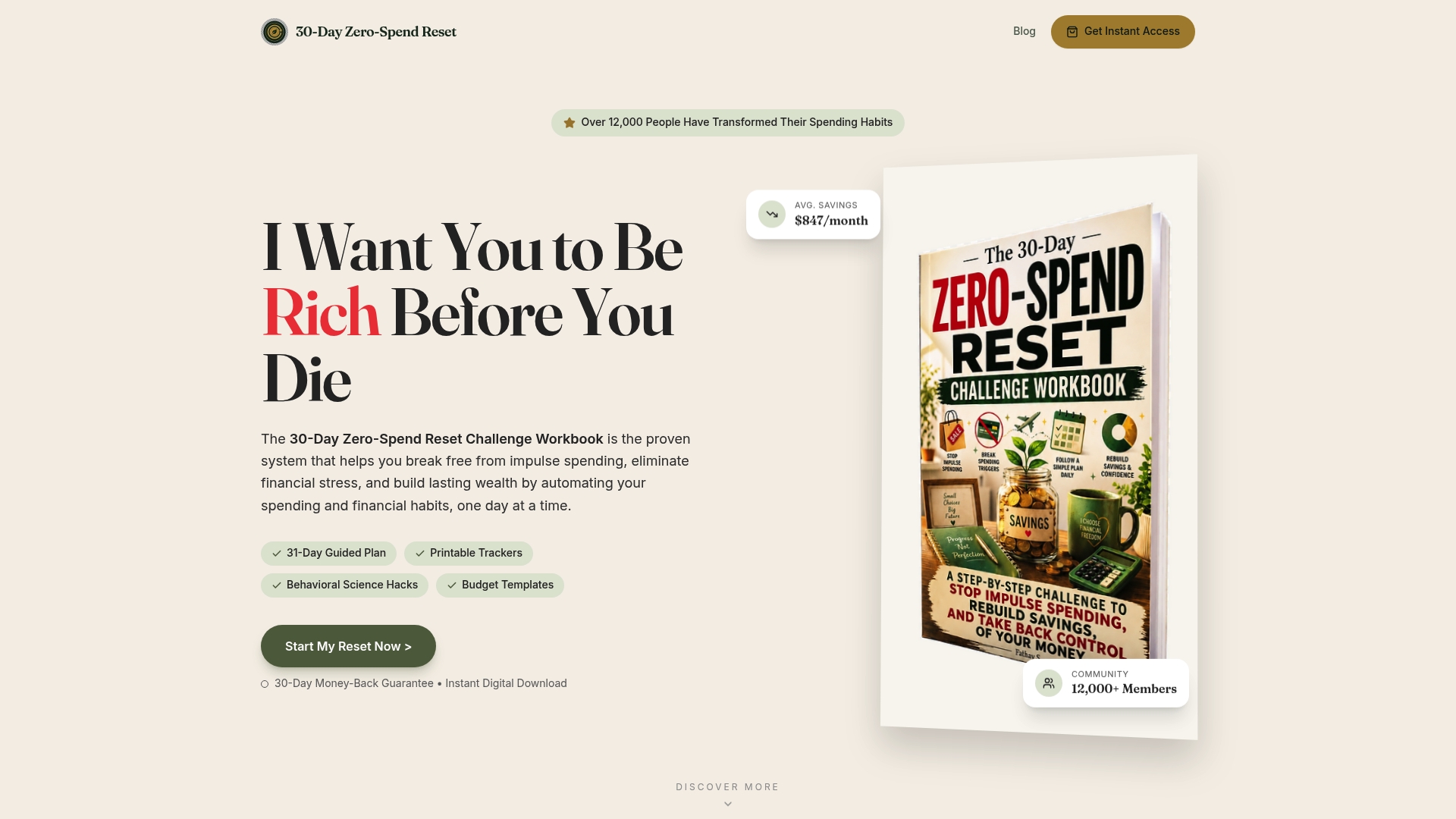
If you want extra tools alongside it, the Zero-Spend Accelerator Vault adds more resources, and the webapp page shows how the interactive side works.
Make it stick after day 30
The reset is a beginning. These habits keep it going:
- Keep one weekly money check. Ten minutes on the same day each week to review spending against your limit.
- Keep a short list of personal rules. Our spending rules list has examples you can adopt, such as waiting a set number of days on any purchase above a set amount.
- Share your numbers with one trusted person. The Haas research suggests that visibility of real spending and saving corrects our guesses about peers. A single honest conversation does a version of that for you.
- Notice the trigger. When you feel the urge, ask: am I buying this for me, or for how it looks?
If you are also trying to stop worrying about money in general, the same principle applies: worry shrinks when it becomes a plan with dates, amounts and next steps.
FAQ
What is social spending pressure?
It is the feeling that you must spend money to keep up with friends, family, coworkers or people online. It can be direct, like an expensive group dinner, or indirect, like comparing your life to what you see on social media. In a LendingTree survey, 32% of Americans said they feel financial pressure to keep up with someone.
How do I say no to a friend's expensive plans without feeling guilty?
Lead with the relationship, then offer a cheaper alternative: "I'd love to see you, can we do a walk or a dinner at my place?" A short, friendly script is easier than a long explanation. Practicing the sentence before the invitation arrives helps you stay calm when it does.
Can social spending really lead to debt?
Yes. In the LendingTree survey, 56% of Americans who overspent to impress someone went into debt because of it, and 63% regret their most recent overspending. Tracking social costs for a month shows how fast small amounts add up.
Does cutting back on spending hurt my social life?
It does not have to. Swapping paid activities for free or home-based ones keeps the connection and drops the cost. Many people find that friends are relieved when someone else suggests a lower-cost plan, since everyone feels some version of this pressure.
How much emergency savings should I aim for?
Vanguard's guide recommends at least $2,000 in cash for common spending shocks, and a job-loss reserve of about three to six months of expenses. If you have debt, start with the smaller cushion while you pay at least the minimum on each balance, then build from there.
Sources
- How our friends' spending habits can keep us from saving for retirement (UC Berkeley Haas News)
- 62% of Gen Zers Feel Pressured to Keep Up With the Joneses (LendingTree survey)
- Women's Experiences of the Effect of Financial Strain on Health (PMC)
- Associations between financial strain and well-being (UCL)
- Impulse Buying: Design Practices and Consumer Needs (University of Michigan)
- Online Pilot Grocery Intervention among Rural and Urban Adults
- Vanguard's guide to financial wellness
Recommended
Ready to reset your spending?
Get the 30-Day Zero-Spend Reset Workbook and turn these ideas into a daily action plan.
Start the 30-Day ResetThis article is part of the 30-Day Zero-Spend Reset method. Explore the complete day-by-day system behind these ideas.
Read the full guideKeep reading


Join the conversation
Be the first to share your thoughts on this article.