
Cash Stuffing Not Working? Why It Stalls and How to Fix It

Cash stuffing not working for you? See why envelopes run dry, how to fix bills, debt and impulse spending, and how a 30-day reset gets your budget moving again.
Cash Stuffing Not Working? Why It Stalls and How to Fix It
Cash stuffing usually stops working for one of three reasons: your envelopes don't match how you really spend, your bills and debt payments don't fit in cash, or impulse and emotional spending drain the envelopes faster than you fill them. The fix is rarely more discipline. It is a short reset that shows where the money goes, then a system built around your actual life. That is what our 30-Day Zero-Spend Reset Challenge Workbook walks you through, one daily challenge at a time.
TL;DR
- Cash stuffing fails when the categories are guesses, when bills are paid electronically, or when one overspent envelope gets quietly refilled from another.
- Cash does tend to curb spending, but the effect is small and varies by context, so it is a tool and not a guarantee.
- Before changing anything, track every dollar for a month: small purchases, subscriptions and food spending show up fast.
- Protect bills and debt payments first, and keep a regular transfer going to emergency savings in an insured account.
- A 30-day reset gives you the data and the habits, so any method you choose afterward actually sticks.
Table of Contents
- Why cash stuffing stops working for some people
- Diagnose what is going wrong before you change anything
- Step 1: Track every dollar for 30 days
- Step 2: Cut the leaks that cash was never going to catch
- Step 3: When cash stuffing leaves you short for bills
- Step 4: Adapt the method to electronic bills and surprise costs
- Step 5: Balance debt payments and an emergency fund
- Perspective: why a reset beats another round of envelopes
- Start the reset with the workbook
- FAQ
- Sources
Why cash stuffing stops working for some people
The idea behind cash stuffing is simple: pull out cash for each spending category, put it in labeled envelopes, and stop spending when an envelope is empty. The logic is that handing over physical bills hurts more than tapping a card.
There is real research behind that. A 2024 meta-analysis in the Journal of Retailing pooled 392 effect sizes from 71 papers, covering 11,257 participants and 338,513 transactions across 17 countries. It found a small but significant tendency to spend more with cashless payment than with cash.

Note the word small. The same analysis found that the effect varies by context, is stronger for showy purchases, weaker for pro-social spending, and has generally weakened over time. So cash makes overspending a little harder, but it doesn't fix the underlying reasons you overspend. If those reasons are unplanned categories, stress, boredom or late-night scrolling, the envelopes become one more thing you feel you are failing at.
Here are the patterns that most often make the method stall.
The categories were guesses
Most people fill envelopes with round numbers: $400 for groceries, $100 for fun. If you never measured what you spent in those categories, you set the targets blind. The first week goes badly, the envelope empties on day nine, and you raid another one. Once you borrow from envelope to envelope, the system is no longer limiting anything.
Your money is mostly electronic
Rent, utilities, insurance, loan payments, subscriptions and memberships usually leave your account automatically. Cash only covers the slice of spending you do in person. If you stuff cash for groceries and gas but your online orders, app subscriptions and delivery fees still run on your card, the envelopes cover a small part of the picture and the rest leaks.
Emotional and impulse spending doesn't care what is in the envelope
Cash adds friction at checkout. It does nothing at 11 p.m. when you are tired and a sale email arrives. If your spending is triggered by stress, you will find a way around the envelope: the card, the app, or a quick trip to the ATM. Our piece on how to stop doomscroll shopping covers that trigger directly.
The money was never there to stuff
Sometimes the plan isn't the problem. If fixed bills take most of your paycheck, there is little left to put into envelopes, and the system just makes the shortfall visible. That calls for a different move, covered below.
Diagnose what is going wrong before you change anything
Match your experience to the likely cause. Then pick one fix, not five.
| What you notice | Likely cause | First fix | |---|---|---| | Envelope empty by mid-month | Target was a guess | Track a month of real spending, then reset amounts | | You keep moving money between envelopes | Too many categories, or targets too tight | Merge categories and set one realistic target for each | | Cash gets lost or spent without thinking | Cash is carried everywhere | Stuff only the categories you spend in person on | | Bills still land and you're short | Fixed costs exceed income, or due dates are misaligned | Contact creditors and adjust due dates (see below) | | You overspend when stressed | Emotional or impulse triggers | Add a pause rule and a trigger log | | You quit after two weeks | The system is too heavy to maintain | Shrink it to the two or three categories that cause trouble |
Step 1: Track every dollar for 30 days
The most reliable first move is to stop adjusting the envelopes and start measuring. The Consumer Financial Protection Bureau's Spending Tracker says tracking all income and spending for a month can reveal small purchases that add up, expose spending that doesn't match your priorities, and help you find money for emergencies and goals.
Do it plainly:
- Write down every purchase, including the $4 ones, from every account and from cash.
- Mark recurring charges: subscriptions, memberships, app renewals.
- At month's end, sort everything into needs, obligations and wants.
The CFPB's guidance for military communities uses the same split: needs, obligations such as debt, child support, alimony and student loans, and wants. It recommends looking at wants first when you need to cut.
Where people go wrong: they track for three days, feel judged by the numbers and stop. Nothing needs to be fixed during tracking. You are collecting data. Our workbook turns this into daily challenges with printable trackers, so the tracking has a prompt each day and you aren't relying on memory or willpower.
Step 2: Cut the leaks that cash was never going to catch
Once you have a month of numbers, the quick wins are usually recurring and easy to miss.
Subscriptions. Pull up your last two statements and list every recurring charge. Cancel what you don't use, and put the rest on a calendar with the renewal date. The workbook includes a subscription audit for this, and our list of expenses to cut first shows where most households find money.
Groceries. Food is the category where envelopes most often run dry. A meal plan and a shopping list written before you walk in do more than a smaller envelope does. If you shop with children, grocery shopping with kids during a no-spend month lays out how to keep the trip short and the cart on plan. The companion meal planning guides in our program are built for this.
Impulse buys. Add a waiting rule: anything not on the list waits 48 hours. Write the item and the price in your tracker instead of buying it. Many wants fade by the second day.
Marketing triggers. Every promotional email is a nudge to spend. Unsubscribing from marketing emails removes some of them before they reach you.
Step 3: When cash stuffing leaves you short for bills
If your envelopes are fine but the bills don't fit, tightening won't solve it. Start with priorities. The CFPB's checklist, When cash is short, advises weighing how each bill affects protecting your job, shelter, assets and legal responsibilities. Housing, utilities, transportation to work and secured debts generally come ahead of discretionary spending.
Then talk to the people you owe before a payment is missed. According to the CFPB's Behind on bills? booklet, creditors may waive an occasional fee, offer a short-term arrangement, or move a due date to line up with your income. That last option matters for cash stuffers, because a due date that falls the day before payday forces you to borrow from envelopes.
The CFPB's Improving cash flow tool suggests negotiating due dates, splitting large payments where possible and turning periodic lump-sum costs into smaller payments if that eases your cash flow. It also warns that monthly payment arrangements may carry a fee, so ask before you agree.
The awkward part of these calls is often the talking. Our workbook includes social scripts for money conversations, so you have words ready for a creditor, a family member or a friend who keeps suggesting dinner out.
For a simple structure, the CFPB's monthly budget tool has you list monthly income and expenses and subtract total spending from total income. If the answer is negative before you buy a single wants item, the work is on income, due dates or creditor arrangements, not on envelope discipline.
Step 4: Adapt the method to electronic bills and surprise costs
You don't have to abandon envelopes. You need to match them to how money moves in your life.
- Keep a bill map. Ready.gov's Emergency Financial First Aid Kit recommends documenting automatic rent, mortgage, utility, loan and membership payments. A one-page list of what leaves your account, how much and when, shows you what cash can and can't cover.
- Use cash only for variable, in-person categories. Groceries, gas, dining out and personal spending are the usual picks. Leave bills on autopay from the bank account.
- Make a small sinking category for irregular costs. Car repairs, medical copays and annual fees arrive without warning. Dividing a yearly cost by 12 and setting that aside each month keeps one surprise from wrecking three envelopes.
- Keep some cash in a safe place. The same Ready.gov kit suggests holding some cash for emergency purchases if ATMs or banks are unavailable.
If you want the envelope logic without carrying bills around, our explainer on zero-based budgeting and the envelope system with digital banking shows how to assign every dollar a job while your money stays in your account. Our simple budget method is a lighter option if even that feels like too much, and budget overwhelm covers what to do when the whole thing feels like a second job.
Step 5: Balance debt payments and an emergency fund
This is where many cash stuffers stall: every dollar goes to envelopes, nothing goes to debt, and any surprise ends up on a credit card.
The CFPB's military-community guide treats debt as an obligation, to be protected alongside other essential obligations, while making regular or automatic transfers into emergency savings. The sources don't give a universal ratio for debt versus savings. The right split depends on your income, your required payments and what happens if you fall behind. A practical starting point is to pay every required minimum, then send a small fixed amount to savings each payday so the habit exists before the amount is big.
MyMoney.gov recommends paying yourself first through regular or automatic transfers, and building emergency savings before investing, in an insured bank or credit-union account you can reach when needed.
As for where to keep it, the CFPB's Finding a place for savings tool says money at home is easy to reach but can be lost, stolen or destroyed, while deposits at federally insured banks and credit unions are protected up to $250,000 per depositor under the conditions it states. A cash envelope is fine for this month's groceries. Your emergency fund belongs in an insured account.

If you carry credit card balances, the way minimums are set can keep you in debt for years. Our article on the minimum payment trap explains why, and what it takes to get ahead of it.
Perspective: why a reset beats another round of envelopes
We built the workbook because we kept seeing the same loop: someone starts cash stuffing with energy, hits a bad week, feels they failed, and quits. The envelopes were never the problem. The missing piece was knowing where the money actually goes and having a way to change the habits behind it.
That is why our program starts with 30 days of daily, small challenges instead of a perfect budget. Each day has one task: track, audit a subscription, plan a meal, pause before a purchase. The structure is grounded in behavioral psychology, so it doesn't depend on willpower or guilt.
By day 30 you have real numbers, a cleaner set of recurring charges and a few habits that hold. Then any method, cash, digital envelopes or a plain spreadsheet, works because it is built on facts, not guesses.
Omar
Start the reset with the workbook
If you want a plan for the next 30 days, the 30-Day Zero-Spend Reset Challenge Workbook gives you daily behavioral challenges, printable trackers, budget templates, social scripts for money conversations, meal planning guides and subscription audits. It also comes with a companion webapp, and it is designed to target impulse buying, subscription creep and emotional spending without guilt or deprivation.
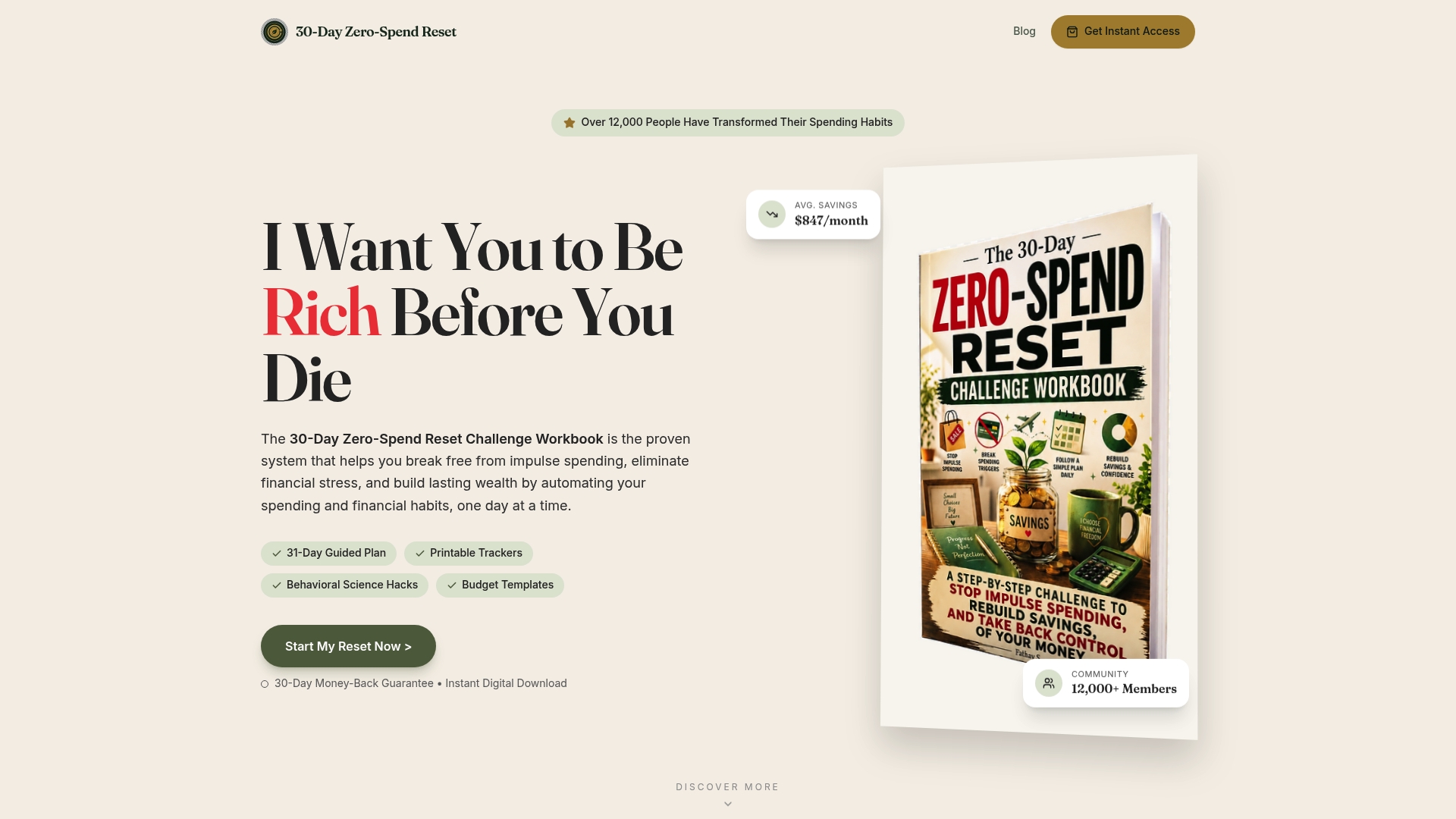
Want extra tools to go further? The Zero-Spend Accelerator Vault adds more resources, and the Zero Spend Guide is a good place to see how the approach works before you begin.
FAQ
Does cash stuffing work for everyone?
No method works for everyone. Research shows paying with cash tends to reduce spending slightly compared with cards, but the effect is small and varies by situation. It helps most for variable, in-person spending. If your trouble is bills, debt or emotional triggers, you need a fix aimed there.
Why do I run out of cash before the month ends?
Usually the target was a guess or a category is hiding extra spending, often groceries or eating out. Track every purchase for a month, then set each amount from real numbers. Avoid refilling an envelope from another one, since that hides the problem.
Can I cash stuff if most of my bills are automatic?
Yes, for the part you spend in person. Keep autopay for bills, list those payments in a one-page bill map, and use envelopes only for groceries, gas, dining and personal money. The zero-based envelope approach with digital banking works the same way without handling cash.
Should I pay off debt or build an emergency fund first?
Official guidance doesn't set one ratio. Protect required debt payments, and also make small regular transfers to emergency savings in an insured account. The right balance depends on your income and what missing a payment would cost you. If you're already behind, contact your creditors early.
How long should I try before deciding it isn't working?
Give it one full pay cycle with accurate tracking before changing the method. If you're still short after that, the issue is likely income versus fixed costs, and the steps on due dates and creditor arrangements apply more than any envelope adjustment.
Sources
- Less cash, more splash? A meta-analysis on the cashless effect, Journal of Retailing, 2024
- CFPB, Spending Tracker
- CFPB, Your money, your goals: Focus on Military Communities
- CFPB, When cash is short
- CFPB, Behind on bills? Start with one step
- CFPB, Improving cash flow
- CFPB, Monthly budget tool
- Ready.gov, Emergency Financial First Aid Kit
- CFPB, Finding a place for savings
- MyMoney.gov, Save and Invest
Recommended
Ready to reset your spending?
Get the 30-Day Zero-Spend Reset Workbook and turn these ideas into a daily action plan.
Start the 30-Day ResetThis article is part of the 30-Day Zero-Spend Reset method. Explore the complete day-by-day system behind these ideas.
Read the full guideKeep reading


Join the conversation
Be the first to share your thoughts on this article.