
Save More in 30 Days: 20 Practical Spending Rules That Work

Try 20 spending rules in a 30 day plan. Start an automatic transfer and use round up savings to grow your balance.
Save More in 30 Days: 20 Practical Spending Rules That Work
The most useful spending rules are the simplest ones: pay yourself first, cap discretionary categories with something like the 50/30/20 split, run occasional no-spend days, and audit subscriptions monthly. Pick one rule today, attach it to an automatic transfer or a 30-day timer, and let the rest of this list fill in the details as you go.
TL;DR:
- Automating savings via automatic transfers or paycheck scheduling leads to larger and more consistent growth in savings balances.
- Contingent rules like round-up savings are more widely adopted, but guaranteed rules such as autosave result in better long-term savings improvements.
- Starting with one primary rule and one support rule during a 30-day trial helps build sustainable habits and avoid overwhelm.
- Regular subscription audits and setting fixed spending caps in categories prevent small leakages from undermining financial goals.
- Behavioral tools, including daily check-ins and friction tactics like deleting saved cards, significantly improve rule adherence and habit formation.
Table of Contents
- 1. Spending rules you can adopt this week
- How do you choose the right spending rules for your temperament?
- How to apply spending rules: a 30-day plan that sticks
- What the research says about which rules actually work
- Treat your spending rules like experiments, not punishments
- A faster way to put these rules into practice
- FAQ
- Sources
1. Spending rules you can adopt this week
You do not need twenty new habits. You need one or two rules that fit your income pattern and enough structure to keep them running without daily willpower. The list below mixes classic budgeting splits with smaller behavioral rules, so you can match the approach to your temperament rather than forcing yourself into someone else's system.
- Spend less than you earn. This is the foundation every other rule sits on; track your true monthly outflow against income for one cycle before adding anything else.
- Pay yourself first. Set an automatic transfer to savings on payday, before the money reaches your checking account, so saving stops depending on what is left over.
- 50/30/20 split. Allocate roughly half of take-home pay to needs, 30% to wants, and 20% to savings or debt; it works best for steady, salaried income.
- 60/30/10 split. Shift more toward needs (60%) when housing or debt payments are heavy, leaving 30% for wants and 10% for savings.
- 50/15/5 split. A version built around 50% needs, 15% retirement savings, and 5% short-term savings, useful once retirement contributions become a fixed line item.
- Build a starter emergency fund. Keep a small cash buffer in a separate account so a flat tire or a vet bill does not undo your other rules.
- Round-up savings. Let purchases round up to the nearest dollar and sweep the difference into savings, a contingent rule that works quietly in the background.
- No-spend days. Pick two or three fixed days a week with zero discretionary spending; it builds awareness faster than any tracking app.
- The two-week wait. Any non-essential purchase over a set amount waits 14 days before you buy it, which filters out most impulse buys.
- Category percent caps. Give categories like dining out or clothing a fixed percentage of your paycheck instead of a dollar figure, so the cap scales with your income.
- Monthly subscription audit. Review every recurring charge once a month and cancel anything you have not used in the last 30 days.
- Day-of-week spending freeze. Choose one weekday, often midweek, where you spend nothing at all, breaking the habit of treating every day as a potential purchase day.
- Cash-only discretionary spending. Withdraw a fixed cash amount for wants each week; once it is gone, spending in that category stops.
- One-in-one-out rule. For clothes, gadgets, or hobby gear, something leaves your home before something new comes in.
- Mobile spend alerts. Set your bank or card app to notify you after every purchase over a threshold you choose, reintroducing friction that debit cards remove.
- Automate bill timing. Schedule fixed bills right after payday so what remains in your account is your real discretionary balance.
- Percentage-based debt payoff. Direct a fixed percentage of every paycheck, not just a flat dollar amount, toward extra debt payments.
- Windfall rule. Send tax refunds, bonuses, or rebates straight to savings or debt instead of your checking account.
- Meal-plan-first grocery rule. Plan meals before shopping and shop from a list, which curbs the impulse add-ons that inflate grocery bills.
- Annual rule review. Revisit your rules every 12 months; income, rent, and goals change, and a rule that fit last year might not fit now.
Pro Tip: Start with one guaranteed rule (an automatic transfer) and one contingent rule (round-ups), since combining the two covers both consistency and small daily wins.
How do you choose the right spending rules for your temperament?
Matching a rule to your situation matters more than picking the "best" one on paper. A three-step process keeps this simple:
- Audit first. Spend one pay cycle tracking actual spending by category before changing anything, so you know what you're really working with.
- Pick one primary rule and one support rule. A primary rule carries most of the weight, like a 50/30/20 split; a support rule, like no-spend days, reinforces it.
- Timebox and review. Commit to 30 days, then review what worked before adding a third rule.
A few questions help narrow the choice: How much of your income is locked into fixed costs like rent and insurance? How variable is your paycheck month to month? Are you saving toward a specific goal or just trying to stop leaking money? Do you tend toward impulse spending or slow, creeping overspending?
If your income is steady, guaranteed automation (scheduled transfers) tends to work better as your primary rule. If your income fluctuates, a contingent rule like round-ups can flex with smaller paychecks without feeling like a broken promise to yourself. Many people do best combining both: automation for consistency, contingent rules for anything extra.
How to apply spending rules: a 30-day plan that sticks
Rules fail when they stay abstract. A short, structured window gives them a chance to become habits instead of good intentions.
- Day 1: Audit subscriptions. List every recurring charge and cancel what you have not used in 30 days.
- Day 2: Set up automation. Schedule an autosave transfer for payday and turn on round-ups through your bank or a savings automation option.
- Days 3 through 30: Daily check-ins. Spend two minutes logging purchases and noting the trigger behind any unplanned one, building the awareness that makes rules stick.
Behavioral tools matter as much as the schedule. Implementation intentions, or simple if-then plans like "if I want to buy something over $50, I wait 48 hours," reduce impulse purchases by inserting a pause where none existed before. Removing a saved card number or deleting a shopping app adds friction that does the same job passively.
The 30-Day Zero-Spend Reset Challenge Workbook is built around this exact structure: daily behavioral challenges, printable trackers, and subscription audit templates designed to turn a rule from an idea into a routine.
Pro Tip: Pair one if-then plan with one friction tactic, like deleting a saved card, since reducing temptation and adding a pause work better together than either alone.

What the research says about which rules actually work
Evidence backs a habit-first approach over willpower alone. FINRA's 2024 National Financial Capability Study found that Americans' ability to make ends meet declined compared with 2021, and 67% of adults cut back on other spending because of higher food costs, a sign that intentional rules matter more than ever, not less.
- Contingent rules like round-ups are the most widely adopted, used in roughly 81% of savings goals, according to CFPB's analysis of Qapital savings data.
- The same analysis found guaranteed rules, like autosave and payday transfers, are linked to larger increases in savings balances overall, even though fewer people use them.
- Separate CFPB consumer research on money rules shows that worksheets and personalized rules help people adopt spending habits that actually stick.
The most popular rule is not always the most effective one: round-ups dominate adoption at 81% of goals, but guaranteed autosave rules move the needle further on actual savings growth. Pairing both covers the gap.
Treat your spending rules like experiments, not punishments

The rules that last are the ones you can measure and adjust, not the ones you grit your teeth through. I'd rather see someone run a sloppy 30-day no-spend challenge and learn something from it than follow a perfect-looking budget they abandon by week three out of guilt.
Start with one rule. Watch what happens to your balance and your mood for a month. Keep what works, drop what does not, and resist the urge to add five more rules before the first one has had a fair test. Financial planners generally recommend small, incremental changes over full overhauls, and a structured workbook can give that first experiment some real shape.
, Omar
A faster way to put these rules into practice
Reading a list of spending rules is easy. Running one for 30 days with daily structure is the part most people skip, which is why we built the 30-Day Zero-Spend Reset Challenge Workbook around daily behavioral challenges instead of abstract advice.
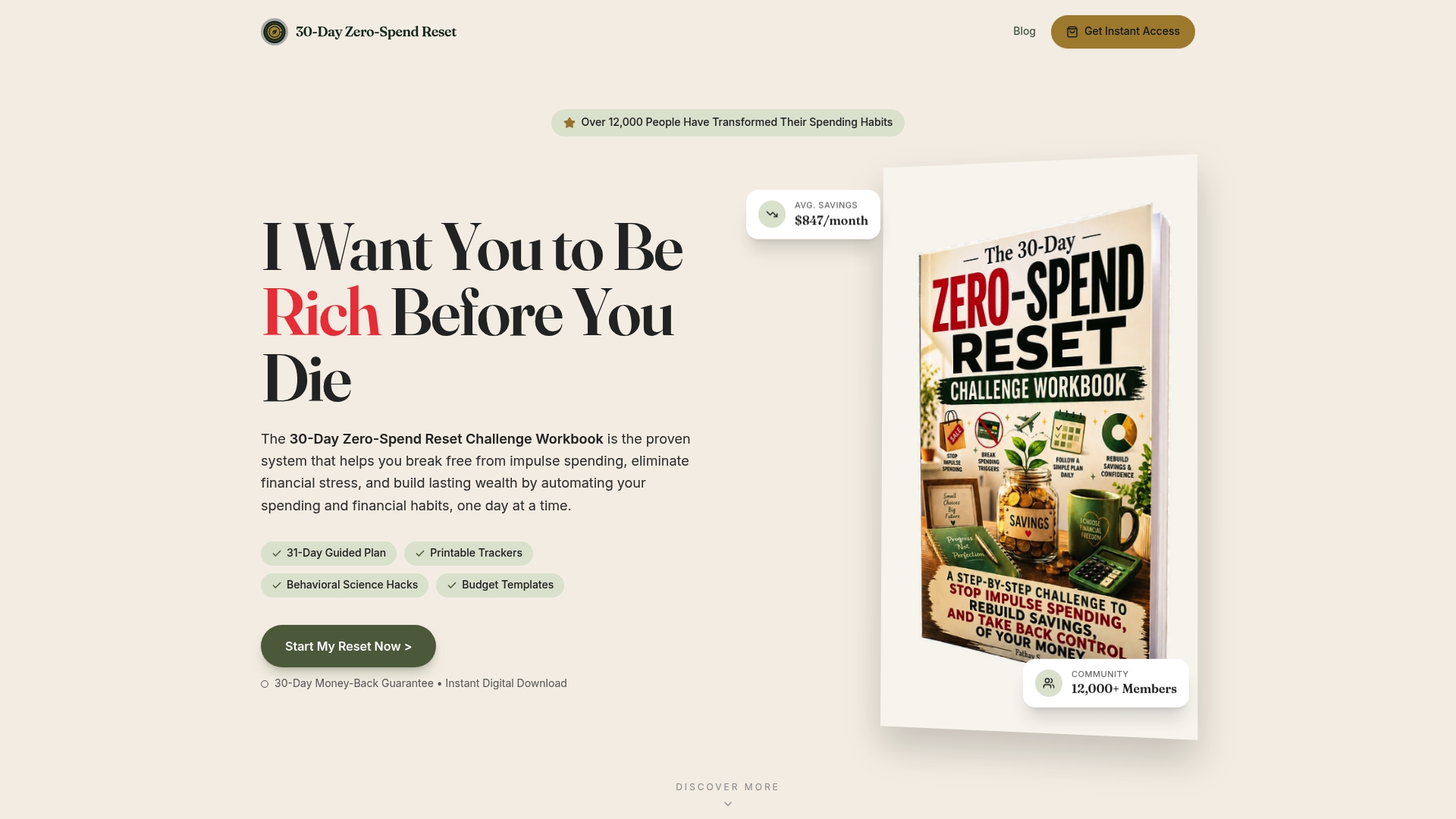
The workbook pairs printable trackers, subscription audit templates, and meal planning guides with a private interactive companion webapp, providing a system rather than just a checklist. For anyone who wants more tools after the first 30 days, the Zero-Spend Accelerator Vault adds advanced templates and tracking resources.
- Workbook: daily challenges, trackers, subscription audits, meal plans.
- Additional resources: advanced templates for readers who finish the initial 30 days and want more.
- Companion tool: a private tool for daily check-ins.
| Resource | What it includes | Best for | |---|---|---| | 30-Day Zero-Spend Reset Challenge Workbook | Daily challenges, trackers, subscription audit templates, meal plans | Readers starting their first structured reset | | Zero-Spend Accelerator Vault | Advanced tools and templates | Readers who finish the 30-day reset and want to keep going |
If a big chunk of your budget is eaten by fixed housing costs rather than discretionary spending, it's worth looking at the bigger levers too, including seller options for reducing housing costs before assuming the fix is always another spending rule. Start with the Zero Spend Guide if you want to see the full approach before committing.
This article is general information, not a substitute for advice from a qualified financial advisor. Consult a qualified financial professional about your own circumstances before acting on anything here.
FAQ
What are the 7 money rules?
Common versions of the "7 money rules" include spending less than you earn, paying yourself first, building an emergency fund, avoiding high-interest debt, tracking expenses, investing early, and reviewing your budget regularly. The exact list varies by source, since no single official version exists.
What are Dave Ramsey's five rules?
Dave Ramsey's framework centers on his own "Baby Steps" program rather than a standalone five-rule list, and the exact wording varies across his materials. Readers looking for his specific steps should check his official resources directly rather than rely on a paraphrased version.
What are the 12 rules of money?
There is no single, universally recognized "12 rules of money" framework; the phrase shows up in various personal finance books and blogs with different content each time. A more reliable approach is to build your own short list from tested rules like the 50/30/20 split, automatic saving, and subscription audits.
What is the 7-7-7 rule for money?
Definitions of the "7-7-7 rule" vary across personal finance sources, and no primary financial authority defines it consistently. Rather than chase a specific numbered rule, focus on tested approaches like automated saving and category-based spending caps, which have documented outcomes behind them.
How do I know which spending rule is right for me?
Start by tracking one pay cycle of real spending, then pick one primary rule that matches your income pattern, like automatic saving for steady paychecks or percentage caps for variable income. Give it 30 days before adding a second rule.
Sources
- FINRA Foundation releases sixth wave of the National Financial Capability Study
- CFPB analysis of saving-rule categories and outcomes (Qapital data)
- What is a Financial Plan? How to Get Started and What it Includes | Thrivent
Recommended
Ready to reset your spending?
Get the 30-Day Zero-Spend Reset Workbook and turn these ideas into a daily action plan.
Start the 30-Day ResetThis article is part of the 30-Day Zero-Spend Reset method. Explore the complete day-by-day system behind these ideas.
Read the full guideKeep reading





Join the conversation
Be the first to share your thoughts on this article.