
Urge Surfing for Spending: Ride Out a Buying Urge

Urge surfing helps you ride out the pull to buy instead of fighting it. Learn the steps, scripts for carts, groceries and subscriptions, and when to get help.
Urge Surfing for Spending: Ride Out a Buying Urge
Urge surfing means noticing the pull to buy something and watching it rise, peak and fall without acting on it. You don't fight the urge or argue with it. You stay with it for a few minutes, breathe, and let it pass. Then you decide what to do from a calmer place. It was built for addiction recovery, and the same skill works on impulse buys, late-night carts, grocery overspending and "just this once" subscriptions.
This guide explains where the technique comes from, what a spending urge does inside you, and how to practice it step by step. It also shows how to fold it into a bigger plan for paying down debt or building an emergency fund.
TL;DR
- An urge is a wave: it builds, peaks and fades, usually without you having to obey it.
- Pause, name the urge, find it in your body, breathe through it for at least a minute, then reassess.
- Fighting an urge or distracting yourself often makes it louder, so observe it with curiosity instead.
- Pair urge surfing with a waiting rule, a trigger journal and a list of free replacements.
- If spending feels uncontrollable or is causing real harm, talk to a licensed therapist or your doctor.
Table of Contents
- What urge surfing is and where it comes from
- Why spending urges feel so urgent
- How to practice urge surfing, step by step
- Urge surfing in the moments that cost you most
- Make the wave smaller before it arrives
- Our perspective
- Using urge surfing in a debt payoff or emergency fund plan
- What urge surfing won't do on its own
- A 30-Day Zero-Spend plan built around urges
- FAQ
- Sources
What urge surfing is and where it comes from
Urge surfing was developed by Alan Marlatt, PhD, at the University of Washington's Addictive Behavior Resource Center, as part of a program called Mindfulness-Based Relapse Prevention for Addictive Behaviors, according to UCI's Susan Samueli Integrative Health Institute. The same source describes a craving as an arc with four stages: trigger, rise, peak and fall.
That arc is the whole idea. You picture the urge as an ocean wave. A wave swells, crests and breaks on the shore. You can't stop it, but you can stay upright on it until it's gone.

Most of the pages you will find on this topic are written about alcohol, drugs or smoking. That makes sense, because that's where the research began. But the mechanism is not limited to substances. The skill is the same: feel the urge fully, don't act on it, and let it end on its own. Shopping, scrolling for deals and tapping "subscribe" all create their own small waves.
Why spending urges feel so urgent
A buying urge usually starts with a trigger. It might be an ad, a sale email, a rough day, a bored hour on the couch or a friend suggesting dinner out. Then comes the rise: a tight, restless feeling that says "get it now."
The trap is what happens next. UCI's institute notes that when we give in to a craving, we are temporarily reinforced. That teaches us that giving in is the way to make the urge stop. The relief is real, so the lesson sticks, and the next urge arrives with more authority.
Fighting back doesn't solve it either. Dartmouth-Hitchcock's urge surfing handout explains that suppressing a thought, feeling or sensation ultimately increases it. Even talking yourself out of an urge or distracting yourself can make it bigger. The same handout says that whatever you repeat gets stronger and whatever you don't repeat gets weaker. If you ruminate on the urge, it will likely grow. If you practice surfing it, your ability to surf will likely improve.
So the goal is not to feel nothing. The goal is to change your relationship to the feeling, so you aren't forced into a purchase just to make it stop.

How to practice urge surfing, step by step
You can do this anywhere: in a checkout line, at your desk, on the couch with your phone in hand. Here is a sequence that combines the Dartmouth-Hitchcock guidance with a few practical additions for money.
- Pause. Stop whatever you're doing. Put the phone face down, step back from the shelf, or leave the cart open and untouched.
- Name it. Say to yourself, "This is an urge to buy." Naming it separates you from it. You are someone who is having an urge, not someone who has to obey it.
- Find it in your body. Where do you feel it? Chest, stomach, hands, jaw? Notice its size, temperature and pull.
- Breathe and watch. Dartmouth-Hitchcock suggests watching the urge for at least five cycles of breathing, about one minute, and noticing whether its intensity or size changes. It will often shift even in that short time.
- Stay curious, not harsh. Skip the inner shouting match. Treat the urge like weather passing through.
- Let the wave finish. For many people it takes longer than a minute. Give it several more minutes if you can.
- Reassess. Ask whether you still want the item, whether it fits your plan, and whether you'd buy it at the same price tomorrow.
One more tip from the same handout: try to surf only one urge at a time, because willpower and self-regulation capacity are limited. If three urges hit at once, pick one, then move to the next. The handout also notes that studies show willpower is strengthened the more you practice self-regulation, so each surf makes the next one easier.
A quick example
It's 10:40 p.m. You're tired after a stressful week, and a pair of boots you looked at once is now on sale. Your thumb hovers over "Buy now."
You pause. You say, "This is an urge to buy, and it's a 7 out of 10." You notice a tight, buzzy feeling in your chest. You breathe for a minute and it dips to a 5, then bumps back to a 6. You keep watching. Around the ten-minute mark it's a 3, and you realize you're mostly tired. You add the boots to a wish list, close the app and go to bed. The decision is still available tomorrow. It just isn't being made by the crest of the wave.
Urge surfing in the moments that cost you most
The technique stays the same, but the setting changes what you're surfing. Here are the situations our readers most often tell us about.
Late-night and doomscroll shopping
The trigger is boredom or fatigue and the urge arrives with a perfectly timed ad. Surf first, then close the app before you reassess. If this is your pattern, our guide to stopping doomscroll shopping pairs well with the steps above.
The grocery aisle
Grocery urges are sneaky because food feels necessary. The urge to grab a convenience item, a snack "for the kids" or a third brand of something you already own is still an urge. Name it, breathe for a minute, then check your list. If you shop with children, our post on grocery shopping with kids during a no-spend month covers how to handle the "can we get this?" wave from both sides.
Subscriptions and free trials
Subscription urges are quiet. The wave says, "It's only a few dollars, and you can cancel later." Surf it, then ask whether you'd pay for this today if it had no free trial. Marketing emails feed this urge, so it helps to unsubscribe from marketing emails and remove triggers before they reach you.
Emotional spending
Some waves are not about the item at all. America Saves, a nonprofit savings campaign, lists common emotional spending triggers as stress or anxiety, boredom, loneliness, celebration and social pressure. When you name the urge, add the feeling under it: "This is an urge to buy, and I'm lonely." Naming the feeling gives you something real to respond to, like texting a friend or taking a walk.
Make the wave smaller before it arrives
Urge surfing works best as part of a system. Research on spending supports that. A 2021 meta-analysis of financial self-control strategies covered 29 studies and 12 different strategies. It found that strategies significantly reduced spending and increased saving, with a medium effect size (d = 0.57). Proactive strategies, which you set up beforehand, and reactive strategies, which you use in the moment, were equally effective.
Urge surfing is a reactive tool. Here is how to build proactive ones around it.
- Add a waiting rule. America Saves recommends a 24-hour rule before buying something non-essential, noting that the urge often passes once emotions settle. Surf now, then wait a day for anything that survives.
- Keep a trigger journal. America Saves suggests tracking triggers to spot emotional spending patterns. After each urge, jot down the time, place, feeling and what you wanted to buy.
- Write a "feel good" list. The same source recommends a list of low- or no-cost alternatives to spending. Keep it on your phone: a walk, a call, a bath, a playlist, a home-cooked meal.
- Remove friction in your favor. Delete saved cards, log out of shopping apps and cancel what you don't use. Our spending rules list has ready-made rules you can borrow.
It also helps to understand how your brain files money away. We tend to treat a "small" purchase, a bonus or a refund differently from our paycheck. This habit is called mental accounting and your money, and noticing it makes it easier to see why a $19 impulse buy doesn't feel like a real expense in the moment.
Our perspective
We built the 30-Day Zero-Spend Reset around one observation: most people don't overspend because they lack a budget. They overspend because a feeling shows up and buying is the quickest way to make it go away.
That's why we don't ask you to white-knuckle it. Willpower and guilt are a poor foundation. A daily practice is better. When you spend 30 days noticing urges, naming triggers and choosing a different response, the pattern loosens. Urge surfing is the core skill underneath that.
We also think it works best when it's structured. A single "good intention" in the checkout line won't hold up against a hard week. A daily challenge, a tracker, a script for money conversations and a plan for the hours when you're most vulnerable give the skill somewhere to live.
Our program is designed to help you build that system without deprivation or shame. You aren't banning joy. You're teaching yourself that an urge is information, not an order.
Omar
Using urge surfing in a debt payoff or emergency fund plan
If you are repaying debt or building an emergency fund, every skipped impulse buy has a destination. That changes how the wave feels. Instead of "I'm denying myself," it becomes "this $40 is going to the balance that is costing me interest."
A few ways to connect the two:
- Attach a number to the urge. Before you reassess, ask what the money could do elsewhere: one extra payment, one week of an emergency cushion, one grocery trip.
- Move the money right away. When you ride out an urge and don't buy, transfer the amount to savings or debt immediately, while the win is fresh.
- Cut the biggest leaks first. Urge surfing handles the daily waves, but recurring costs need a decision once. Our guides on expenses to cut and the minimum payment trap show where the larger money sits.
- Use an official toolkit for the planning side. The Consumer Financial Protection Bureau's Your Money, Your Goals toolkit includes tools for setting goals, building an emergency savings fund, tracking where your money goes, balancing cash flow and making a simple plan to pay down debt.
After a holiday season, urges are especially loud. Sales emails, gift guilt and January bills collide. Our post-holiday money reset is a good companion if that's where you are.
What urge surfing won't do on its own
Urge surfing is a skill, and skills take practice. You'll have waves you ride well and waves that knock you over. That's normal. Counting the times you pause, not only the times you resist, keeps the habit growing.
It also doesn't replace professional care. Seek help from a licensed therapist or your doctor if any of these sound familiar:
- Spending feels impossible to control, even after repeated attempts to stop.
- It is affecting your work, your relationships or your health.
- You are hiding purchases or debt from people close to you.
- Money thoughts bring constant dread or shame that doesn't ease.
A licensed therapist, including one who focuses on financial therapy, can work with the feelings behind the spending. Peer groups such as Debtors Anonymous also exist for people whose spending and debt have become overwhelming. If you ever feel unsafe or in crisis, call or text 988, the Suicide & Crisis Lifeline in the United States.
A 30-Day Zero-Spend plan built around urges
If you want structure instead of building it yourself, the 30-Day Zero-Spend Reset Challenge Workbook gives you a daily sequence of behavioral challenges. It includes printable trackers, budget templates, social scripts for money conversations, meal planning guides, subscription audits and a companion webapp. It's designed to help you notice triggers, practice pausing and replace automatic purchases with habits you choose.
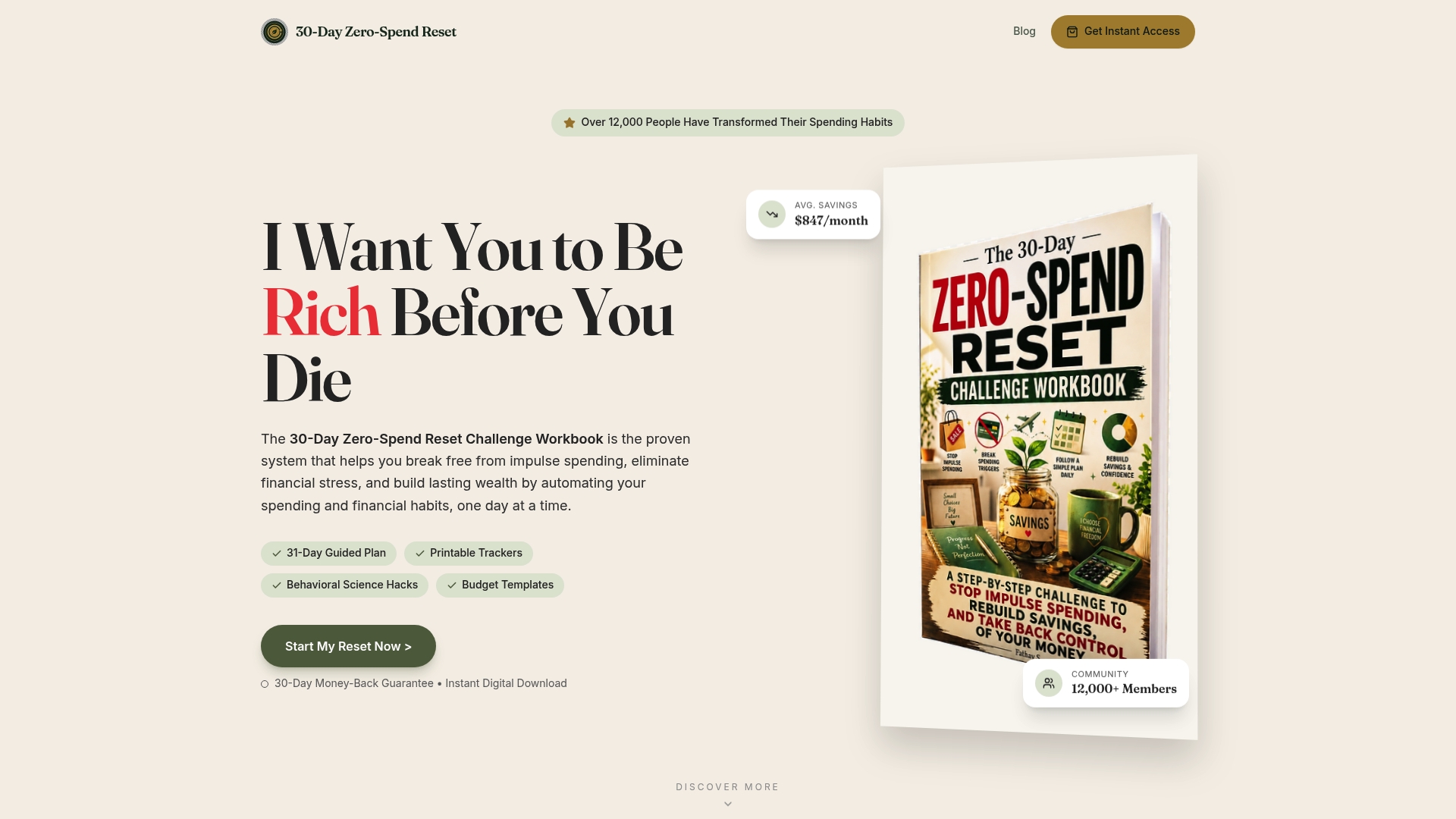
If you want extra tools to go further, the Zero-Spend Accelerator Vault adds more resources, and the Zero Spend Guide is a good place to see how the program works before you start.
FAQ
What is urge surfing in simple terms?
Urge surfing is a mindfulness technique where you observe a craving instead of acting on it or fighting it. You notice where it shows up in your body, breathe, and watch it rise, peak and fade. It was developed for relapse prevention and is now used for many unwanted habits, including overspending.
How long does a spending urge last?
It varies by person and situation. Dartmouth-Hitchcock suggests watching an urge for at least five breath cycles, about a minute, to see how it changes. Many people find that a wave is much weaker within a few minutes. If you still want the item after that, wait a day before buying a non-essential purchase, as America Saves recommends.
Does urge surfing work for online shopping?
Yes, because online urges are still waves with a trigger, a rise and a fall. The difference is that buying takes seconds. Add friction by logging out of shopping apps, removing saved cards and moving items to a wish list. Then surf the urge before you decide.
Can urge surfing help me pay off debt faster?
It can help you stop adding to the problem, which frees up money for repayment. When you ride out an urge and skip the purchase, move that amount to a debt payment or emergency fund right away. For the planning side, the CFPB's toolkit offers a simple plan to pay down debt.
When should I get professional help instead?
Get help if spending feels out of control, keeps going despite repeated attempts to stop, or is damaging your finances, work or relationships. A licensed therapist or your doctor is the right starting point. Urge surfing can still be part of your toolkit, but it shouldn't be your only support.
Sources
- UCI Susan Samueli Integrative Health Institute: Urge Surfing in the New Year
- Dartmouth-Hitchcock: Urge Surfing
- America Saves: 6 Ways to Break the Emotional Spending Cycle
- A meta-analysis of financial self-control strategies (PMC, 2021)
- Consumer Financial Protection Bureau: Your Money, Your Goals toolkit
- Mental accounting in investing
Recommended
Ready to reset your spending?
Get the 30-Day Zero-Spend Reset Workbook and turn these ideas into a daily action plan.
Start the 30-Day ResetThis article is part of the 30-Day Zero-Spend Reset method. Explore the complete day-by-day system behind these ideas.
Read the full guideKeep reading


Join the conversation
Be the first to share your thoughts on this article.