
No-Spend Month With Kids: A Parent's Plan That Works

How to run a no-spend challenge with kids: set the rules, involve them, say no to treats without meltdowns, and keep the savings going afterward.
No-Spend Month With Kids: A Parent's Plan That Works
A no-spend challenge with kids works when the children are part of the plan, the rules are written down before day one, and every "no" comes with a free "yes" attached. Do those three things and the weekend or month stops feeling like punishment. It becomes a family project with a number at the end. Our 30-Day Zero-Spend Reset Challenge Workbook was built around daily challenges, printable trackers and social scripts for money conversations, which is the structure most parents find missing when they try this on willpower alone.
TL;DR
- Decide what "no-spend" means for your household before you start: absolute zero, or zero except essentials like groceries and gas.
- Bring your kids into the plan. Let them see the budget, pick free activities, and own a small allowance.
- Prepare answers for "Can I have...?" ahead of time: a wish list, a 24-hour wait, and a free alternative.
- Move the money you would have spent into savings or debt payments at the start, not at the end.
- Start with one weekend, then stretch to a month once the routine feels easy.
Table of Contents
- Why kids make a no-spend challenge harder (and why it's worth it)
- Step 1: Define "no-spend" for your family
- Step 2: Bring the kids into the plan
- Step 3: Answer "Can I have...?" before it's asked
- Step 4: Plan the days, not just the rules
- Step 5: Don't forget the quiet leaks
- Step 6: Count what you saved and move it
- A realistic first month
- What to do when it slips
- Where the Zero-Spend Reset Workbook fits
- Our perspective
- FAQ
- Sources
Why kids make a no-spend challenge harder (and why it's worth it)
Solo no-spend challenges are mostly about your own habits. With children, you also face school fundraisers, birthday parties, snack requests in the checkout line, and a calendar full of "quick" errands that end at a store.
The good news is that the same pressure points are where a family gets the most out of the challenge. Utah State University Extension notes that involving children in real financial decisions, such as comparing prices, planning grocery budgets and managing allowances, can build confidence and practical money skills. A no-spend month is a month of exactly those decisions, made out loud.
If you are carrying credit card debt or trying to build an emergency fund, the stakes are practical too. Every dollar that stays in your account during the challenge can go toward a balance or a cushion, which is the whole point.
Step 1: Define "no-spend" for your family
Before you tell the kids anything, agree with your partner on the rules. America Saves advises deciding up front what no-spend means in your home: some families allow absolutely nothing, while others permit essentials like commuting gas or fresh produce.
For most families with children, the second version is the realistic one. Ohio State University Extension defines basic needs as the things you must have to live day to day: food, water, clothing, shelter, keeping your family safe and having a source of income. Its rule for hard choices is to meet basic needs first.
Write two lists on one page:
| Keep paying for (needs) | Pause for the challenge (wants) | |---|---| | Rent or mortgage, utilities, insurance | Takeout and coffee runs | | Groceries from your planned list | Toys, books, games, apps | | Gas for work and school | Entertainment outings that cost money | | Medications, required school items | Impulse snacks, new clothes that aren't outgrown necessities | | Minimum debt payments | Subscriptions you don't use |
That last row matters. Skipping a minimum payment to hit a "zero" is not a win, and it can cost you in fees. If you want to see how a household sorts spending, our spending categories list and list of expenses to cut can help you fill in both columns.
Decide in advance on exceptions, too. NerdWallet's Erin El Issa, who runs a no-spend January, allows a small number of school book-fair books for her kids each year. One planned exception is far easier to live with than an argument at the door of the book fair.
Step 2: Bring the kids into the plan
Children cooperate with rules they helped write. How much you share depends on their age, but the method is the same.
Show them the family budget. Utah State University Extension suggests building the monthly budget together: list all income, have the children list expenses such as rent or mortgage, food, insurance, car payments and clothing, use past bank or card statements to see what was actually spent, and let a child work out the difference between income and expenses. Older kids can do the subtraction. Younger ones can sort picture cards into "must have" and "nice to have."

Give everyone a personal allowance. The same USU guidance recommends that every family member get a small allowance to manage. If a child wants something that isn't in the family budget, they can buy it or save for it with their own money, and they learn that spent money can't buy anything else. During a no-spend month, you can decide that allowance money is also paused, or that it can only be saved. Either works if it is decided before day one.
Make it a game with a scoreboard. Put a chart on the fridge. Each day without an unplanned purchase earns a sticker. Pick the reward together, and make it free (more on that below). Our workbook includes printable trackers for this kind of daily check-in, so you don't have to design one yourself.
Say it plainly. A simple script works for most ages: "For the next month our family is saving money for something important. We still buy food and pay for the house. We're taking a break from extras, and we're going to find fun things that don't cost anything."
Step 3: Answer "Can I have...?" before it's asked
This is where most family challenges wobble. The solution is a few standard responses you can give calmly, every time.
Use "we're choosing" language
The USU guidebook recommends replacing "we can't afford that" with "we're choosing to spend our money on something else". It frames the no-spend as a decision the family made, not a lack, which protects kids from feeling that money is scary. If you are worried about the opposite problem, feeling deprived once the challenge ends, see our piece on overcoming a scarcity mindset after frugality.
Start a wish list
University of Wisconsin Extension recommends that children add store requests to a wish list rather than hearing a flat refusal. The want is acknowledged, written down, and parked. At the end of the challenge, the list is a ready-made guide for birthdays and for items worth saving up for.
Try the 24-hour rule
The USU guidebook also describes a 24-hour rule: for non-essential purchases, children wait a day to see whether they still want the item. Most "I need it" moments fade by dinner. During a no-spend month, you can lengthen this to the whole challenge, with the wish list as the holding pen.
Offer a non-material reward
The Wisconsin Extension guidance suggests offering non-material incentives, such as a trip to the park or letting the child choose a free activity. "We can't buy that today, but you can choose what we do Saturday afternoon" gives your child real power in exchange for the thing you declined.
Practice the grocery store
The store is the hardest room in the house. USU suggests making a shopping list together before you go, sorting needs from wants, and, when your child spots a tempting treat that isn't on the list, asking how they feel about skipping it. That question turns a standoff into a small lesson. We go deeper in our guide to grocery shopping with kids during a no-spend month.

Step 4: Plan the days, not just the rules
Empty time is what spends money. A family with a plan for Saturday afternoon doesn't drift to the mall.
Free things to do
America Saves lists several free weekend ideas that translate well to families:
- A hike or nature walk
- A family game or movie night using what you already own
- A visit to a local park or splash pad
- Decluttering and donating, which kids can turn into a sorting game
- A pantry-staples potluck with family or neighbors
- A DIY home project
- A "vacation at home" day
Let each child pick one item for the week. Choosing is half the motivation.
Handle food before the weekend starts
Food is where no-spend plans most often fail, because hungry kids and tired parents order pizza. America Saves recommends meal prepping and filling the gas tank before Friday night to cut mid-weekend temptation. For a family, that means a menu for the week built from what is already in the fridge, freezer and pantry, with a few backup meals that take ten minutes. If you want to avoid common slip-ups when you batch cook, this rundown of meal prep mistakes parents make is a handy checklist. Our workbook also includes meal planning guides for exactly this kind of week.

Plan around the calendar
Look at the next 30 days for birthday parties, school events and holidays. Decide in advance which are in and which are out, and prepare a free option for each: a handmade card instead of a store-bought gift, or a homemade snack for the class party. If your challenge lands right after the holidays, our post-holiday money reset guide shows how to set the starting point.
Step 5: Don't forget the quiet leaks
A no-spend challenge isn't only about what happens in stores. Kids' households leak money through streaming services, game subscriptions, app purchases, and recurring box deliveries that renew without anyone noticing. Spend an evening with your last two statements, list every recurring charge, and cancel what the family didn't use. Then reduce the sales emails that trigger new wants: here is how to unsubscribe from marketing emails.
If you are paying down debt, also check what your cards are charging you. Our article on the minimum payment trap explains why paying only the minimum keeps balances alive far longer than most people expect.
Step 6: Count what you saved and move it
The challenge only pays off if the money lands somewhere. America Saves suggests tracking what you would have spent, for example a $12 takeout order, a $5 coffee or $40 in entertainment, totaling it on Monday and considering a transfer to savings or toward debt.
For a month, NerdWallet suggests the reverse order. Estimate how much you normally spend on nonessentials, then transfer that amount at the start to savings, debt or investments so the spending isn't simply postponed to the following month. For a parent with an emergency fund goal, that means the first transfer happens on day one, while motivation is highest.
Let the kids watch the number grow. A jar, a chart or a thermometer drawn on paper shows them where the "no" money went. Then choose one family reward that costs little, so the end of the challenge doesn't turn into a spending spree.
A realistic first month
Here is a pattern that suits many families.
| Week | Focus | Kid role | |---|---|---| | 1 | Set rules, sort needs and wants, audit subscriptions, plan meals | Help write the rules, start the wish list | | 2 | Free activities, one grocery trip with a list | Pick two activities, check items off the list | | 3 | Handle a party or event with a free option | Make a card or gift | | 4 | Total the savings, move the money, plan what's next | Update the savings chart, choose the free reward |
If a month feels like too much, start with one no-spend weekend and repeat it. Our guide to a low-spend month covers a gentler version for households that need some flexibility.
What to do when it slips
It will, at some point. A child gets a fever and you order dinner, or a birthday gift appears that you hadn't planned for. Treat it as information, not failure. Write down what happened, decide whether it was a real need or a planned-for gap, and restart the next day. A single slip doesn't cancel the other twenty-nine days, and your kids learn more from watching you reset calmly than from watching you never miss.
Where the Zero-Spend Reset Workbook fits
If you would rather not build the system from scratch, our 30-Day Zero-Spend Reset Challenge Workbook gives you daily behavioral challenges, printable trackers, budget templates, social scripts for money conversations, meal planning guides and subscription audits in one place. A companion webapp keeps the daily routine on your phone. The money-conversation scripts are built for moments like the ones above: what to say to a child at the checkout, and to a relative who wants to buy gifts.
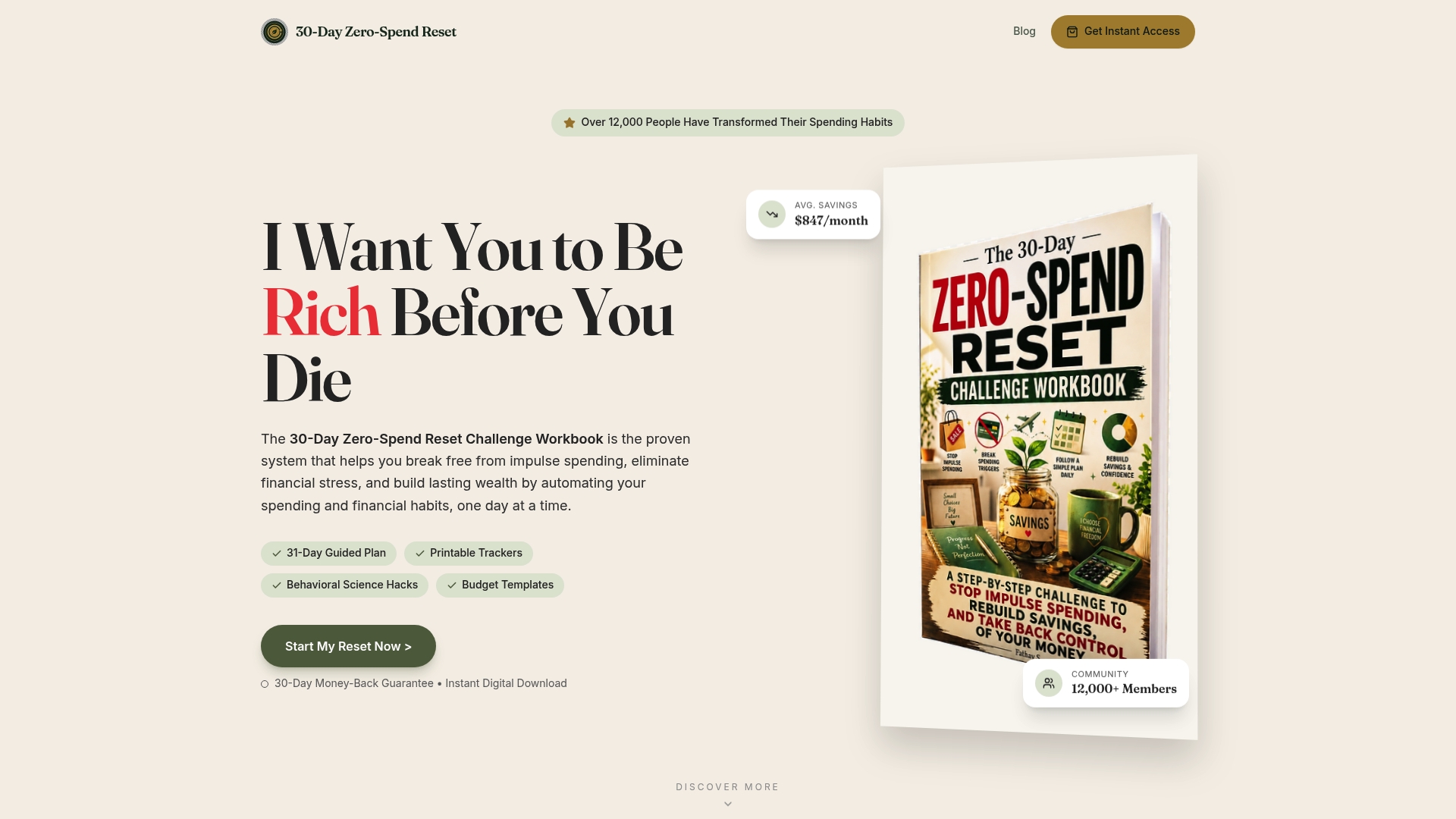
If you want to go further, the Zero-Spend Accelerator Vault adds more resources to the program. You can also read the Zero Spend Guide to see how the approach works before you decide.
Our perspective
Most families who try a no-spend challenge fail for the same reason: they rely on willpower. By Thursday of week one, the parent who said "no" nine times is tired, and the tenth request wins.
We built the workbook on a different idea. Spending habits are behavior, and behavior changes when the environment, the daily routine and the language you use all change together. That is why our program is built around daily challenges, trackers you can see, scripts for the awkward conversations, and meal plans that remove the 5 p.m. decision. It is designed to work without guilt and without deprivation, because guilt is what makes people quit.
Kids are part of that environment. When children see the plan, help choose the free activities and watch the savings grow, the challenge stops being something you do to them. It becomes something your family does together, and the habit has a much better chance of lasting past day thirty.
The goal isn't a perfect month. It is a household that knows where its money goes and points it at debt repayment, an emergency fund or a goal you chose.
Omar
FAQ
Should kids really take part in a no-spend challenge?
Yes, in an age-appropriate way. Utah State University Extension recommends including children in the family budget conversation and giving each person a personal allowance. Even young children can sort items into needs and wants, and older ones can do the math on income and expenses.
What if my child asks for something at the store?
Stay calm and use a prepared response. Add the item to a wish list, use "we're choosing to spend our money on something else" instead of "we can't afford it," and offer a free alternative such as a trip to the park. If the item is a non-essential purchase, the 24-hour wait often settles the matter.
Can we still buy groceries and gas?
Most families do. Many households define no-spend as no spending on nonessentials, while still paying for basics such as food, shelter, utilities and transportation to work. Decide which of those your family will keep, write them down, and tell your kids so the rules are clear.
How long should our first no-spend challenge be?
A single weekend is a good test run, and a full 30 days is the natural next step. Pick the length you can finish. A short challenge completed builds more confidence than a long one abandoned in week two.
What should we do with the money we save?
Move it on purpose. Total the amount you would have spent and transfer it to savings or toward a debt balance, ideally at the start of the challenge so it can't be spent later. Let your children see the total, because it shows them what the effort bought.
Sources
- How to Host a No-Spend Weekend (and Actually Enjoy It), America Saves
- Teaching Children Money Management, Utah State University Extension
- Guidebook, Utah State University Extension
- Moderation, University of Wisconsin Extension
- Counting Your Money Calendar, Ohio State University Extension
- Why No Spend January Has Become My Annual Tradition, NerdWallet
Recommended
Ready to reset your spending?
Get the 30-Day Zero-Spend Reset Workbook and turn these ideas into a daily action plan.
Start the 30-Day ResetThis article is part of the 30-Day Zero-Spend Reset method. Explore the complete day-by-day system behind these ideas.
Read the full guideKeep reading

Join the conversation
Be the first to share your thoughts on this article.