
Finish Your Low Spend Month: 8 Steps, Daily Tracking, Auto Transfers

Try a 30 day low spend month without deprivation: follow an 8 step checklist, set targeted rules, track daily, and automate transfers.
Finish Your Low Spend Month: 8 Steps, Daily Tracking, Auto Transfers
A low-spend month means cutting your discretionary spending to a bare minimum for 30 days while keeping essentials intact. The single most effective way to finish one is to set clear category rules, track every purchase daily, and move whatever surplus you confirm straight into savings or debt payoff. Done right, this builds an emergency buffer or knocks down a balance faster than a vague "spend less" resolution ever will.
TL;DR:
- Setting clear spending rules and tracking daily can ensure surplus funds are moved directly into savings or debt repayment, enhancing financial progress.
- Focusing on specific categories rather than blanket bans makes a low spend month more sustainable and tailored to individual overspending tendencies.
- Using simple tools like a paper log or automated transfers reduces the likelihood of tracking fatigue and helps enforce disciplined habit formation.
- Handling slip-ups with small corrections and social scripts helps maintain momentum and prevents quitting due to setbacks.
- Automated transfers of saved money reinforce habits and ensure funds contribute to emergency savings or debt reduction without relying solely on willpower.
Table of Contents
- Quick checklist: 8 steps to start a low spend month today
- How to plan rules and a budget that fit your life
- Track daily: tools and a minimal logging system that actually gets used
- Staying sane: handling social pressure, cravings, and slip-ups
- What to do with the money you save
- Publisher perspective: why a structured 30-day workbook increases follow-through
- Optional: how the 30-Day Zero-Spend Reset Challenge Workbook can help
- Official worksheets and data to back up the guide
- Sources
- FAQ
Quick checklist: 8 steps to start a low spend month today
You do not need a perfect plan to begin, just a clear one. These eight steps cover the setup most people skip and then regret.
- Pick your start and end dates and one measurable goal, like saving $400 or paying off a specific card; you can also use a helpful affordability calculator to see how much fits your income.
- Decide what is allowed, what is blocked, and name one or two exceptions in advance so the rules survive real life.
- Review subscriptions now: pause what you can, cancel what you will not use, and note renewal dates.
- Pre-shop your pantry and plan a week of meals so takeout stops being the default.
- Pick one payment method or use cash envelopes so every purchase requires a conscious choice.
- Log spending daily using a simple template rather than trying to remember it later.
- Automate a transfer for any verified surplus so the money leaves checking before you can second-guess it.
- Set a small reward and a review date at month's end to avoid rebound spending once the challenge ends.
How to plan rules and a budget that fit your life
A low spend month works better as a targeted cut than a blanket ban. Start by listing your fixed costs, variable costs, and irregular expenses on a one-month budget worksheet, the same approach Consumer recommends for anyone trying to find money to cut.
From there, build rules around specific categories instead of banning everything. The CFPB's spending rules guidance suggests picking one or two categories where you tend to overspend, defining exactly what counts as allowed, and naming your exceptions before temptation shows up.
A few things to nail down before day one:
- List fixed costs (rent, insurance, loan payments) separately from discretionary ones (dining out, streaming, impulse buys).
- Write down your allowed categories and your blocked ones, then name any planned exceptions.
- Set a success metric tied to your own income and goal, not someone else's savings screenshot.
- Include irregular costs like annual fees or car maintenance so they do not derail week three.
Whether $200 or $2,000 saved counts as "good" depends on your starting point. The Federal Reserve's 2026 report on household well-being found that 55% of adults had three months of expenses saved in 2025, and 63% could cover a $400 emergency. Progress toward your own goal matters more than a fixed dollar target borrowed from someone else's budget.
The 50/30/20 framework (needs, wants, savings) is a useful starting frame, but treat it as context to adjust, not a rule to follow blindly during a month built around cutting wants further than usual.

Track daily: tools and a minimal logging system that actually gets used
Tracking fails when it is complicated. The CFPB's spending tracker guidance recommends a simple daily log: date, category, planned amount, actual amount, and reason for any gap.
Pick a tool you will actually open:
- Paper log: zero setup, easy to abandon if you travel or lose the notebook.
- Spreadsheet: flexible and searchable, but requires a few minutes each evening.
- Bank export: accurate and automatic, but shows spending after the fact rather than in the moment.
- Budgeting app: convenient reminders and categorization, though most require linking accounts.
Review the week's log every Sunday and look for patterns. Stress, boredom, and social plans are the usual triggers behind an off-plan purchase, and seeing them in writing makes them easier to name and preempt next time.
Pro Tip: Set a recurring phone reminder for 8 p.m. to log the day's spending in under two minutes, before you forget the details.

Card controls and calendar blocks for known trigger times (Friday night, payday) add friction exactly when you need it.
Staying sane: handling social pressure, cravings, and slip-ups
Slips happen. The plan that survives is the one built to absorb a bad day, not the one that assumes there won't be any.
- When you slip, acknowledge it, make a small correction like skipping one planned purchase later, and keep going instead of quitting the whole month.
- Keep a one-line script ready for social situations: "I'm doing a spending reset this month, let's do something free instead."
- Suggest low-cost swaps like a walk, a potluck, or a movie night at home instead of dinner out.
- Use a 24-hour rule before any non-essential purchase, hide saved payment cards, and delete or block shopping apps during the challenge.
- Build in small, planned rewards (a favorite coffee, a free afternoon) so the month feels sustainable rather than punishing.
What to do with the money you save
The savings only count if they leave your checking account. A verified surplus sitting there tends to disappear into small purchases within days.
- Move confirmed surplus into a separate savings account or toward debt immediately, not at some point later.
- Set up a recurring transfer so the same amount moves automatically every payday going forward.
- Prioritize in this order: emergency savings first, then high-interest debt, then a specific goal fund.
- Measure success against the goal you set at the start and adjust your regular budget based on what you learned.
Automating the transfer removes the decision entirely. The CFPB's guidance on automatic savings points to recurring transfers as a more reliable way to keep money saved than relying on willpower after the challenge ends. If your goal is a specific number, like saving $5,000 over a few months, dividing it across pay periods turns an abstract target into a concrete transfer amount each time you get paid.
Publisher perspective: why a structured 30-day workbook increases follow-through
Most low spend months fail somewhere in week two, not because the goal was wrong but because the plan had no scaffolding. A daily structure, pre-built trackers, and scripts for awkward social moments remove the friction that causes people to quit rather than adjust.
A workbook built around daily challenges, meal plans, and a companion tracking app gives structure to days that would otherwise rely on memory and mood. Behavioral tools that address impulse buying and subscription creep directly, rather than through general budgeting advice, tend to convert a temporary spending freeze into a habit that outlasts the 30 days.
, Omar
Optional: how the 30-Day Zero-Spend Reset Challenge Workbook can help
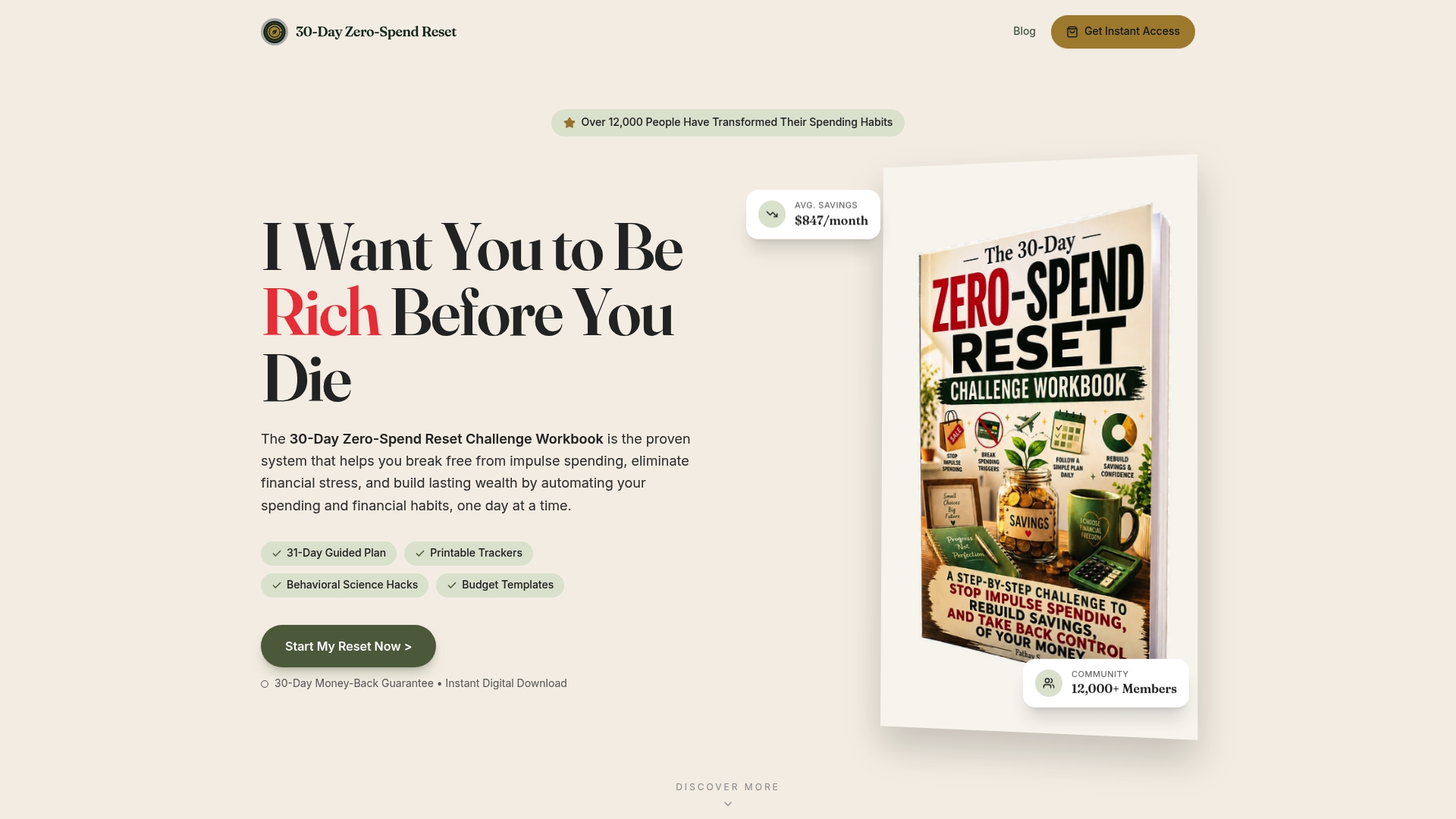
If building your own rules, trackers, and meal plans from scratch feels like the hardest part of a low spend month, a ready-made system removes that setup entirely. The 30-Day Zero-Spend Reset Challenge Workbook is built around daily behavioral challenges rather than a single willpower-based rule, which fits anyone who wants structure instead of guesswork on day one.
What it includes:
- Daily challenges targeting impulse buying, subscription creep, and emotional spending
- Printable trackers and budget templates for the full 30 days
- Meal planning guides to cut food costs without extra decisions
- Social scripts for money conversations with friends and family
- A private webapp that automates tracking and recurring transfers
Users of the program have reported financial improvements such as increased savings per month, reflecting the workbook's focus on changing financial habits. For those who want to go further after the first month, the Zero-Spend Accelerator Vault adds deeper templates for sustaining the habit long-term.
Official worksheets and data to back up the guide
For readers who want the source material directly: the CFPB's budget-building worksheets, consumer.gov's budget worksheet, and the Federal Reserve's household savings data all offer free, downloadable planning tools that pair well with any low spend challenge.
Sources
- CFPB blog, Track your spending with this easy tool
- Federal Reserve, Economic well-being of U.S. households in 2025 (executive summary)
- Consumer
FAQ
Is spending $300 a month a lot?
It depends entirely on your income and what that $300 covers. The Federal Reserve's 2026 household report frames financial health around savings progress and emergency readiness rather than a fixed spending number, so compare $300 against your own budget categories instead of a universal benchmark.
What is the $27.40 rule?
This is not a term defined by a government or financial authority source, and definitions circulating online vary widely. Rather than follow an undefined rule, use a documented approach like the CFPB's category-based spending rules, which ties limits to specific categories you actually overspend in.
How do I save $5,000 in 3 months?
Divide the total across your pay periods to get a concrete target: consumer.gov's budgeting guidance shows that $5,000 over three months means dividing the total goal across months or pay periods to find a concrete transfer amount each payday. Automating a transfer for that exact amount each payday removes the need to hit the number manually.
Is putting $2,000 a month into savings good?
A $2,000 monthly savings rate is strong in absolute terms, but whether it is "good" depends on your income and expenses. The better measure is whether it moves you toward a specific goal, like the three-months-of-expenses benchmark reported by 55% of adults in 2025, rather than comparing the raw dollar figure to someone else's budget.
Ready to reset your spending?
Get the 30-Day Zero-Spend Reset Workbook and turn these ideas into a daily action plan.
Start the 30-Day ResetThis article is part of the 30-Day Zero-Spend Reset method. Explore the complete day-by-day system behind these ideas.
Read the full guideKeep reading





Join the conversation
Be the first to share your thoughts on this article.