
How to Stop Credit Card Spending in 30 Days

Stop credit card spending by removing the triggers, not just the card. A 30-day plan for impulse buys, subscriptions, groceries, debt and your first emergency fund.
How to Stop Credit Card Spending in 30 Days
To stop credit card spending, take the card out of the daily routine, then replace the habits that kept reaching for it. Hiding the card works for a week. What lasts is a fixed stretch of days with a rule for each trigger: the late-night cart, the forgotten subscription, the grocery run on autopilot. Thirty days is long enough to see where the money actually goes, and short enough to finish. Our 30-Day Zero-Spend Reset Challenge Workbook is built around exactly that stretch, with one small challenge per day.
TL;DR
- Remove the card from your wallet, phone wallets and shopping apps first. Friction is the cheapest brake you have.
- Name your triggers (stress, boredom, "I deserve this") and put a 48-hour wait between wanting and buying.
- Audit recurring charges and groceries next: they quietly drain the card every month.
- Keep paying the card down while charges stop, and send the freed-up payment into a starter emergency fund.
- A structured 30-day reset beats good intentions because each day tells you what to do.
Table of Contents
- Why stopping the card is harder than it sounds
- The 30-day plan to stop using your credit card
- Paying down the balance while the charges stop
- Turning saved money into an emergency fund
- Our view: the card is not the problem, the autopilot is
- Make the 30 days easier with the workbook
- FAQ
- Sources
Why stopping the card is harder than it sounds
A credit card removes the pause between wanting something and paying for it. The money is not yours yet, so the purchase feels free. That is why "just use less" fails: it relies on willpower at the exact moment willpower is lowest.
The Louisiana Office of Financial Institutions lists stress, fatigue, sadness and even happiness ("I deserve this") as common emotional spending triggers. Notice that half of those are good moods. You are not weak, you are human, and the fix is a system that works whether you feel strong or not.
If you want to practice staying steady when the urge hits, building self-regulation skills is a useful companion to the steps below, because spending urges are physical before they are financial.
There are three kinds of card spending, and each needs a different fix:
- Impulse purchases: one-off buys driven by a mood or an ad.
- Recurring charges: subscriptions, memberships and auto-renewals you stopped noticing.
- Routine spending: groceries, takeout and household items bought on autopilot because the card is already in hand.
The plan below attacks them in that order.
The 30-day plan to stop using your credit card
Days 1 to 3: Remove the easy path
Start with friction. Take the physical card out of your wallet. Delete it from Apple Pay, Google Pay, PayPal, Venmo and any shopping app, and clear saved card details from the websites you use most. Each saved number is one less step between you and a purchase.
Then choose what you will use instead: cash, a debit card tied to money you have, or a mobile payment from a checking account. Where it goes wrong: people remove the card but leave it saved in one browser, then spend from there in a weak moment. Do a full sweep, searching your email for "order confirmation" to catch the stores that have it on file.
Do not cancel the account out of frustration. Closing cards with a balance or a long history can complicate your finances, and the goal here is to stop using the card, not to punish yourself. Keep paying it on time.
Days 4 to 7: Learn where the money goes
You cannot cut what you cannot see. The CFPB's budgeting guide lays out the sequence: record all your income, log spending by category, list every bill with its due date, and then build a working budget. Pull the last two statements and sort every charge into categories. If you want a ready-made set, our spending categories list gives you the buckets.
The same guide notes that missed or late payments can have a larger effect on credit scores and overall financial well-being. So put due dates on a bill calendar now. It also shows you which weeks need extra care.
In the workbook, the first week of daily challenges and printable trackers walk you through this audit so it does not stall at "I'll do it this weekend."
Days 8 to 14: Install a wait rule for impulse buys
The Louisiana Office of Financial Institutions recommends a simple routine: write the item's name and price on a wish list, wait 48 hours, then ask whether you really need it and need it now. Most urges fade inside that window. The ones that do not are usually real needs, and you buy them with money you have.
Two additions make the wait rule hold:
- Cut the ad stream. Unsubscribe from promotional emails and remove one-click checkout. We cover the how in unsubscribing from marketing emails and the scroll-and-buy habit in stopping doomscroll shopping.
- Write your own rules down. A short list such as "no purchases after 9 p.m." or "nothing over $50 without a day's wait" removes in-the-moment negotiation. See our spending rules list for examples.
Where it goes wrong: the wish list becomes a shopping list. Review it at the end of the 48 hours with one question, "Would I buy this if I had to hand over cash?"
Days 15 to 21: Audit subscriptions and recurring charges
These are the charges that keep landing while you are "not spending." Go through your card and bank statements line by line and mark anything that repeats: streaming, apps, memberships, software trials that rolled into paid plans. The CFPB's savings booklet specifically suggests checking for unused memberships such as magazines, streaming services and gyms.
For each one, decide: keep, pause or cancel. Then cancel in writing or through the account page and save the confirmation.
If a company makes cancelling hard, you are not imagining it. The CFPB's Circular 2023-01 says that negative-option marketing (charging you until you opt out) may violate federal consumer finance law when sellers fail to clearly disclose key terms, fail to get informed consent, or put unreasonable obstacles in the way of cancelling. Its examples include hang-ups, unreasonably long holds and false information about how to cancel. If a seller keeps billing after you followed its stated cancellation steps, contact your card issuer to dispute the charge, and keep your cancellation record.
Our workbook includes a subscription audit so every recurring charge gets a keep-or-cut decision in one sitting rather than a slow leak you fix one month at a time.

Days 22 to 28: Take groceries off autopilot
Groceries are where many households lean on the card most, because the spending is frequent and feels unavoidable. It is also the category where a plan pays back fastest, especially for parents.
- Use cash by the week. Utah State University Extension's Cutting Expenses guide recommends shopping with cash split by week, planning meals around store ads, using your pantry inventory and shopping alone after you have eaten.
- Try generics. The same guide says switching to generic brands can save many families about $20 a week, which it puts at $1,040 a year, because generics can cost about 50% less than name brands.
- Shop from a list. The FDIC's Plan to Find Money material notes you are more likely to avoid impulse buys and extras with a grocery list, and suggests coupons or store savings clubs.
The workbook pairs this with meal planning guides, and if you shop with children, our article on grocery shopping with kids during a no-spend month has practical tactics for the checkout aisle.
Days 29 and 30: Set the rule you will live by
End the challenge by choosing the standing rule that replaces the card. The CFPB's My Spending Rule to Live By worksheet uses the 50/20/30 approach: 50% of take-home pay for needs, 20% for savings and debt payments, and no more than 30% for wants, with a weekly or monthly cap on wants that you keep where you can see it.

If you prefer to assign every dollar a job, zero-based budgeting with the envelope system in digital banking does the same thing with categories in your own bank app.
Paying down the balance while the charges stop
Stopping new charges is half the job. The other half is the balance already on the card.
The CFPB's Your Money, Your Goals materials name the two main methods for paying down debt: the highest-interest-rate method (extra money goes to the card with the highest rate first) and the snowball method (smallest balance first, for momentum). They also advise calling your creditors if you are struggling. Pick whichever you will actually stick with.
The same materials add prevention tips that fit this challenge: ask whether you can pay cash instead of using credit, plan ahead for seasonal expenses that previously became debt, and check eligibility for energy assistance or weatherization programs to lower monthly bills.
One trap deserves its own warning: paying only the minimum keeps you in debt far longer than most people expect. We break down the arithmetic in the minimum payment trap. To find more room in the budget for extra payments, start with the list of expenses to cut.
Turning saved money into an emergency fund
Every dollar you stop charging is a dollar you can point somewhere. Without a plan, it drifts back into spending. The CFPB training treats turning money saved from decreased spending into actual savings as a deliberate step.
The same training says many emergencies can be managed with $500 to $1,000 in an emergency fund, and its assessment frames a fuller cushion as 3 to 6 months of living expenses. So the order is:
- Keep paying every card at least the minimum, on time.
- Build the first $500 to $1,000 as a starter buffer, so a car repair does not go back on the card.
- Direct extra money to the highest-interest card or the smallest balance, whichever method you chose.
- Once the card is paid off, redirect that monthly payment to savings.
That last step comes from the FDIC, whose consumer-education material frames paying down high-interest card debt as a savings strategy: the payment that used to go to the card company becomes money you pay yourself.
The point of the starter fund is not the number. It is the first time an unexpected bill arrives and the card stays in the drawer.
Our view: the card is not the problem, the autopilot is
We built the 30-Day Zero-Spend Reset Challenge Workbook because most people who want to stop credit card spending already know what to do. The trouble is doing it on a Tuesday night when they are tired and the cart is open.
That is why our approach rests on behavioral psychology rather than willpower or guilt. Instead of asking you to "be better," the workbook gives each day one small, specific challenge, with printable trackers, subscription audits, meal plans and social scripts for the awkward money conversations that come up with family and friends.
A generic budget tells you what you should have spent. A reset changes what you reach for. Our users report saving an average of $847 per month, and we think the reason is simple: when the next step is already written down, there is nothing to argue with yourself about.
You do not have to deprive yourself to make this work. You need thirty days of structure and a few rules that outlast them.
Omar
Make the 30 days easier with the workbook
If you want the daily structure without building it yourself, the 30-Day Zero-Spend Reset Challenge Workbook gives you the sequence in this article as a day-by-day plan: daily behavioral challenges, printable trackers, budget templates, subscription audits, meal planning guides and scripts for money conversations. It comes with a private interactive webapp for tracking your progress.
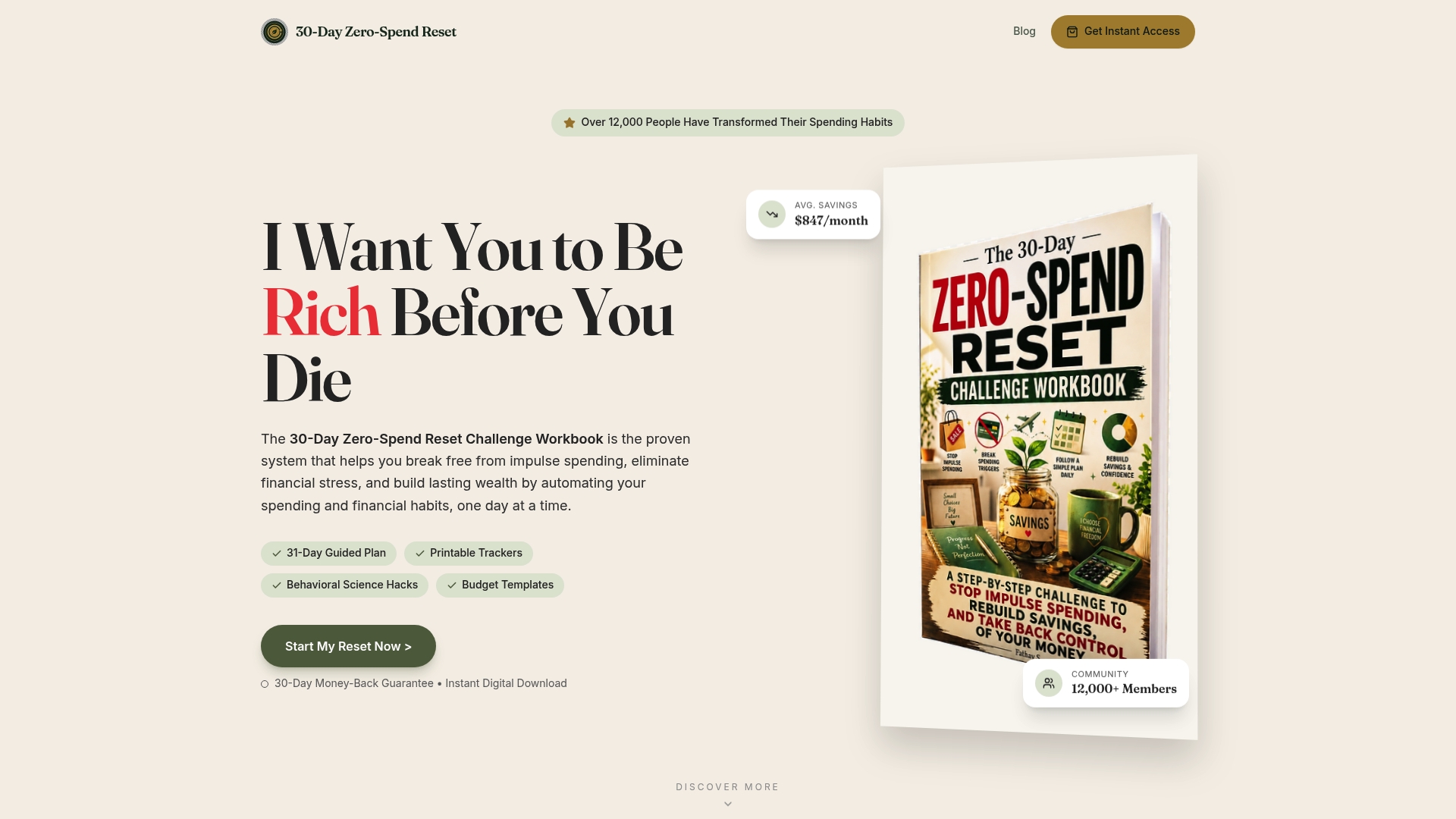
The Zero-Spend Accelerator Vault adds further resources for readers who want to go deeper on habit retraining and savings. You can also read the Zero Spend Guide to see how the reset fits together.
FAQ
Should I cancel my credit card to stop spending on it?
Not necessarily. The goal is to stop using the card while you keep paying it down on time. Remove it from your wallet, phone wallets and saved websites first. If you carry a balance, keep making at least the minimum payment, and if you want to change your account, talk to your card issuer.
What can I use instead of a credit card for everyday purchases?
Cash or a debit card are the simplest options, because both limit you to money you already have. Mobile payments from a checking account work too. A weekly cash amount for groceries, as Utah State University Extension suggests, makes the limit visible.
How do I stop subscription charges from coming out of my card?
List every recurring charge from your last two statements, then cancel each unwanted one through the account page or in writing and keep the confirmation. If a company keeps billing after you followed its cancellation steps, contact your card issuer about disputing the charge. Federal regulators have warned that obstructing cancellation can be unlawful.
How long does it take to break the credit card habit?
There is no fixed number, but a focused 30-day stretch gives you enough days to see your triggers, cancel recurring charges and set a standing spending rule. What matters is that each day has a specific task, so the habit has something to replace it.
What should I do with the money I stop spending?
First keep paying your cards on time. Then build a starter emergency fund of $500 to $1,000, which the CFPB says can cover many emergencies, and send extra money toward the highest-interest card or smallest balance. Once a card is paid off, redirect its monthly payment into savings.
Sources
- Louisiana Office of Financial Institutions: 7 Ways to Reduce Emotional Spending
- CFPB: Budgeting, how to create a budget and stick with it
- CFPB: Building your savings? Start with small goals
- Federal Register: CFPB Circular 2023-01 on unlawful negative option marketing practices
- Utah State University Extension: Cutting Expenses
- FDIC: Plan to Find Money
- CFPB: My spending rule to live by
- CFPB: Your Money, Your Goals
- Training self-regulation skills
Recommended
Ready to reset your spending?
Get the 30-Day Zero-Spend Reset Workbook and turn these ideas into a daily action plan.
Start the 30-Day ResetThis article is part of the 30-Day Zero-Spend Reset method. Explore the complete day-by-day system behind these ideas.
Read the full guideKeep reading

Join the conversation
Be the first to share your thoughts on this article.