
Spending Audit Checklist: Find Where Your Money Goes

A step-by-step spending audit checklist for US households: what to gather, how to categorize, where leaks hide, and how to turn findings into a plan.
Spending Audit Checklist: Find Where Your Money Goes
A spending audit is a line-by-line review of where your money went over the last few months, sorted into categories so the surprises show up. This checklist walks you through it: gather your records, log and categorize every transaction, hunt down subscriptions, grocery waste and impulse buys, then pick one to three changes you will actually keep. Set aside a couple of hours for the first pass.
TL;DR
- Gather 3 to 6 months of bank, credit card and bill records, plus digital payment app history, before you total anything.
- Sort every transaction into a handful of clear categories, then compare the totals with what you assumed you spent.
- Check subscriptions in your statements, your email and your phone's app store settings, then sort each into keep, cancel or review.
- Note what you felt or what was happening around each unplanned purchase, so you fix the trigger and not only the charge.
- Choose one to three changes with a number attached, and repeat the audit every quarter.
Table of Contents
- What a personal spending audit is (and what it is not)
- Step 1: Gather your records
- Step 2: Pick a tracking method and list every transaction
- Step 3: Sort into categories
- Step 4: Total, compare and flag
- Step 5: Run the subscription sweep
- Step 6: Audit your grocery spending
- Step 7: Look for impulse and emotional spending
- Step 8: Turn findings into a plan
- How we think about the audit
- How often to repeat it
- Want the audit built into a daily routine?
- FAQ
- Sources
What a personal spending audit is (and what it is not)
One personal finance guide describes an audit as a thorough review of your financial situation: income, expenses, debts, savings and investments. A spending audit zooms in on the expense side. It is not a budget. A budget is a plan for the future. An audit is a look at what really happened, without judgment.
The FDIC's Money Smart for Adults describes a spending and saving plan as a way to compare income and expenses, understand where your money is going, and adjust so your money serves your goals. The audit is the part that makes that comparison honest.
Step 1: Gather your records
Before you add anything up, collect the documents below. Missing one is the most common reason an audit comes out too rosy.
- Pay stubs, and last year's W-2 if you are salaried
- Checking and savings statements from your bank or credit union
- Credit card statements
- Rent or mortgage statements
- Household bills: utilities, garbage, phone, internet
- Loan statements, such as auto and student loans
- Insurance premiums: auto, life, health, renter's or home
That list follows what America Saves, a nonprofit recommends having on hand before building a spending and savings plan. Add your payment app history (Venmo, PayPal and similar), because advisors who teach spending audits include those transactions alongside bank and card statements.
How far back? Three to six months is the usual window; a more comprehensive audit can use 12 months. Six months is a good compromise, because it catches irregular costs such as car repairs and annual renewals that a single month hides.
Step 2: Pick a tracking method and list every transaction
Choose the tool you will actually open: a spreadsheet, a notes app, a printed tracker or a budgeting app. Then list every transaction, including cash, debit, credit and transfers. One audit method has you list every transaction in a spreadsheet before you assign anything to a category, which keeps you from skipping the embarrassing lines.
If you want to keep tracking after the audit, the FDIC guide suggests reviewing your spending records monthly, whether they come from an app, receipts or your own log.
Step 3: Sort into categories
Keep categories few and plain. Eight to twelve is plenty. A simple starting frame, used by one advisory firm, is four buckets:
- Essentials
- Discretionary spending
- Debt payments
- Savings and investments
Split essentials further if it helps: housing, utilities, groceries, transportation, insurance, health. Split discretionary into dining out, entertainment, shopping, subscriptions and everything else. PSECU, a credit union, also suggests dividing bills into fixed and variable, which makes it clearer which numbers you can move quickly.
A worked example
Say you assumed you spend about $250 on dining out each month. You total three months of statements and find $800 across the quarter, about $267 a month. That is close. But if the real number is $800 in a single month, you have found a leak. One audit guide gives this exact type of gap as an example of the surprises totals reveal. The point is not the dollar figure. It is the distance between what you believed and what the records say.

Step 4: Total, compare and flag
Add each category, then turn the totals into percentages of your take-home pay. Now go through the list with three questions:
- Which categories are bigger than I thought?
- Which charges did I forget about entirely?
- Which spending would I choose again if I were deciding today?
Mark each expense as essential, adjustable or seasonal. Essentials include rent and insurance. Adjustable costs include dining out and shopping. Seasonal costs, such as holiday gifts or annual fees, belong in a monthly average so they stop ambushing you. If your audit lands right after the holidays, our guide to a post-holiday money reset shows how to handle the aftermath.
Step 5: Run the subscription sweep
Subscriptions hide because they are small, automatic and spread across accounts. A good sweep checks four places:
- Statements. Kiplinger suggests combing through one to two months of bank and card statements. Consumer Reports advises looking back over the last year, since annual charges will not show up in a short window.
- Phone settings. Check the subscription settings in the Apple App Store or Google Play.
- Email. Search your inbox for words like subscription, receipt, renewal and membership.
- Payment apps. Rob Berger recommends also reviewing PayPal and Venmo automatic payments.
Then sort every service into Keep, Cancel or Review. Kiplinger's test is simple: did you use it in the last 30 days, and would you sign up again at today's price? If you keep a service, write down its renewal date. Clark.com recommends reminders before annual renewals, one dedicated card for recurring charges, and a review of the list every three months.
Two extra checks save real money. Consumer Reports suggests setting a calendar alert two or three days before a free trial ends. And Clark.com notes that some phone plans, internet providers and credit cards bundle streaming or cloud storage, so you may be paying twice for the same benefit.
While you are in cleanup mode, cutting the marketing emails that trigger purchases helps too: see our post on how to unsubscribe from marketing emails.
Step 6: Audit your grocery spending
Groceries are often the biggest adjustable line in a family budget, and the hardest to see because the spending is scattered across stores, gas stations, coffee shops and vending machines.
The University of Idaho Extension suggests a one-week version: save receipts for every food purchase, sort them into food prepared at home and food bought away from home, total each, and compare your home-food total with the USDA Low-Cost Food Plan. Penn State Extension goes longer, tracking a full month of food spending down to the penny, including every coffee.

For a benchmark, the USDA's most recent monthly report lists the Low-Cost Plan for a 4-person household at $276.30 for a woman aged 20 to 50, $317.70 for a man and $261.50 for a child aged 6 to 8. These figures assume all meals and snacks are prepared at home, and they update monthly, so check the USDA page for the current numbers.
Once you know your totals, three habits do most of the work:
- Plan meals around what you already have. The University of Idaho says careful meal planning can save up to 15% on groceries.
- Compare unit prices. Oklahoma State University Extension explains that the unit price shows the cost by weight or volume, so a bigger box can turn out cheaper per pound. It also warns that buying more than you can use before it spoils just creates waste.
- Track what you throw out. Log discarded items with their price and the reason you did not eat them.
If you shop with children, our grocery shopping with kids guide covers how to keep the cart under control.
Step 7: Look for impulse and emotional spending
Numbers tell you what happened. They rarely tell you why. For this step, pull one to three months of statements and highlight every purchase that was unplanned. Next to each, write what was happening that day: a stressful meeting, a boring evening, a sale email. SmartAsset advises this same approach, then jotting down how you feel before and after non-essential purchases for a few weeks.
Patterns show up fast. Maybe it is late-night browsing, payday rewards or buying to cope after a hard day. Once you see the trigger, you can interrupt it. Practical safeguards from the same SmartAsset guide include:
- A 24-hour or 72-hour wait before non-essential purchases
- Removing saved payment details and shopping apps from your phone
- Budgeting for guilt-free discretionary spending, so restriction does not backfire
- Logging every purchase
The Beck Institute, a cognitive behavioral therapy training center, describes impulse buying as a sequence of trigger, justifying thoughts and habit. It recommends If-Then plans (for example, if you are bored and tempted to browse online, you first take a 10-minute walk) and "urge surfing": rate the urge from 1 to 10 and watch it for 10 to 15 minutes as it peaks and fades.
If stress is the trigger, a few emotional regulation tools you can repeat daily give you something to do besides open a shopping app.
Step 8: Turn findings into a plan
An audit that ends with a spreadsheet changes nothing. End it with a short list:
- Pick one to three changes. Not ten. A cancelled subscription, a weekly grocery cap and a 72-hour rule is a solid first round.
- Attach a number to each. "Cut dining out from $400 to $250 a month" beats "eat out less."
- Send the savings somewhere. Money freed up and left in checking tends to disappear. America Saves recommends setting up automatic saving so you do not have to remember each deposit.
- Check housing and debt together. Your biggest fixed costs shape everything else. This guide to housing costs and other debt shows how to look at them side by side.
If you carry debt
List each balance, its minimum payment and its interest rate next to the audit totals. The money you recover from cancelled subscriptions and trimmed groceries becomes your extra debt payment. Paying only the minimum keeps balances alive longer than most people expect; our explainer on the minimum payment trap shows how. If a balance feels unmanageable, a nonprofit credit counselor can review your full picture with you.
If you are building an emergency fund
Start with a small, automatic transfer from the savings your audit uncovered, and raise it as you find more. Reassess your plan whenever life changes. America Saves lists marriage, a new baby, a move or a promotion as moments to adjust.
How we think about the audit
Most people think an audit will make them feel guilty. The opposite is true when you do it right: the numbers are just information, and information is the first thing that makes change possible.
We built the Zero-Spend Reset around that idea. Willpower fails when you are tired, stressed or bored, so our approach gives you a daily structure instead: one small challenge at a time, a way to catch the trigger before the purchase, and scripts for the awkward money conversations that often come with changing habits.
An audit shows you the leaks. A 30-day reset helps you stop them without feeling deprived, because you are retraining the habit and not just tightening a rule. That is why we pair the audit with trackers, subscription checks and meal planning in one place.
Omar
How often to repeat it
A full audit once a year is too slow, because habits drift. A practical rhythm is a full review each quarter. Clark.com says that after a year of quarterly statement reviews you will have a complete picture of every automatic charge, including the annual ones.
Between full audits, run a short check after you make a change. A one- or two-week micro-audit shows whether the new habit stuck. The FDIC guide also suggests a monthly household goal-setting session: each person writes a goal for the coming month, you review the last month's goals, and you celebrate wins. It works for a solo household too, with a calendar reminder and one page of notes.
Want the audit built into a daily routine?
If you would rather not build the system yourself, our 30-Day Zero-Spend Reset Challenge Workbook turns the steps above into daily challenges. It includes printable trackers, budget templates, subscription audits, meal planning guides and social scripts for money conversations, plus a companion webapp. It is designed to help you catch impulse and emotional spending and replace it with habits you can sustain. Customers have reported saving an average of $847 per month.
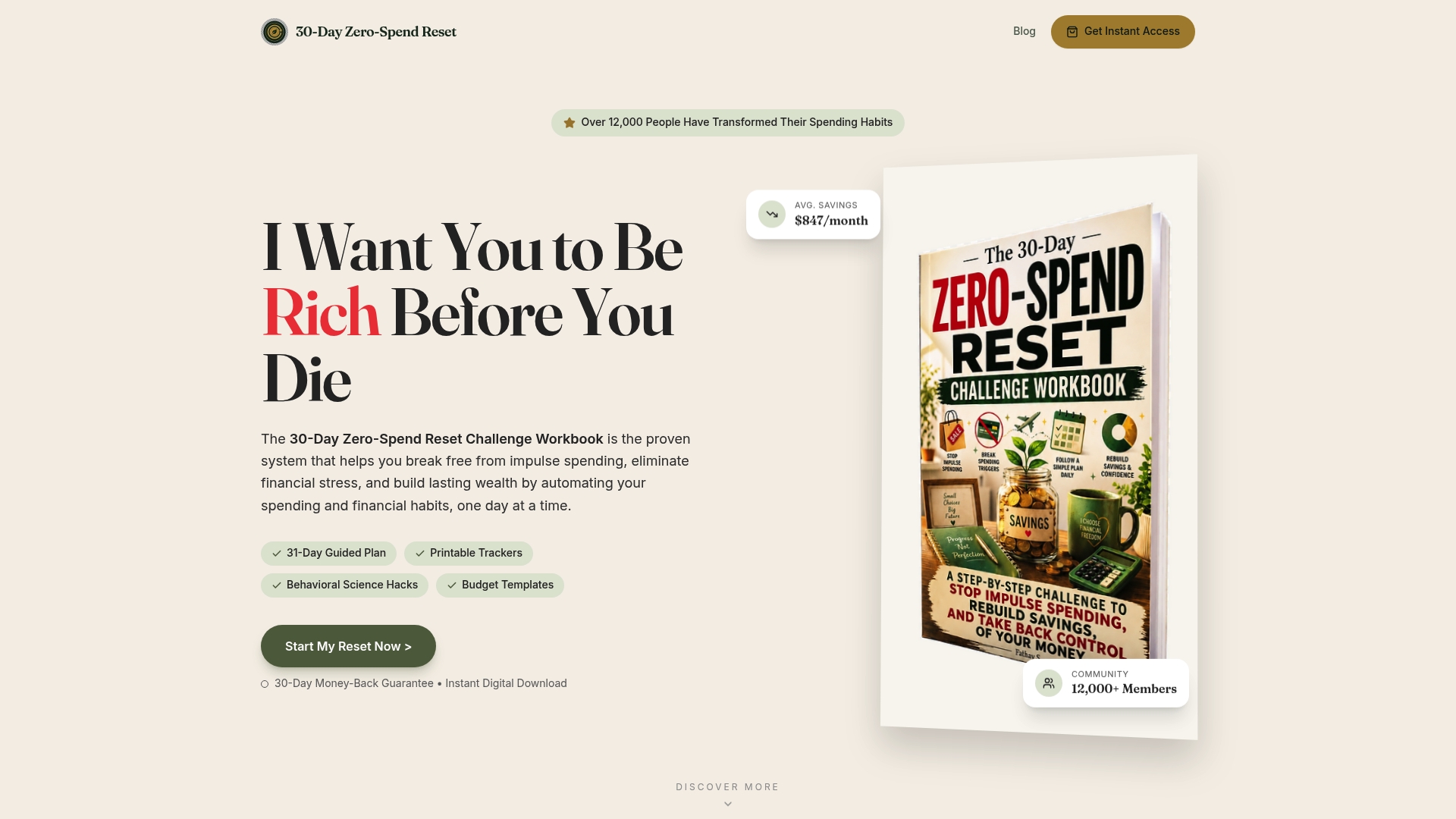
You can start with the 30-Day Zero-Spend Reset Challenge Workbook, explore the Zero-Spend Accelerator Vault, or read our list of expenses to cut first.
FAQ
How far back should a spending audit go?
Three to six months of statements works for most people, and 12 months gives a more comprehensive view. Use the longer window if you have annual subscriptions, insurance premiums or seasonal costs that do not appear every month.
What should a spending audit checklist include?
It should include your income records, bank and credit card statements, payment app history, bills, loan statements and insurance premiums. Then it should cover categorizing every transaction, a subscription sweep, a grocery review, a check for impulse purchases, and a short action plan with numbers.
How long does a spending audit take?
The first pass usually takes a couple of hours if your records are in one place. A focused subscription check can be done in about 30 minutes. Later audits go faster because your categories and spreadsheet already exist.
What if I find more spending than income?
That is exactly what an audit is for. Separate essentials from adjustable costs, cut the easiest adjustable items first, and list your debts with their rates. If the gap remains after that, a nonprofit credit counselor can help you build a plan around your full situation.
Sources
- How To Audit Your Personal Finances: A Step-By-Step Guide
- 6 Steps To Establishing A Spending & Savings Plan, America Saves
- How to Audit Your Spending Habits
- How to Perform a Personal Finance Audit, PSECU
- Money Smart for Adults Module 4 Participant Guide, FDIC
- Spending Audit, Pomegra Wiki
- The 30-Minute Subscription Audit, Kiplinger
- How to Find and Cancel Unwanted Online Subscriptions, Consumer Reports
- How To Find and Cancel Unused Subscriptions, Clark.com
- How to Find All of Your Subscriptions, Rob Berger
- Smart tips, University of Idaho Extension
- How to Make a Food Spending Plan, Penn State Extension
- USDA Food Plans: Monthly Cost of Food Reports
- Smart Eating: Balancing Health, Budget and Waste Reduction, Oklahoma State University Extension
- Emotional Spending: Triggers and Strategies to Stop It, SmartAsset
- Break the Impulse Buying Habit, Beck Institute
- Emotional Regulation Tools You Can Use Now
- Austin Home Budget: Check Housing Costs and Other Debt
Recommended
Ready to reset your spending?
Get the 30-Day Zero-Spend Reset Workbook and turn these ideas into a daily action plan.
Start the 30-Day ResetThis article is part of the 30-Day Zero-Spend Reset method. Explore the complete day-by-day system behind these ideas.
Read the full guideKeep reading


Join the conversation
Be the first to share your thoughts on this article.