
Post-Overspend Recovery: A Step-by-Step Plan to Reset

Overspent and not sure where to start? Follow a practical recovery plan: assess the damage, protect essentials, pay down debt, cut costs and rebuild savings.
Post-Overspend Recovery: A Step-by-Step Plan to Reset
To recover from overspending, stop the bleeding first, then get the facts: pause nonessential purchases, pull your last month or two of transactions, and work out how much you overspent and where the money came from. Next, protect essentials and minimum payments, aim spare cash at your highest-interest debt, trim the spending you control, and rebuild a small cushion so one bad month does not repeat. This guide walks through each step in order, with the numbers and sources behind it.
TL;DR
- Pause flexible spending today, then review recent transactions to see the real shortfall and whether savings or credit paid for it.
- Cover housing, food, utilities, transportation, insurance and minimum debt payments before trying to win back every overspent dollar.
- Send extra cash to the highest-interest card first, and never skip minimums: a payment about 30 days late can stay on your credit report for seven years.
- Cut variable costs (groceries, eating out, rideshares) and unused subscriptions, then automate savings so the fix does not depend on willpower.
- Avoid debt settlement as a first move, and talk to a nonprofit credit counselor if the debt feels unmanageable.
Table of Contents
- What actually happens when you overspend
- Step 1: Find out exactly where you stand
- Step 2: Protect the essentials before anything else
- Step 3: Put your debt in order
- Step 4: Cut what you can control
- Why it happened: the triggers behind overspending
- Perspective
- Rebuild your cushion so it does not repeat
- A 30-day recovery plan
- Make the reset easier with a structure
- FAQ
- Sources
What actually happens when you overspend
Overspending rarely stays a one-month problem. It can leave less money for necessary expenses, lead to credit-card debt and high interest, raise your credit utilization and contribute to stress. Which of those you face depends on how you paid.
If you paid from your bank account, the immediate result may be a declined transaction or an overdraft. The CFPB explains that an overdraft happens when your bank pays a transaction despite insufficient funds, and you then owe the shortfall plus any overdraft fees. Overdrafts do not usually show up on the three major credit reports, but one sent to collections may affect your scores, and overdraft activity may appear in ChexSystems, which can make opening another checking account harder.
If you paid with credit, the risk is a cycle. Late fees and high interest can compound the debt, and minimum payments may barely reduce the balance while leaving less income for savings. Balances near your limit also matter for your score: FICO names amounts owed and total revolving credit used as important score factors.
None of this is a verdict on you. It is a list of things to check, which is exactly what the first step does.

Step 1: Find out exactly where you stand
Resist the urge to guess. Guessing usually makes the situation feel worse than it is, or better.
- Pause flexible spending. Until you have numbers, hold off on anything that is not an essential.
- Identify the funding source. Ally recommends first determining whether the overspending came from savings or from credit, then reviewing account statements to establish the actual position. The order of your recovery changes depending on the answer.
- Review the last month or two of transactions. NerdWallet suggests looking at the full picture, then picking one high-stress issue to fix first.
- Calculate the shortfall. Write down how much you overspent against your normal budget and how much cash remains until your next paycheck.
- Sort every charge into a category. Experian treats this visibility as the first intervention: categorizing statements shows whether the problem is necessities, discretionary spending, recurring charges or dependence on credit.
Watch for the warning signs that a one-off has become a pattern. Routinely running out of money, dipping into savings regularly, or using credit cards to make ends meet all suggest income is not covering expenses and the fix needs to go beyond a single tight month.
Step 2: Protect the essentials before anything else
Recovery is not about repaying every overspent dollar at once. Smart Budgeting advises covering housing, basic food, utilities, essential transportation, insurance and required minimum debt payments first. Only then should flexible categories absorb the correction.
A simple way to do it:
| Priority | What goes here | What to do | |---|---|---| | 1. Must pay | Rent or mortgage, utilities, groceries, insurance, transportation to work | Fund these first, in full | | 2. Must not miss | Minimum payments on every loan and card | Set up autopay for at least the minimum | | 3. Flexible | Eating out, shopping, entertainment, extras | Set a lower limit for the rest of the month | | 4. Optional | Subscriptions you rarely use, impulse buys | Pause or cancel |
If your cash will not cover priorities 1 and 2, call your lenders and utility providers before a payment is missed. AARP suggests exploring lower interest rates through creditor discussions and points to nonprofit credit counseling, with a tip to check any agency with your state or local consumer-protection authorities.
Step 3: Put your debt in order
If the overspend landed on a credit card, your next move is a debt inventory. Experian says to list each debt's balance, minimum payment and interest rate before choosing a repayment approach.
Highest interest first
The debt avalanche means paying the minimum on every account while sending extra money to the highest-interest debt, then rolling that payment to the next-highest rate. The Financial Readiness program describes highest-interest-first as the approach that limits total interest, while paying the smallest balance first can feel motivating but usually costs more. If a quick win keeps you going, that is a fair trade, as long as you know what it costs.

Debt before savings, within reason
Ally advises that if overspending created credit-card debt, you pay it down before replenishing savings, starting with the highest-interest cards. NerdWallet's version is to direct the savings from your spending changes toward card debt while also building some emergency savings, so a car repair does not send you back to the card. A small starter cushion plus an aggressive debt payment is a workable middle path.
Never skip the minimum
The NFCC notes that a payment roughly 30 days late on an open loan or credit card can appear on credit reports and stay there for seven years. Autopay on the minimum is the cheapest insurance in this whole plan. If you are stuck at the minimum each month, our piece on the minimum payment trap shows why the balance barely moves.
Be careful with debt settlement
When the numbers feel crushing, ads for debt relief look like an exit. The CFPB warns that settlement companies may encourage you to stop paying, which can bring late fees, penalty interest, collection activity, credit-score damage and possible lawsuits, and the original debt can grow before any settlement. Start with your creditors and a nonprofit credit counselor instead.
Step 4: Cut what you can control
You cannot negotiate rent in a week, but you can change what you spend on food, rides and apps. NerdWallet recommends focusing corrective goals on variable expenses such as groceries, rideshares and eating out, because they are more controllable than fixed ones.
Subscriptions and recurring bills
Review your bills for recurring subscriptions and cancel the ones you do not need. The same source suggests reducing utility use, comparing phone and internet plans and shopping your insurance rates. Ally adds calling providers about better rates or bundles, using library alternatives to streaming and selling unused items to put cash toward debt and savings.
A quick audit takes about twenty minutes:
- Open the last two statements for every card and bank account.
- Highlight every charge that repeats monthly or yearly.
- For each one, ask: did I use this in the last 30 days?
- Cancel or pause anything that gets a no. Keep a note of the renewal date for anything you keep.
Our list of expenses to cut first can help you decide what goes.
Groceries
Food is usually the largest flexible line, and the easiest to tighten. Consumer Reports recommends grocery loyalty cards, comparing weekly prices and comparing unit prices, and says store-brand foods and beverages can save 20% to 25% compared with national brands. The same article points to planning from sales flyers, shopping from a list and notes that self-checkout may reduce impulse additions because you have to scan each item yourself.
If you shop with children, see our tips on grocery shopping with kids during a no-spend month.
Set a revised limit, not a fantasy one
Pick a number for each flexible category that you can actually keep for the rest of the month. A limit you abandon on day four does more harm than a modest one you hold. If you want a framework for this, our guide to zero-based budgeting with digital envelopes shows how to assign every dollar a job.
Why it happened: the triggers behind overspending
Recovery sticks only if you know what pulled you off course. The common culprits include social pressure and comparison, lifestyle or subscription creep, inflation that has not been reflected in the budget, easy credit or buy-now-pay-later, and emotional spending tied to stress, boredom, sadness, celebration or fear of missing out. The same report cites an Intuit study in which 45% of respondents said impulse spending had derailed their financial progress, so you are far from alone.
Certain conditions make it worse. Limited-time offers, scarcity, targeted social ads, one-click checkout and present bias, the tendency to value an immediate reward over a later consequence, are all built to shorten the gap between wanting and buying. Forgotten subscriptions and untracked spending are signs of mindless overspending, and credit cards add convenience, delayed consequences and high limits that make it easy to spend more than planned.
Two habits interrupt the loop. One credit union recommends a 48-hour pause on nonessential purchases. And a rule written in advance beats a decision made in the moment: see our spending rules list and our piece on stopping doomscroll shopping.
Perspective
Most recovery advice stops at "make a tighter budget." We think that is the part people already know, and the part that fails first. A budget asks for willpower on the exact days willpower is lowest: tired, stressed, scrolling at 11 p.m.
That is why we built our approach around a short, structured reset instead. Thirty days of daily challenges give you a clear, finite job, with no guilt and no lifelong deprivation. Each day targets one specific driver: an impulse trigger, a forgotten subscription, an emotional purchase, a grocery habit. You see the pattern, then you change it.
We designed the workbook around behavioral psychology because the overspend is rarely about math. It is about habits, cues and rewards. When you retrain the habit, the numbers tend to follow, and the savings you free up can go to debt and an emergency fund.
If you have just had an expensive month, treat it as information, not a verdict. A month like that tells you exactly where to start.
Omar
Rebuild your cushion so it does not repeat
Once high-interest debt is under control, the second half of recovery is making the next surprise cheaper.
Size the target to your life. Recalculate your emergency-fund goal from your current essential monthly costs, and aim for a longer range if you are a single earner or have variable income.
Restart quickly, and stay realistic. The same source suggests restarting automatic contributions the month after any withdrawal and rebuilding at a sustainable pace instead of picking an aggressive amount you will cancel.
Plan for predictable spikes. Ally recommends estimating the cost of anticipated seasonal spending, such as holidays, and setting money aside monthly. With the holiday season ahead, a few dollars a week now is far easier than a January statement.
The reason this matters goes back to the cycle. Borrowing to cover spending reduces savings, unexpected costs then require more borrowing, and interest and fees make repayment harder. A cushion, even a small one, is what breaks that loop.
A 30-day recovery plan
| Days | Focus | Result | |---|---|---| | 1 to 3 | Pause flexible spending, review statements, find the funding source | A real shortfall number | | 4 to 7 | List essentials, minimums and due dates; set autopay | No missed payments | | 8 to 14 | Subscription audit, bill calls, grocery plan | Lower fixed and variable costs | | 15 to 21 | Debt inventory; send extra cash to highest-interest balance | A clear payoff order | | 22 to 30 | Start automatic savings, write your spending rules | A repeatable system |
Make the reset easier with a structure
If you would rather not build all of this from scratch, our 30-Day Zero-Spend Reset Challenge Workbook gives you a daily plan. It includes printable trackers, budget templates, subscription audits, meal planning guides, social scripts for money conversations and habit-retraining tools aimed at impulse and emotional spending. It also comes with a companion webapp to keep your days on track.
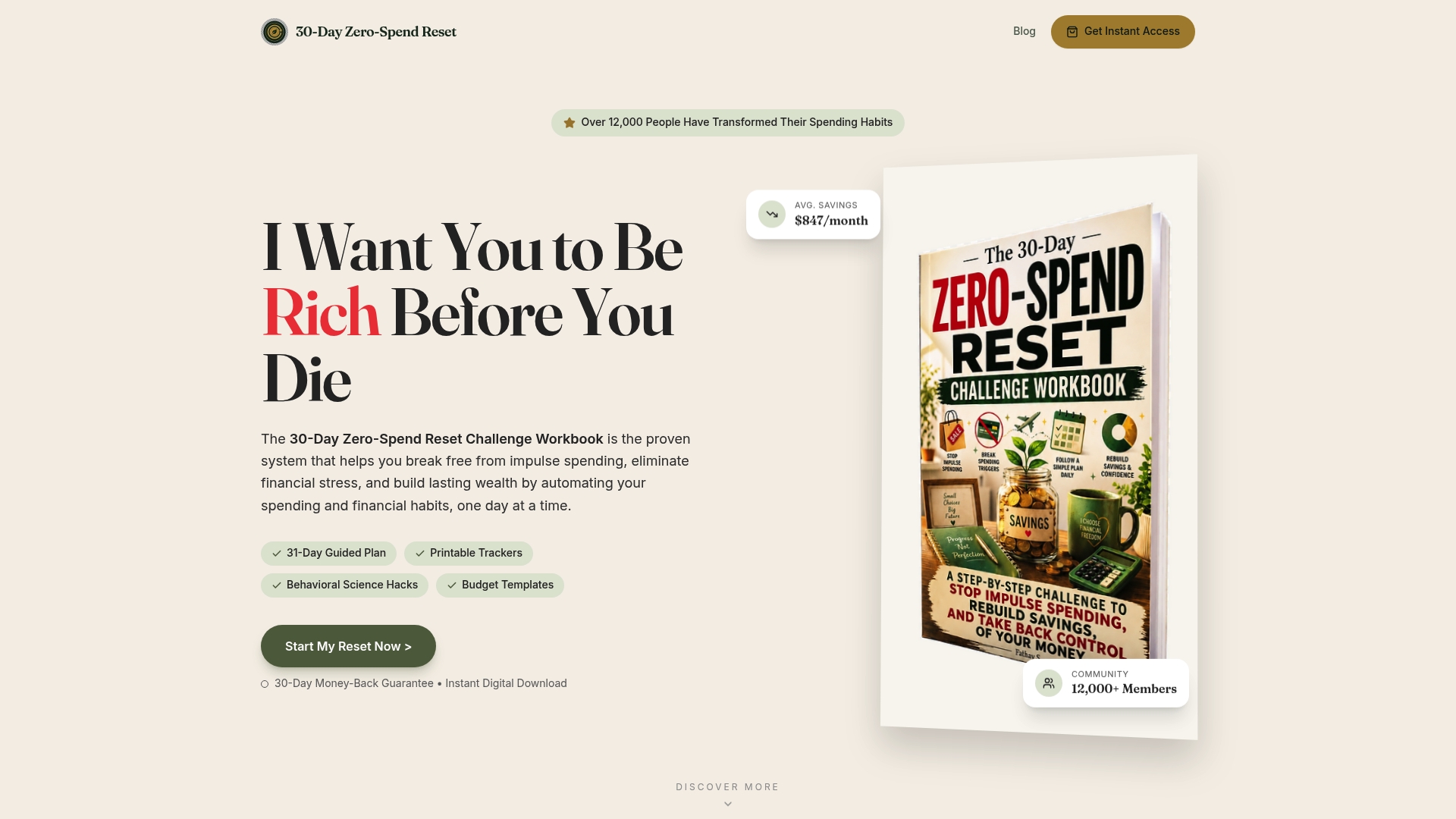
Want to go further? The Zero-Spend Accelerator Vault adds extra resources for the same goal: spending less on autopilot and keeping more of what you earn.
FAQ
How do I recover from spending too much money?
Pause flexible purchases, review your recent transactions and calculate the shortfall. Protect essentials and minimum payments, cut variable categories and unused subscriptions, then set revised limits for the rest of the month. Direct any freed cash toward high-interest debt and a small emergency cushion.
What happens if you overspend?
You may have less for necessities, an overdraft if you paid from your bank account, or credit-card interest if you paid with credit. High balances can also raise utilization and lower your credit score. Acting early keeps the cost of one expensive month from compounding.
What is the root cause of overspending?
Usually a mix of triggers rather than one thing: emotions like stress or boredom, social comparison, easy credit, targeted ads and one-click checkout. Subscription creep and untracked spending add to it quietly. Identifying your own top trigger is the most useful step, because that is the one to design around.
Should I pay off debt or rebuild savings first?
If the overspend went on a credit card, pay minimums on everything and put extra cash toward the highest-interest balance, while keeping a small starter cushion. Once that debt is gone, shift your freed-up payment to building the emergency fund. If your debt feels unmanageable, a nonprofit credit counselor can help you review options.
Sources
- How to Identify and Stop Overspending, Chase
- Know your overdraft options, CFPB
- Does an Overdraft Affect Your Credit Score?, Capital One
- How to Avoid or Break the Debt Trap Cycle, FINRED
- Frequently Asked Questions About FICO Scores
- How to recover after overspending during holidays, Ally
- Ghosting Your Money? How to Get Back on Track, NerdWallet
- How to Stop Overspending Each Month, Experian
- How to Reset Your Budget After Overspending, Smart Budgeting
- Step-By-Step Guide to Solving Financial Messes, AARP
- How to Pay Off Debt in a Year, Experian
- Americans Not Paying Bills on Time, NFCC
- What is a debt relief program?, CFPB
- How to Save Money on Monthly and Medical Bills, Food, Gas, Consumer Reports
- Inside the Psychology of Overspending and How to Stop, U.S. News
- How To Prevent Overspending with a Credit Card, Chase
- How to Stop Overspending, Arizona Central Credit Union
- How to Rebuild Your Emergency Fund, Get Wealth Calc
Recommended
Ready to reset your spending?
Get the 30-Day Zero-Spend Reset Workbook and turn these ideas into a daily action plan.
Start the 30-Day ResetThis article is part of the 30-Day Zero-Spend Reset method. Explore the complete day-by-day system behind these ideas.
Read the full guideKeep reading


Join the conversation
Be the first to share your thoughts on this article.