
Emotional Purchase Regret: Why It Hits and How to Move On

Regret after an emotional purchase is common and fixable. Learn why it happens, what to do in the first 24 hours, and how to stop repeating it.
Emotional Purchase Regret: Why It Hits and How to Move On
Emotional purchase regret is the sinking feeling after you buy something to soothe a mood, not to meet a need. It is common and it usually fades. It also carries useful information about what you were trying to fix. The way out has three parts: calm the first reaction, handle the purchase itself, then change the conditions that led to it so the next buy is a choice and not a reflex.
TL;DR
- Regret after a stress or mood purchase is normal. In one national survey, 69% of emotional spenders said they regretted acting on their emotions.
- Do not fix regret with another rushed money decision. Check your mood first and ask what need the purchase was meant to meet.
- Look at the receipt and return window today. Most online purchases have no legal cooling-off right, so the store's own policy is what counts.
- Prevent a repeat with a 24-hour wait, removed saved cards, fewer triggers in your inbox and feed, and a short written list of spending rules.
- If regret keeps recurring, treat it as a pattern and run a structured reset, not a one-off promise to "be better."
Table of Contents
- What emotional purchase regret actually is
- How common is it, and how long does it last?
- Why emotional purchases are so regret-prone
- What to do in the first 24 hours
- A regret table: what happened and what to do next
- Fixing the pattern, not just the purchase
- When regret has already become debt
- Our perspective on regret and resets
- A 30-day reset built for this exact problem
- A simple plan for your next regret-free week
- FAQ
- Sources
What emotional purchase regret actually is
Most people call it buyer's remorse. SoFi describes it as regret after buying something, often because the item cost too much, did not live up to expectations, or was bought in a way that felt rushed or misleading. It can show up as anxiety, anger, annoyance, fear or sadness, and it can start right after checkout.
The emotional version has a specific signature. You did not buy because you needed the thing. You bought because you were stressed, bored, lonely, celebrating, or trying to feel capable again. The item became a tool for changing your mood, and the mood returned as soon as the package opened (or before).
Two kinds of regret are worth separating, a distinction SoFi draws as well:
- Outcome regret: the purchase did not deliver, or another option would have been better.
- Process regret: you were rushed, pressured, or not informed enough when you decided.
Emotional purchases often produce both. The jacket does not fit the life you imagined, and you also remember clicking "buy" at 11 p.m. with a bad day behind you.
Why it feels so personal
A large part of the sting is not the money. It is the gap between how you see yourself and what you just did. Psychology Today explains that the conflict between seeing yourself as a competent decision-maker and recognizing a bad decision creates discomfort, and people try to reduce it. Some return the item. Some talk themselves into loving it. Some avoid looking at their statements.
A reader on a public forum put it well: they earn a decent income and the cost was not the issue, but the feeling of having been cheated, by the seller and by themselves, was what stayed. That is the signature of emotional regret. It is about trust in your own judgment.
How common is it, and how long does it last?
More common than most people admit:
- A Harris Poll for NerdWallet, fielded in August 2026 among 2,086 U.S. adults, found that 60% of Americans say they have spent money on something expensive and later regretted it.
- A Google and Ipsos poll of 1,358 U.S. adults found that 42% have bought something on sale and later regretted it, and 62% of those who regret a purchase said it was because they did not really need it.
- A LendingTree survey of 2,000 U.S. consumers found that 63% said emotions influenced their shopping and 74% of emotional shoppers said it led them to overspend.
So if you are asking whether it is normal to feel this way, yes.
As for duration, it scales with the stakes. According to SoFi, remorse may last moments after a small purchase and several months or longer after a major one. A 2023 Google study reported by MediaPost found that 40% of people experience guilt for up to a week. For home purchases, Redfin reports that regret usually lasts a few weeks to a few months while people settle in.
The more money, time and mental effort you invested, the harder the regret tends to hit, a point also made in the general overview of the phenomenon. That is why a $12 impulse buy stings for an hour and a $1,200 one can follow you for weeks.
Why emotional purchases are so regret-prone
Stress and bad feelings push many people toward what is often called retail therapy: shopping to cope or to regain a sense of control. Psychology Today notes that this kind of compensatory shopping can leave people less happy, because it does not address the underlying emotional issue, and shopping to repair self-esteem can lead to regret.
Research and consumer-finance guidance point to a handful of recurring patterns. NerdWallet lists these as signs of a purchase likely to be regretted: it was unplanned, made during an emotional high, hard to resell, or out of line with your lifestyle or goals.

The Google study cited above found that guilt over buying gifts for yourself (48%) and impulsivity (42%) were top reasons for remorse. A 2024 Forbes piece describes research showing that post-purchase remorse increases rumination and negative emotions and lowers satisfaction with the purchase and the shopping experience. In other words, the purchase meant to cheer you up can make the next bad mood worse.
Common emotional triggers
- Stress and exhaustion: the end-of-day order that feels like a reward.
- Boredom and scrolling: targeted ads and shoppable posts. Our piece on doomscroll shopping covers this trigger in detail.
- Celebration or "I deserve it": the splurge after a raise, a bonus or a hard week.
- Social pressure: buying to keep up, to host, or to avoid an awkward conversation.
- Sales urgency: the countdown timer that turns "maybe" into "now."
What to do in the first 24 hours
The goal for the first day is to avoid making a second emotional decision on top of the first one. Work through these steps in order.
- Pause and name the feeling. Write one sentence: "I bought this because I felt ___." Naming the trigger takes some of the shame out and tells you what you actually need.
- Check the facts. What did it cost, and where did the money come from? Was it cash flow, a credit card, or money set aside for something else?
- Find the return terms. Look at the order confirmation and the store's policy. Take screenshots and keep the receipt or confirmation email.
- Decide with a clear head. If you are unsure whether to keep it, set a short deadline inside the return window and revisit it after a night's sleep.
- Do not punish yourself with an extreme budget. Cutting everything for a week usually backfires. Make one concrete adjustment instead.
Do you have a legal right to cancel?
Often less than people assume. The FTC's Cooling-Off Rule, as explained by the Georgia Attorney General's consumer office, gives three business days to cancel certain sales made at your home, workplace or a seller's temporary location. It does not cover online, mail or telephone sales, real estate, insurance, securities or emergency purchases, and it has dollar minimums for qualifying sales. For a typical online order, your protection is the retailer's return policy and, if something was charged you did not agree to, your card issuer.
The FTC also advises checking carts and order confirmations for pre-checked boxes and unwanted add-ons, watching for auto-renewals, and keeping written proof of any cancellation. If a company keeps charging after you tried to cancel, the FTC says you can dispute the charge with your card issuer and should keep records of your request.

Big purchases deserve a budget check
Regret over a car or a home tends to come from the same two causes: spending at the top of your range and costs you did not plan for. Capital One cites a Bankrate survey in which 64% of millennial homeowners were second-guessing recent purchases, with unexpected maintenance and stretched budgets as leading reasons. If you are weighing a property, working through a framework for budgeting for a home purchase before you commit is a good way to set a monthly ceiling you can live with.
A regret table: what happened and what to do next
| Situation | What it usually means | Best next move | |---|---|---| | Small impulse buy, regret within hours | Mood-driven purchase, low stakes | Log the trigger, return if easy, move on | | Sale purchase you did not need | Urgency worked on you | Return it, then add a 24-hour wait for sale items | | Gift to yourself that left you guilty | Reward without a plan | Set a small, planned "fun" line in your budget | | Subscription you forgot | Subscription creep | Cancel, keep proof, check statements monthly | | Large purchase on credit | Process and outcome regret | Review the budget, make a paydown plan, avoid new debt |
Fixing the pattern, not just the purchase
One regretted buy is an event. Three in a quarter is a pattern, and patterns respond to design more than to willpower.
Add friction before you buy
U.S. Bank recommends a 24-hour waiting rule: put the item in the cart, walk away, and reconsider the next day. The same guidance suggests removing saved card details, unsubscribing and unfollowing, automating savings, shopping with a list, and keeping an "almost bought" journal of things you nearly purchased. That journal is especially useful, because it turns near-misses into proof that wanting passes.
Check your mood before you check out
NPR's shopping guidance suggests checking your mood and asking whether you are trying to solve an emotional problem with a purchase. It also recommends never pulling money meant for housing, groceries, transportation, credit card payments, emergency savings or vacation savings. A simple version: before paying, ask whether you are hungry, angry, lonely or tired. If yes, find another way to meet that need first.
Shrink the inbox and the feed
Many regrettable buys begin with a promotional message, not a want. Clearing the sources helps: our guide to unsubscribing from marketing emails walks through it, and writing your own spending rules gives you something to point to when a sale tries to talk you out of them. If the problem is seasonal, a post-holiday money reset can help you start clean.
Get feedback on where the money goes
The Consumer Financial Protection Bureau's research found that people who received spending feedback spent 9.6% less during the trial than those who did not, and that consumers wanted real-time information about their remaining budget. You do not need an app for this. A weekly ten-minute look at your transactions does much of the same work, especially if you tag each one as planned, needed or mood-driven. A clear spending categories list makes the tagging faster.
When regret has already become debt
The LendingTree survey found that 43% of emotional spenders had gone into debt because of emotional spending. If that is you, the answer is not shame and not another rushed move. The CFPB says emotions can produce short-term financial choices that conflict with long-term goals, and recommends a calm sequence:
- Track spending and the emotional triggers behind it, without judging yourself.
- Bring cash flow into balance and protect necessities first.
- Make a simple debt-paydown plan.
- Automate even small emergency savings.
On that last step, the CFPB's Your Money, Your Goals toolkit gives $500 as a starting goal and explains that savings reduce the need for interest-bearing borrowing in emergencies. For windfalls, NerdWallet quotes a certified financial planner who suggests covering necessities and savings before discretionary spending, then dividing extra money among savings, retirement and fun. If you are carrying card balances, our explanation of the minimum payment trap shows why paying only the minimum keeps the balance alive, and our list of expenses to cut helps free up cash for the paydown. If debt feels unmanageable, a nonprofit credit counselor or a certified financial planner can look at your whole picture.
Our perspective on regret and resets
We built our workbook around one observation: regret is rarely about the item. It is about a moment when a feeling made the decision, and no system was in place to slow it down.
That is why we do not start with a budget spreadsheet. A budget tells you where money should go. It does not tell you what to do at 10 p.m. when you are stressed and a checkout page is one tap away. Our 30-day approach uses daily behavioral challenges, printable trackers, subscription audits and scripts for money conversations so the pause becomes a habit, not an act of willpower.
We also think guilt is a poor teacher. People who feel ashamed tend to avoid their statements, and avoidance is where subscription creep and emotional spending grow. A structured reset that treats each regretted purchase as data, not as a verdict, keeps you looking and learning. Thirty days with no discretionary spending is long enough to see which wants fade and which needs were real.
If you have been telling yourself you will do better next month, give yourself a plan that does the remembering for you.
Omar
A 30-day reset built for this exact problem
If you recognize the pattern, our 30-Day Zero-Spend Reset Challenge Workbook gives you a daily system for it: structured challenges aimed at impulse buying, subscription creep and emotional spending, plus trackers, budget templates, meal planning guides and social scripts for money conversations. It is designed to build awareness of your triggers and replace them with habits, without relying on guilt or deprivation.
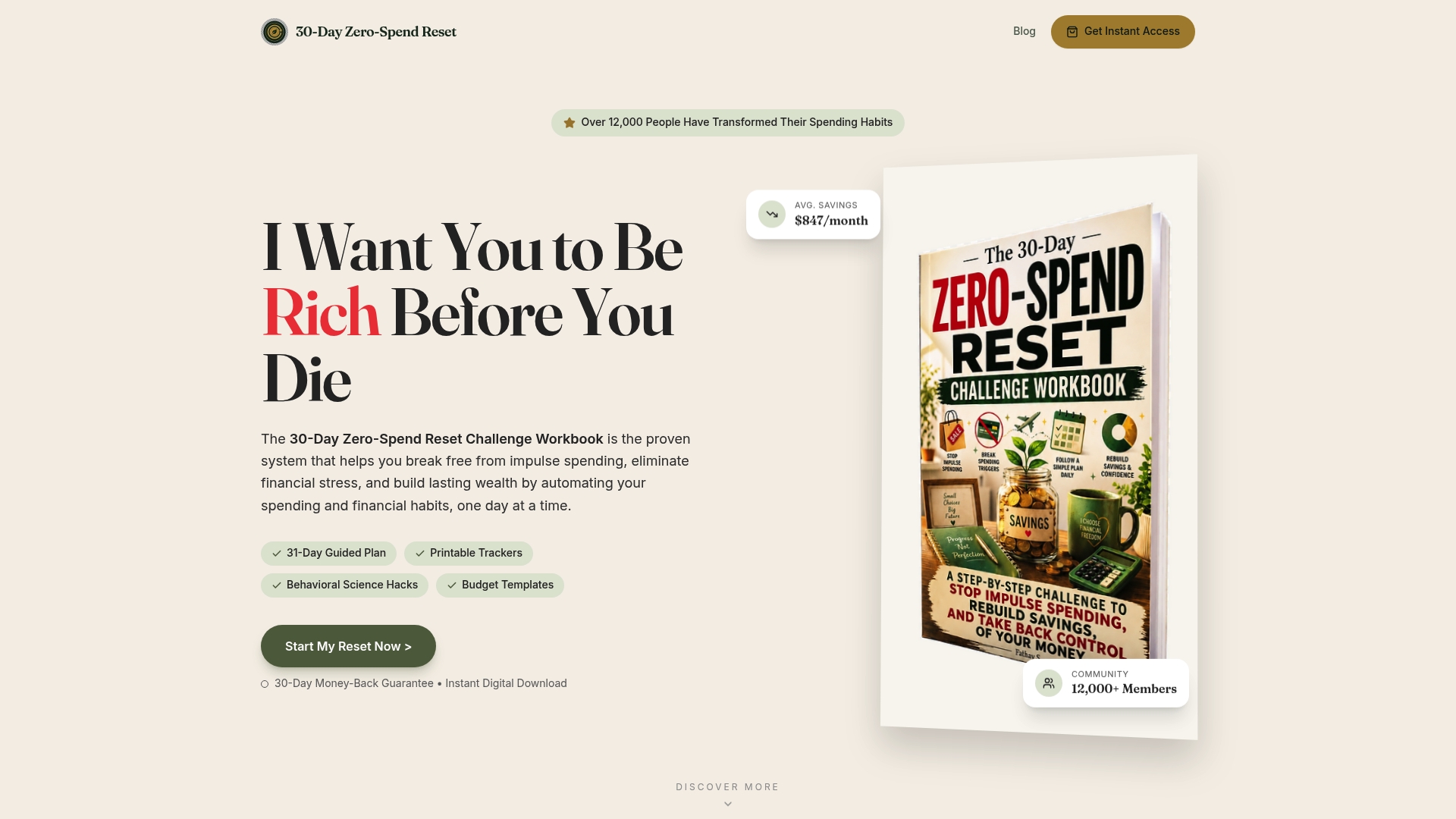
The companion webapp keeps your challenges and trackers in one place, and the Zero-Spend Accelerator Vault adds extra resources if you want to go further. Our free zero spend guide is a good place to see how the approach works before you commit.
A simple plan for your next regret-free week
You do not have to wait for a full reset to start. This week:
- Day 1: Write down your last three regretted purchases and the feeling behind each.
- Day 2: Remove saved cards from your phone and browser, and unsubscribe from five promotional senders.
- Day 3: Review your statements and cancel one subscription you do not use.
- Day 4: Start an "almost bought" note on your phone.
- Day 5: Apply the 24-hour rule to everything not on a list.
- Day 6: Set up a small automatic transfer to emergency savings.
- Day 7: Review the note. Count what you did not buy and what you would still want.
That last count is the point. Most people find that a large share of the list no longer appeals, which is the clearest evidence that the urge, not the item, was in charge.
FAQ
How do I deal with purchase regret?
Start by naming the feeling that drove the purchase, then check the return terms and keep your receipt or confirmation. If you keep the item, decide on one small change, such as a 24-hour wait. Avoid responding with a harsh budget or another rushed purchase.
What is the term for regretting a purchase?
The common term is buyer's remorse. When the regret comes from stress or mood, people also call it emotional spending regret or retail-therapy regret. Psychologists link it to cognitive dissonance, the discomfort of acting against your own view of yourself.
How long does buyer's remorse last?
It depends on the stakes. After a small purchase it may pass within hours or days, while a major purchase can bring regret for weeks or months. Redfin reports that home buyer's remorse usually fades within a few weeks to a few months.
Is it normal to regret a purchase?
Yes. A 2026 NerdWallet and Harris Poll survey found that 60% of U.S. adults regretted an expensive purchase. Occasional regret is normal. Repeated regret tied to stress, debt or forgotten subscriptions is a sign to change the system around your spending.
Sources
- What Is Buyer's Remorse? (SoFi)
- Most Americans Admit to Emotional Spending (LendingTree)
- Spending Scaries: The Financial Regrets Haunting Americans (NerdWallet)
- Many Americans have experienced buyer's remorse (Ipsos)
- Google Study Finds 75% Of Consumers Are 'A Little Upset' (MediaPost)
- Understanding Home Buyer's Remorse (Redfin)
- Buyer's remorse (Wikipedia)
- Buyer's Remorse (Psychology Today)
- The roots of retail therapy (Psychology Today)
- How to Avoid Splurge Pitfalls (NerdWallet)
- Post-purchase remorse (Forbes)
- Cooling-Off Rule explained (Georgia Attorney General)
- Pre-checked boxes and add-ons (FTC)
- How to stop subscriptions you never ordered (FTC)
- What Is Buyer's Remorse? (Capital One)
- Budgeting for a home purchase
- How to stop impulse buying (U.S. Bank)
- Should I buy it? A guide to shopping mindfully (NPR)
- Consumer insights on managing spending (CFPB)
- A financial empowerment toolkit for workers (CFPB)
- Your Money, Your Goals toolkit (CFPB)
Recommended
Ready to reset your spending?
Get the 30-Day Zero-Spend Reset Workbook and turn these ideas into a daily action plan.
Start the 30-Day ResetThis article is part of the 30-Day Zero-Spend Reset method. Explore the complete day-by-day system behind these ideas.
Read the full guideKeep reading



Join the conversation
Be the first to share your thoughts on this article.