
How to Identify Your Spending Triggers: A 7-Day Method

Learn how to identify your spending triggers in 7 days: what to log, which patterns to look for, and how to interrupt the urge before you buy.
How to Identify Your Spending Triggers: A 7-Day Method
You can identify your spending triggers by logging every unplanned purchase for one to two weeks and recording four things: where you were, what time it was, how you felt, and what happened right before. Then review your last one to three months of statements for clusters. The cue behind most impulse spending is a feeling, a place, a time of day or an app, and it shows up in your own data within days.
This guide gives you the categories to look for, a one-week tracking method, a statement audit, and ways to interrupt an urge once you can see it coming.
TL;DR
- A spending trigger is a cue (an emotion, a situation, a marketing prompt or a thought) that comes right before an unplanned purchase.
- Log each unplanned purchase with time, place, feeling, the event just before it, and how you felt afterward. Do it for 7 to 14 days.
- Cross-check with 1 to 3 months of bank and card statements. Highlight unplanned charges and note what was happening around each one.
- Once you know the trigger, pair it with a plan: a waiting rule, added friction, or an if-then replacement action.
- Watch the quiet triggers too: subscriptions that renew unnoticed and grocery trips without a list.
Table of Contents
- What a spending trigger actually is
- The main types of spending triggers
- A 7-day method to find your own triggers
- Common trigger patterns, and what they usually look like in your data
- Triggers hiding in subscriptions and groceries
- How to interrupt a trigger once you see it
- Why this matters for debt and your emergency fund
- Perspective
- Put your triggers to work with a 30-day plan
- FAQ
- Sources
What a spending trigger actually is
A trigger is the moment before the purchase, not the purchase itself. The Beck Institute describes impulse buying as often starting with an emotional trigger (stress, boredom, loneliness, excitement) or a situational one, such as seeing an ad. Justifying thoughts and easy-to-use habits then follow, like one-click checkout.
That sequence matters because it moves the problem away from "I have no willpower." You have a chain: cue, thought, action. You can break a chain once you know which link to cut.
The scale of this is large. A LendingTree survey of 2,000 U.S. consumers, run in June 2025, found that 63% of Americans say their emotions influence their purchases, and 74% of emotional shoppers say it has led them to overspend. If your spending feels out of your control, you are in very large company.
The main types of spending triggers
Sorting triggers into a few buckets makes them easier to spot. Most lists reduce to four.
Emotional triggers
America Saves lists stress or anxiety, boredom, loneliness, celebration and social pressure as common emotional spending triggers. Note that celebration is on the list. Good moods trigger spending too, which is why "I deserve this" purchases are easy to miss.
A purchase can feel like relief because of how the brain handles anticipation. SmartAsset explains that buying triggers a release of dopamine, which can become a go-to coping tool when other outlets feel out of reach. Many people feel a rush while filling a cart and a letdown or guilt after it arrives. That letdown is useful data, and we come back to it below.
Situational and environmental triggers
These are cues in the world around you: a sale notification, a store layout, a recommendation feed, payday. A 2019 meta-analysis in the Journal of the Academy of Marketing Science covering 231 samples and more than 75,000 consumers found that traits, motives, consumer resources such as time and money, and marketing stimuli all drive impulse buying. The same paper cites an estimate that about 62% of in-store purchases are made impulsively, and that online buyers are more likely to be impulsive than in-store shoppers.
Scarcity cues work especially well online. A 2021 meta-analysis in PMC reported that a 10% increase in past claims on Amazon led to a 2.08% increase in cart add-ins in the next hour.
Cognitive triggers
These are thought patterns: "it's on sale, so I'm saving money," "I've had a hard week," "it's only $12." Case Western Reserve University economist Sining Wang points to present bias, limited-time offers and the gap between your actual and ideal self as psychological drivers of impulse spending. Present bias means the reward today outweighs a bigger benefit later, which is exactly the trade you make when you skip a savings transfer for a cart full of extras.
Social triggers
The same CWRU piece notes that Instagram, TikTok and Facebook blend content with commerce through influencer endorsements, viral trends and built-in shopping features, and that social comparison can push people to copy what they see, sometimes without realizing it. If your spending spikes after scrolling, or after dinners out with certain friends, this is your bucket.
A 7-day method to find your own triggers
Generic lists only get you so far. "Stress" is too broad to act on. Your trigger is probably something narrower, like "the hour after a tense meeting, on my phone, on the couch." Here is how to get that specific.
Step 1: Log every unplanned purchase
For one week, write down each purchase you did not plan. Skip rent and your usual groceries. Capture:
- Amount and what you bought.
- Time of day and place (including which app or site).
- What was happening right before. A call, an argument, a long day, an ad.
- The feeling underneath, named in one word.
- How you felt afterward. Check again 30 minutes to a few hours later.
This follows the same structure behavior-focused writers recommend. Author Charles Duhigg, in a Get Rich Slowly article, argues that nearly every habit cue falls into five categories: location, time, emotional state, other people, and the action that came immediately before. He suggests writing all five down the moment the urge hits, so the trigger becomes visible after a few days.
Do the log in your phone's notes app, on paper, or in the printable trackers in our companion webapp. The tool does not matter. Doing it in the moment does, because memory edits the story.
Step 2: Capture the aftertaste
Most people log the purchase and stop. The after-feeling is where you learn whether spending is working as a coping tool. If you feel better an hour later, the purchase may be doing a real job, and you will need a substitute that does the same job. If you feel worse, guilt is your signal. Jackson, citing Cleveland Clinic psychologist Susan Albers, notes that feeling guilty after spending can signal buying out of compulsion rather than need.
Step 3: Audit your statements
Your log catches what you remember. Your statements catch what you forgot. SmartAsset recommends pulling bank and credit card statements from the past one to three months, highlighting the unplanned purchases, and noting what was going on in your life at the time.
When you go through them, look for four kinds of pattern:
- Time patterns: certain weekdays, paydays, or late evenings.
- Category patterns: one type of spending that always runs over, such as delivery food or online clothing.
- Emotional patterns: spikes after stressful weeks or lonely weekends.
- Chain patterns: one purchase that reliably leads to another, like a coffee run that turns into a store stop.
Use a simple list of categories so nothing hides in "miscellaneous." Our spending categories list is a good starting template. Count transactions as well as dollars: ten $8 charges are a different problem from one $80 charge.
Step 4: Name the trigger in a sentence
After a week or two, write one sentence per pattern in this form: "When I [situation/feeling] at [time/place], I [buy what]." For example: "When I finish a stressful call and open my phone on the couch after 9 p.m., I add things to a cart." That sentence is your target.
Common trigger patterns, and what they usually look like in your data
The table below turns the buckets into clues you can match against your own log and statements.
| Trigger | What it looks like in your data | First fix to try | |---|---|---| | Stress or fatigue | Takeout, online orders late in the evening or after hard days | Pre-decide a non-spending reset, such as a short walk or a call | | Boredom | Many small purchases, often in apps, at slow times of day | Delete shopping apps, add a waiting rule | | Social pressure | Spikes on weekends or after events with certain people | Plan the spending cap before you go | | Marketing and sales | Purchases right after emails, texts or push alerts | Unsubscribe and turn off notifications | | Payday | Discretionary spending bunched in the days after income arrives | Automate savings the day you are paid | | Decision fatigue | Convenience buys after long, demanding days | Plan meals and defaults ahead |
The stress and decision-fatigue rows have support in the research. Jackson describes decision fatigue as a trigger: when you are overwhelmed, you default to the easy choice, like grabbing overpriced takeout after a week of back-to-back decisions.
Triggers hiding in subscriptions and groceries
Not every trigger is a dramatic urge. Two of the most expensive are quiet.
Subscription creep
The trigger here is inattention. Chase describes the signs of subscription fatigue: surprise charges, trouble remembering what you pay for each month, services you do not use, and a feeling that spending is creeping up for no clear reason. It suggests reviewing recurring charges in your card dashboard and setting up alerts for new or increased subscription charges.
Illinois Extension adds a question worth asking about each one: would you sign up again today at the current price? It also cites research suggesting people keep paying for subscriptions they no longer value because they are not paying attention. Kiplinger flags stacked memberships, such as holding two warehouse club memberships, as a sneaky form of creep that feels justified until you do the math.
Marketing emails often feed the cycle. If promotions are a trigger for you, our walkthrough on how to unsubscribe from marketing emails removes a cue at the source.

Grocery spending
Grocery bills climb for situational reasons. AARP reports that consumer behavior analyst Phil Lempert describes stores as designed to prompt impulse purchases, and says only about one-third of end-of-aisle displays are actually on sale. His advice is to compare endcap prices with similar items in the aisle or skip endcaps entirely.
Kiplinger's advice is practical: start every trip by checking your fridge and pantry, build a loose meal plan from what you have, and shop with a list, because shopping without one leaves you open to sales and impulse buys. If kids are part of your trigger (snacks, checkout-lane requests), see our guide to grocery shopping with kids during a no-spend month.
How to interrupt a trigger once you see it
Identifying the cue is half the work. The other half is a planned response, made in advance, when you are calm.
Ride out the urge
The Beck Institute recommends urge surfing: notice and label the urge, rate its intensity from 1 to 10, and watch it over the next 10 to 15 minutes as it peaks and recedes. Most urges are shorter than they feel.
Write an if-then plan
Beck Institute specialist Deborah Beck Busis says impulse buying is not a failure of willpower but usually a sequence of events, and recommends if-then plans written ahead of time. Her example: if you are tempted to browse online when bored, first take a 10-minute walk, then call a friend. Build one for each trigger sentence you wrote in step 4.
Add a waiting rule
U.S. Bank recommends a 24-hour rule, not saving card details on sites, unsubscribing from retailer emails, and automating savings transfers. SmartAsset suggests a 24-hour or 72-hour rule for non-essentials, plus deleting shopping apps. UNFCU uses a 48-hour version: note the item, wait, and use the time to compare prices or look for a coupon. Pick the length that matches the purchase size. A longer wait suits bigger items.
Give your money a job
America Saves also recommends tracking triggers in a journal, low- or no-cost alternatives, and savings goals, and celebrating progress without spending. A goal with a name and a number ("$1,000 starter emergency fund") gives you something to weigh a purchase against in the moment.
Why this matters for debt and your emergency fund
Triggers are not a small leak. In the LendingTree survey, 43% of emotional spenders said they had gone into debt because of emotional spending, 69% had regretted acting on their emotions while shopping, and 44% said it hurt their financial well-being.
If you are carrying card balances, every trigger purchase you remove becomes money you can aim at the balance. Once you know where the cash is leaking, a clear payoff plan comes next, and this step-by-step plan to pay off credit card debt walks through the repayment options. Also read why paying only the minimum keeps you stuck. For savings, the same freed-up dollars can fund an emergency cushion, which in turn reduces the stress that triggers spending in the first place.
If the holidays are your trigger season, our post-holiday money reset shows how to regroup afterward, and our list of expenses to cut can help you decide what to trim first.

If spending feels compulsive, or guilt and distress around money are heavy, talk with a licensed therapist or your doctor. Self-tracking is a good first step, but it does not replace professional care.
Perspective
We built the Zero-Spend Reset around one idea: you do not need more willpower, you need better information about yourself. Most budgeting tools start with categories and limits. We start with the moment before the purchase.
That is why the first days of the program are about noticing. When you run daily challenges for 30 days, a trigger has nowhere to hide. The late-night cart, the subscription you forgot, the grocery run without a list: each shows up as a pattern you can name, and then retrain.
Our approach rests on behavioral psychology, and it is designed to work without guilt or deprivation. You are not being told to feel bad about spending. You are learning what your spending is trying to do for you, and giving it a better way to do it.
Omar
Put your triggers to work with a 30-day plan
A week of tracking gives you a map. A structured month gives you new habits to follow it. The 30-Day Zero-Spend Reset Challenge Workbook pairs daily behavioral challenges with printable trackers, budget templates, subscription audits, meal planning guides and social scripts for money conversations. It also comes with a private webapp. It is built for people dealing with impulse buying, subscription creep, emotional spending and the stress that comes with debt.
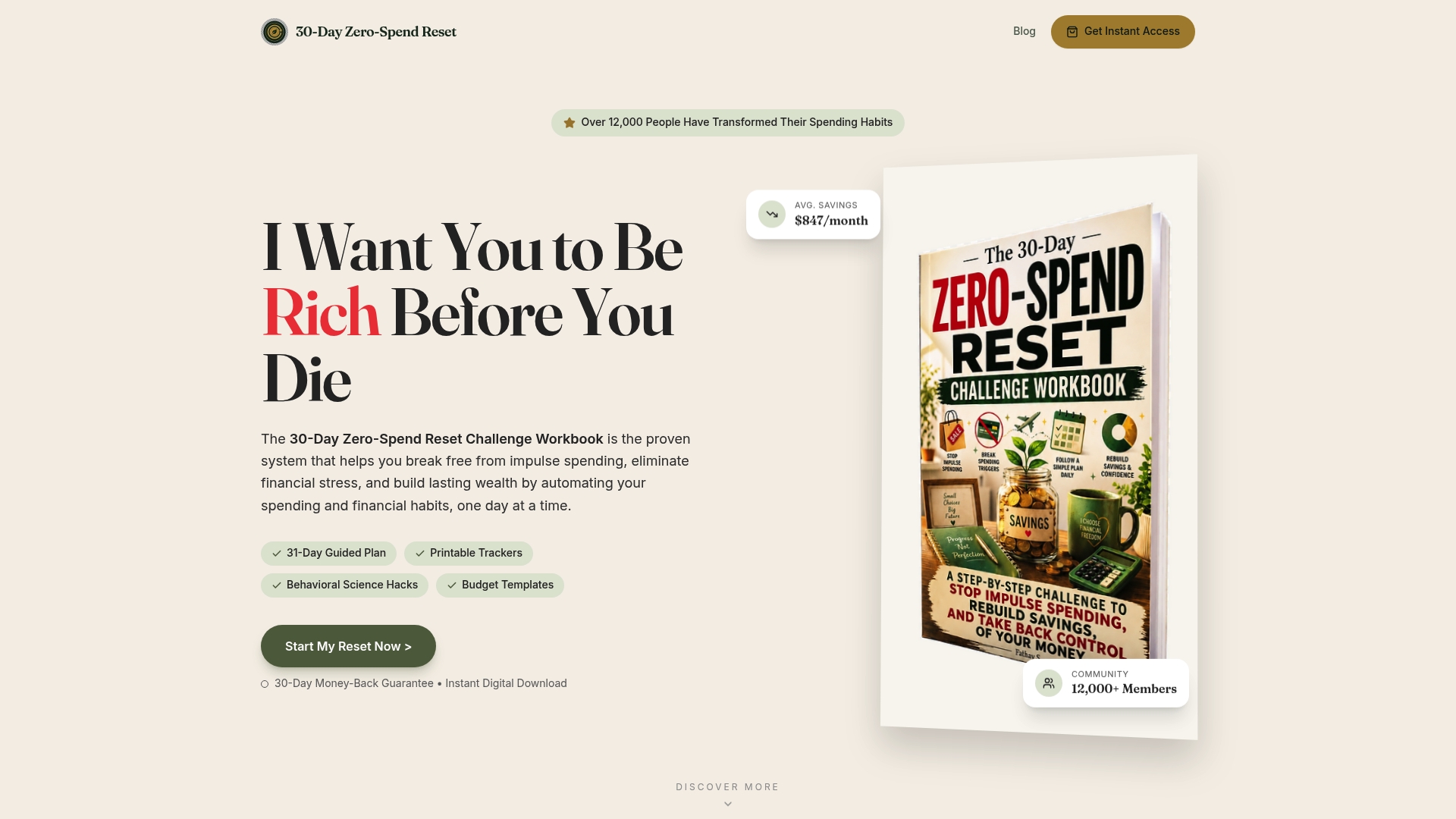
Users have reported saving an average of $847 per month. For extra tools, the Zero-Spend Accelerator Vault adds more resources to build on your reset.
FAQ
How long does it take to identify spending triggers?
Expect a first pattern within a week if you log every unplanned purchase with its time, place, feeling and preceding event. A statement review covering one to three months can show recurring clusters right away. Many people refine their triggers over two to four weeks, as the pattern gets more specific than a general label such as stress.
What are the most common spending triggers?
The most common emotional triggers are stress or anxiety, boredom, loneliness, celebration and social pressure. Situational ones include sales, payday, saved payment details and shopping apps. Many people also have one or two personal triggers, such as a certain time of night or a particular store.
Can I identify triggers without a budgeting app?
Yes. A notes app, a notebook or a spreadsheet is enough, and SmartAsset notes that any of these works for logging purchases. What matters is recording the context at the moment of the urge, not the tool you use.
What should I do the moment I feel the urge to buy?
Name the urge, rate it from 1 to 10 and wait 10 to 15 minutes to see it peak and fade. Then apply your waiting rule, such as 24 hours, before checking out. If you have an if-then plan for that trigger, follow it first.
Do subscriptions count as spending triggers?
They can. A free trial, a renewal reminder or a promotional email is a cue, and forgotten charges are a form of inattention. Review recurring charges in your card dashboard and ask whether you would sign up again today at the current price.
Sources
- Beck Institute: Break the Impulse Buying Habit with CBT
- LendingTree: Most Americans Admit to Emotional Spending
- America Saves: 6 Ways to Break the Emotional Spending Cycle
- SmartAsset: Emotional Spending: Triggers and Strategies to Stop It
- Journal of the Academy of Marketing Science: Impulse buying, a meta-analytic review
- PMC: A Meta-Analysis of Online Impulsive Buying
- Case Western Reserve University: Why is impulse spending so tempting?
- Jackson: Emotional spending, who does it affect most?
- Get Rich Slowly: How to change your spending habits
- Chase: Managing Subscription Fatigue
- Illinois Extension: Time to check your subscription services
- Kiplinger: 7 Grocery Shopping Habits That Are Costing You Money
- AARP: Grocery Store Tricks That Get You to Spend More
- U.S. Bank: How to stop impulse buying
- UNFCU: Seven ways to overcome impulsive spending habits
Ready to reset your spending?
Get the 30-Day Zero-Spend Reset Workbook and turn these ideas into a daily action plan.
Start the 30-Day ResetThis article is part of the 30-Day Zero-Spend Reset method. Explore the complete day-by-day system behind these ideas.
Read the full guideKeep reading



Join the conversation
Be the first to share your thoughts on this article.