
Budgeting Without Apps: A Pen-and-Paper Guide That Works

Learn how to budget without apps using pen and paper: track a month of spending, build a simple plan, use cash envelopes, and keep it going.
Budgeting Without Apps: A Pen-and-Paper Guide That Works
You can budget without apps with a notebook, a pen and about an hour to start. Write down your after-tax income, track every dollar you spend for a month, group the spending into categories, and compare the totals. That one month of honest numbers becomes the plan for the next.
This guide walks through the full process, then shows the no-app methods that help most with impulse buys, forgotten subscriptions and high grocery bills. It also covers where debt payments and an emergency fund fit on the page.
TL;DR
- Start with one month of tracking: income after taxes on top, every expense below it, grouped by category.
- Use the totals to build next month's budget. If spending is higher than income, you have found the lines to cut.
- Cash envelopes, a 24-hour wait and a pocket notebook slow down impulse and emotional spending.
- Put one evening a month on your calendar to compare the plan with what really happened.
- Cover a starter emergency fund first, then high-interest debt, and keep building from there.
Table of Contents
- Why paper works when apps don't
- What you need before you start
- Step-by-step: build your first paper budget
- Three no-app methods and who they suit
- Find the money: subscriptions and groceries
- Where debt and an emergency fund fit
- Keep it going: the monthly reset
- Our perspective on paper budgeting
- Ready for a structured 30 days?
- Common mistakes to avoid
- FAQ
- Sources
Why paper works when apps don't
Most people who drop a budgeting app do not fail at math. They fail at attention. Notifications get ignored, bank connections break, and the numbers become something the app knows and you don't.
Paper reverses that. You have to write the number, and writing makes you look at it. Financial coach Alaina Fingal told CNBC that writing numbers down and seeing them in real time can make priorities resonate and help clients stick with a budget. That is the real advantage: the friction is the feature.
Paper also means no account to register, no login to forget and nothing to cancel later. Your notebook has no subscription fee.
What you need before you start
Keep the kit small, or you will spend the first week shopping for supplies:
- A notebook or a few printed worksheets. The FTC's Make a Budget worksheet is a free, printable starting point.
- A pen, and a calculator if you want one.
- A small envelope or container for receipts. The CFPB's spending tracker recommends exactly this.
- Your last one to three months of bank and card statements.
- About an hour in a quiet place. SavvyMoney's education team suggests starting with a one-hour review of your financial statements.
Step-by-step: build your first paper budget
Step 1: List your income after taxes
At the top of the page, write every source of income you actually receive: paychecks, side income, benefits, child support. Use the after-tax amount, the money that lands in your account. The Make a Budget worksheet asks for after-tax paychecks and other after-tax income for this reason.
If your income varies, use your lowest recent month as the working number. Anything above it becomes a bonus you assign later.
Step 2: Separate fixed bills from everything else
When you define your budget, it helps to distinguish regular fixed expenses from other spending. Fixed costs are the ones that barely move: rent or mortgage, insurance, loan payments, phone. Variable costs are the ones you control day to day: groceries, dining out, gas, shopping, entertainment.

Write the fixed list first, with the due date next to each bill. Timing matters. The CFPB warns that if bills and income do not line up, you could come up short at the end of the month even when the monthly totals look fine.
Step 3: Handle the bills that don't come monthly
Car registration, annual subscriptions, holiday gifts and insurance premiums paid twice a year are the usual budget wreckers. Certified financial planner Sara Zuckerman notes that tracking both monthly and annual numbers is essential for categories with different billing periods.
The practical version: write the yearly total, divide by 12, and treat that amount as a monthly line. Move it into a separate envelope or savings account when you get paid, so the bill is already covered when it arrives.
Step 4: Track every dollar for one full month
This is the step that changes things. Keep receipts in an envelope. When there is no receipt, write the amount and what you bought on paper. Then total by category each week and again at month's end, as the CFPB spending tracker describes.
Why a full month and not a week or two? The CFPB says a month can reveal small purchases that add up, spending that does not match your priorities, and room to save for emergencies and goals.
A simple page layout:
| Date | What I bought | Amount | Category | Need, want or impulse? | |---|---|---|---|---| | Oct 3 | Groceries | $86.40 | Food | Need | | Oct 4 | Coffee and pastry | $7.25 | Food out | Want | | Oct 6 | Phone game purchase | $4.99 | Entertainment | Impulse |
The last column is optional, but it is where the insight lives. By week three you will see a pattern without anyone telling you.
Step 5: Total it and compare
Add up each category, then subtract total spending from total income. The CFPB's monthly budget tool uses this paper-friendly flow: list income, list expenses by category, total spending, subtract.
The Make a Budget worksheet says to use this month's information to plan next month, and to look for expenses to cut if expenses exceed income. If you came out ahead, decide on purpose where the leftover goes, before it disappears into the grocery run.
Step 6: Write next month's plan
For each category, write a target next to last month's actual. Be realistic. A plan that cuts groceries in half after a month of spending twice the target will collapse by day ten. Trim in steps, and put your biggest cuts where you found the most waste.
Three no-app methods and who they suit
Once you have the basic ledger, you can layer on a method that matches how you spend.
| Method | How it works | Best for | |---|---|---| | Cash envelopes | Withdraw cash for problem categories and spend only what is in the envelope | Groceries, dining out, shopping | | Kakeibo | Journal income and spending, with notes on how each purchase felt | Emotional or impulse spending | | Give every dollar a job | Plan each paycheck before it arrives | Tight months and uneven income |
Cash envelopes
Fingal recommends cash envelopes for categories prone to overspending, plus a small notebook to record daily purchases for later comparison with the budget. The CFPB adds that using cash for variable spending can help you avoid borrowing for emergencies.
Don't envelope everything. Pick one or two leaks, usually food out and "miscellaneous." If your bank offers digital sub-accounts, you can copy the same idea without carrying cash; our post on zero-based budgeting and the envelope system with digital banking shows how.
Kakeibo
Kakeibo is a Japanese notebook method. You physically write down income and outgoing money and reflect on your emotional state and whether a non-essential item is truly needed, as CNBC describes. One tactic from the method: take out a set amount of cash for the week and wait 24 hours before buying a non-essential item.
That 24-hour rule is the cheapest impulse-control tool there is. Write the item and the price in the margin. If you still want it tomorrow, buy it without guilt. Most of the time the urge has faded.

Giving every dollar a job
Before each payday, write the amount and assign all of it: bills, food, gas, debt, savings, a small fun line. When nothing is left unassigned, there is nothing to leak.
Find the money: subscriptions and groceries
A paper review is excellent at catching small recurring charges, because you are reading line by line instead of scrolling past them.
Run a subscription audit
Go through your statements and mark anything recurring. SavvyMoney suggests looking for obvious places to cut, such as streaming services you barely use or have forgotten about. The St. Louis Fed adds that you should list bills and automated payments, review how much you use each subscription and what it costs, and check for benefits or alternatives that could lower costs.
For each subscription, write three things: the monthly cost, the last time you used it, and keep or cancel. Annual charges get divided by 12 so they show their true weight. Reading up on the subscription settlement guide for 2026 can also help you spot services that have been in legal disputes before you decide what to keep. And if marketing emails keep triggering purchases, our walkthrough on how to unsubscribe from marketing emails closes that door.
Bring the grocery line down
Groceries are usually the largest flexible category, which makes them the best place to practice. The CFPB's expense-cutting tool suggests joining family or friends to buy in bulk when the per-serving cost is lower. The FTC's consumer education lesson names coupons, comparison shopping and self-restraint as ways to save when you shop.
A few paper habits that make this stick:
- Write the week's meals before you write the shopping list.
- Check the pantry and freezer first, and cross off what you already own.
- Set the grocery envelope amount before you walk in, and keep a running tally on the list.
- Shop once a week, not daily. Every trip is a chance to spend.
Parents will find more in our guides to grocery shopping with kids during a no-spend month and a freezer meal plan.
Not sure what else belongs on the chopping block? Our list of expenses to cut and a spending categories list give you ready-made labels for your ledger.
Where debt and an emergency fund fit
A paper budget shows you what is left after bills. Deciding what to do with it is the harder part. NerdWallet lays out a common order: build a starter emergency fund of at least $500, then consider capturing a 401(k) match, pay off high-interest debt, save for retirement, and grow the emergency fund toward three to six months of basic living expenses.
On paper, that becomes a simple ladder at the bottom of your budget page. Each month you write one line for the starter fund, one for debt above the minimums, and one for the next rung. When the starter fund is full, the line moves.
If minimum payments are eating your budget, read about the minimum payment trap. Anyone behind on payments or facing collections should speak with a nonprofit credit counselor, who can look at the whole picture with you.
Keep it going: the monthly reset
The budget that works is the one you revisit. Set aside one evening each month to update your budget and compare it with actual spending.
The CFPB's financial planning worksheet offers a clean format: compare last month's actual income and expenses with this month's expected income and planned expenses, set spending targets, and calculate what remains for a goal.
Your monthly evening can follow this checklist:
- Total each category and compare it with the target.
- Circle the two biggest misses and write one reason for each.
- Adjust next month's targets, up or down, to match reality.
- Move money to the emergency fund or debt line.
- Check the calendar for annual bills in the next 60 days.
After a holiday or a big life change, do a fresh reset instead of patching the old plan. Our post-holiday money reset gives you a template.
Our perspective on paper budgeting
Paper gets you started, but starting isn't where people struggle. The trouble shows up around day nine, when the novelty is gone, a stressful day arrives and a purchase feels like relief.
That is why we built our approach around daily behavior and not around a bigger spreadsheet. A budget tells you what you planned. A daily challenge changes what you do at the moment of temptation. Our program is designed to use behavioral psychology principles so you are not relying on willpower or guilt to get through it.
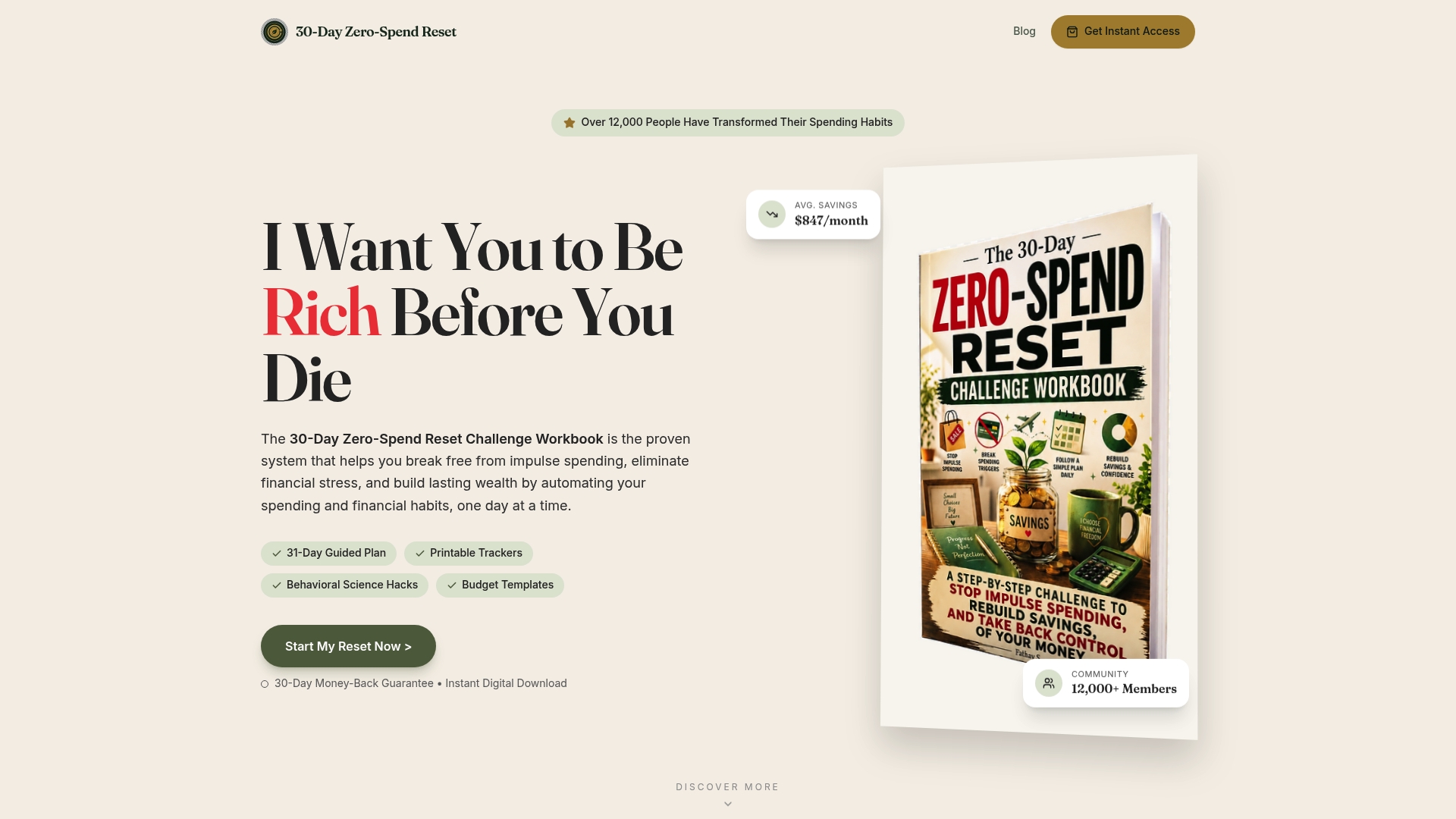
Our 30-Day Zero-Spend Reset Challenge Workbook pairs structured daily challenges with printable trackers, budget templates, subscription audits, meal planning guides and social scripts for awkward money conversations. We think the best use of a no-app budget is as a launchpad: one focused month where you cut the leaks, see the numbers and build the habits, so the ordinary budget that follows is easy to keep.
Paper is where the awareness begins. A system is what keeps it going.
Omar
Ready for a structured 30 days?
If you want the paper method with the daily structure built in, the 30-Day Zero-Spend Reset Challenge Workbook gives you one challenge a day, printable trackers and budget templates, plus a companion webapp. It is made for people dealing with impulse spending, subscription creep, emotional spending and grocery bills.
Want to go further? The Zero-Spend Accelerator Vault adds extra resources, and our zero spend guide explains how the month works.
Common mistakes to avoid
- Tracking only part of your spending. Cash and small card swipes are the ones that go missing, and they are the ones that matter.
- Making categories too detailed. Ten to fifteen categories are enough. Our spending rules list can help you pick a few guardrails instead of a hundred lines.
- Setting targets for a different life. Use actual numbers from last month, then trim.
- Skipping the monthly review. The notebook only works if you open it.
- Swinging to extreme frugality. If a tight month leaves you feeling deprived, read how to overcome a scarcity mindset after frugality.
FAQ
Is pen-and-paper budgeting better than using an app?
It depends on you, but paper suits people who ignore notifications or dislike linking bank accounts. Writing each number by hand keeps you aware of it, which is the main reason coaches recommend it. If you prefer a digital format later, the same categories and routine carry over.
How long should I track spending before making a budget?
Track one full month. The CFPB says a full month can reveal small purchases that add up, which a week or two can miss. You can write a rough plan right away, but treat it as a draft until the month is done.
What if my income changes every month?
Build the budget on your lowest recent month and assign any extra when it arrives. Write out your fixed bills with their due dates so you can see which paychecks cover which bills. Review the plan at your monthly evening and adjust.
What is the simplest way to stop impulse buying without an app?
Use a 24-hour wait for non-essential purchases. Write down the item and price, and decide tomorrow. Pairing that with a weekly cash amount for your problem category keeps the limit visible.
Sources
- Make a Budget worksheet, Consumer.gov
- Spending tracker tool, CFPB
- Budgeting: How to create a budget and stick with it, CFPB
- Monthly budget tool, CFPB
- Budgeting Old School: How to Set Up a Budget Without Using an App, SavvyMoney
- Why this financial coach tells clients to budget with pen and paper, CNBC
- Kakeibo: How this Japanese budgeting system made me richer, CNBC
- Your Money, Your Goals financial empowerment toolkit, CFPB
- 20 Ways to Plug Leaks in Your Household Budget, St. Louis Fed
- Cutting expenses tool, CFPB
- Saving Money When You Shop lesson plan, Consumer.gov
- How to Make a Budget: A Step-By-Step Guide, NerdWallet
- My new money goal worksheet, CFPB
- Subscription Settlement Guide for 2026, ClaimCow
Recommended
Ready to reset your spending?
Get the 30-Day Zero-Spend Reset Workbook and turn these ideas into a daily action plan.
Start the 30-Day ResetThis article is part of the 30-Day Zero-Spend Reset method. Explore the complete day-by-day system behind these ideas.
Read the full guideKeep reading


Join the conversation
Be the first to share your thoughts on this article.