
Cancel Subscription Script: Word-for-Word Phone, Chat and Email

Copy-and-paste cancel subscription scripts for phone, chat and email, plus what to say to retention offers and how to stop charges that keep coming.
Cancel Subscription Script: Word-for-Word Phone, Chat and Email
The fastest way to cancel a subscription is to know exactly what you will say before you reach the company. Below are ready-to-use scripts for a phone call, a live chat and an email, plus the lines that shut down retention offers and the steps that protect you if the charges keep coming.
TL;DR
- Find the real biller first. A charge on your statement may come from Apple, Google or the company itself, and each path is different.
- Say one clear sentence: you want to cancel, you do not want a discount, and you want written confirmation.
- Keep proof: a screenshot, a confirmation email, or the date, time and name of the representative.
- Watch your statements after canceling. If charges continue, dispute them with your card issuer.
- Do not count on a federal click-to-cancel rule to help you. Its status has been in doubt, so rely on your paper trail.
Table of Contents
- Before you contact anyone: find the right company to cancel with
- Why a script helps at all
- Phone cancellation script
- Live chat script
- Email cancellation script
- How to answer the retention offers
- What if the company makes it hard to cancel?
- Confirm it worked: the 60-day check
- If you are charged after canceling
- A weekend subscription audit that makes the scripts useful
- Our perspective: canceling is a habit problem, not a paperwork problem
- Turn canceled subscriptions into a 30-day reset
- FAQ
- Sources
Before you contact anyone: find the right company to cancel with
Most failed cancellations start with contacting the wrong party. You email a streaming service when the charge actually runs through your phone's app store, or you cancel a free trial but never the paid plan behind it.
Start with your records. Consumer Reports suggests reviewing credit-card statements from the past year for recurring payments, then checking the subscription lists in your Apple App Store and Google Play accounts. A year matters because annual renewals hide easily: a charge that hits once every twelve months will not show up in a quick scan of last month's statement.
Write down four things for each subscription you plan to cancel:
- The company name exactly as it appears on the statement
- The amount and how often it is billed
- The email address or username on the account
- The payment method used (which card, or which bank account)
That short list is what you will read from in every script below. It also keeps you from rambling on a call and gives a representative no excuse to say they cannot find your account.
If the charge comes through Apple
When a subscription was bought through Apple, the company itself often cannot cancel it for you. Apple's support page says to use your Apple Account subscriptions list, and if you cannot find the subscription there, to search your email for an Apple receipt or check your bank or card statement to see which company bills you. If there is no Apple receipt, the billing company is the one to contact.
So before you write a single email, open your subscription settings on the phone or computer you used when you signed up. If the service is listed, cancel there and you are done with the scripts. If it is not, the company bills you directly, and the scripts below apply.

Why a script helps at all
Companies that make you phone or chat to cancel are counting on a few things: that you will feel awkward, that you will accept a discount to end the conversation, or that you will give up after being transferred twice. A script removes the awkwardness. You decide the outcome in advance, and every line you say moves toward it.
Three principles sit under every script on this page:
- One request, repeated. You want to cancel. You do not need to explain why.
- No negotiation unless you choose it. You can accept a retention offer, but only deliberately and with a reminder set.
- Leave with proof. A cancellation you cannot document is a cancellation you may have to repeat.
Phone cancellation script
Call from the number tied to your account if you can, and have your list in front of you. Keep your tone calm and friendly. The representative is rarely the person who designed the obstacle course.
Opening
Hi, I’d like to cancel my subscription. The account is under [your name], email [your email]. Can you confirm you can help me with that?
If they ask why you are leaving
I’d rather not go into it. I just need to cancel today, please.
If they offer a discount or a pause
Thank you, but I’m not interested in any offers. Please cancel the subscription completely.
If they transfer you or say you must cancel online
I’d like to cancel on this call. If that isn’t possible, can you tell me the exact steps and confirm that nothing will be charged while I do them?
Closing, before you hang up
Can you please confirm the cancellation is complete, tell me the date of my last charge, and email me a confirmation? May I have your name and a reference number?
Write down the date, the time, the representative's name and any reference number while they are still on the line. U.S. PIRG recommends keeping signup emails, cancellation screenshots, and notes on the date, time and representative for phone cancellations. If you do nothing else, do this.
Live chat script
Chat is often easier than a phone call because you can copy and paste, and the transcript is your proof. Paste your first message instead of typing it live.
First message
Hello, I want to cancel my subscription. Account email: [your email]. Name: [your name]. Please process the cancellation and confirm the final billing date.
If the agent pushes an offer
I appreciate it, but I’m not interested. Please proceed with the cancellation.
If the agent asks you to call or visit a page
Please send me the direct link to the cancellation page, or cancel it from your side. I’d like this handled in this chat.
Before you close the window
Please email me the cancellation confirmation and the transcript of this chat.
If the chat tool has no transcript option, take screenshots of the whole conversation, including the timestamp and the agent's name.
Email cancellation script
Email suits subscriptions with no online cancel button, and it works as a backup after a phone call. It gives you a dated record, which matters most if a dispute follows. A good cancellation email does a few things, which is also the pattern Maestro Labs' cancellation email guide describes: a subject that identifies the subscription, your name and account details, a plain request to cancel, and a request for confirmation that they received it and canceled.
Here is a template you can use almost unchanged.
Subject: Cancellation request: [Service name] account, [your email]
Hello,
I am writing to cancel my [Service name] subscription, effective immediately.
Name on account: [your name] Account email: [your email] Account or customer number (if any): [number] Plan and price: [for example, monthly plan, $X per month]
Please cancel the entire subscription, not only the payment method, and stop all future charges. Please reply to confirm that you received this request, that the subscription has been canceled, and the date of my last charge.
If I do not receive confirmation within [five] business days, I will dispute any further charges with my card issuer.
Thank you, [Your name]
That middle line, canceling the whole subscription and not only the payment method, is not decoration. The Consumer Financial Protection Bureau recommends following a phone call with a written letter or email that makes clear whether you are canceling the contract or only the payment method. Those are two different things, and a company may treat them differently.
A shorter version for a follow-up
If you already called and want a paper trail, keep it brief:
Hello, I called on [date] at [time] and spoke with [representative name] to cancel my subscription under [your email]. Please confirm in writing that it has been canceled and that no further charges will be made.
How to answer the retention offers
Expect at least one offer. It may be a few months at half price, a free pause, or a cheaper plan. Some are genuinely good. The trap is accepting one by reflex and then forgetting about it.
Use this quick test:
| Situation | What to say | |---|---| | You have not used the service in 60 days | “No thank you, please cancel completely.” | | You use it, but the price feels too high | “I’ll consider a lower price. Please tell me the exact amount, the end date, and what it renews at.” | | You might want it later | “Please cancel now. I’ll sign up again if I need it.” | | The agent keeps repeating the offer | “I understand. I’m declining, and I need the cancellation processed now.” |
If you do accept a discount or a free extension, Consumer Reports advises setting a reminder before the promotion ends, so it does not quietly roll into the full price. Put the date in your calendar before you end the call, and make the reminder a week early so you still have time to cancel.
Here is the point most people miss: a discount on something you do not use is still spending. A $6 monthly charge is $72 a year for a service you may not open. Ask yourself whether you would sign up today at that price. If not, cancel.
What if the company makes it hard to cancel?
The frustration is real, and the legal picture has been shifting. The Federal Trade Commission announced a final “click-to-cancel” rule on October 16, 2024, which required clear disclosure of material terms, express informed consent and a simple way to cancel that halts charges immediately. The Federal Register notice set May 14, 2025 as the compliance date for key provisions.

That is not the end of the story. U.S. PIRG reports that a court blocked the rule in July 2025, so you should not assume it is enforceable today. Do not quote it to a representative as though it settles the matter. Your best protection is practical: a clear request, a record of it, and a willingness to dispute charges. Some state laws on automatic renewal may also apply to you, so check your own state's rules.
If a company refuses or stalls, a useful line is:
I’ve asked to cancel and I’m documenting this request. If I’m charged again, I’ll dispute it with my card issuer and file a complaint with the FTC and my state attorney general.
PIRG recommends complaining to both the FTC and your state attorney general when cancellation problems occur. Say it calmly. It signals that you are organized, which is often enough.
Confirm it worked: the 60-day check
A confirmation email is good. A clean statement is better. The FTC's consumer advice is to identify the company, follow its cancellation instructions, keep copies of your request and notes from any conversations, and then monitor your bank and card statements for charges after the cancellation.
A simple routine:
- Save the confirmation email, chat transcript or screenshot in one folder.
- Add a note to your calendar for the day after the next billing date.
- On that day, check your statement. No charge means you are done.
- For annual plans, add a reminder a few weeks before renewal in case you ever re-subscribe. PIRG recommends calendar reminders ahead of annual renewals.
If you are charged after canceling
Do these in order. Each step builds on the one before it.
- Contact the company once more with your cancellation record attached. Ask for a refund of the charge made after your request.
- Dispute the charge with your credit or debit card company. The FTC advises disputing continued charges with the card issuer or bank and preserving letters, notes and emails.
- Revoke authorization if the company draws directly from your bank account. The CFPB says you may revoke permission for automatic payments from your account, even if you authorized them earlier.
- Notify your bank in writing. The CFPB recommends separately telling your bank or credit union in writing that you revoked authorization. Later payments the company initiates may then be errors for which you can seek a refund.
- Report the problem to the FTC and your state attorney general.
A short note to your bank can read:
I revoked authorization for [company name] to withdraw payments from my account on [date]. Please stop all further payments to this company. I am attaching my cancellation request. Please treat any later payments as unauthorized.
A weekend subscription audit that makes the scripts useful
Scripts work best when you cancel in a batch. One sitting beats a trickle of reluctant cancellations over months.
- Pull 12 months of statements from every card and bank account.
- Highlight every recurring charge, including the tiny ones and the annual ones.
- Sort into three piles: use weekly, use rarely, forgot it existed.
- Cancel the third pile first. It is the easiest win and the money is pure savings.
- Make the second pile earn its place. If you cannot name the last time you used it, cancel it and re-subscribe later if you miss it.
- Total the monthly and yearly cost of what you canceled, and move that amount into savings or toward debt the same day.
That last step is where most people lose the gain. The money you stop spending will drift back into the checking account and disappear into everyday spending unless it is given somewhere to go.
Our perspective: canceling is a habit problem, not a paperwork problem
We see the same pattern again and again. People know how to cancel a subscription. What stops them is friction at the moment of decision: an uncomfortable call, a clever offer, a vague plan to do it later. Subscriptions are designed to survive on exactly that hesitation.
The fix is to remove the decision from the moment. Decide in advance what you will cancel, write the sentence you will say, and set a time to do it. That is why we build the daily steps in our workbook around small, specific actions instead of willpower. A subscription audit on day one, a script for the call on day two, and a statement check a month later turns a vague intention into a finished job.
We also think the goal is not to feel guilty about past subscriptions. Everyone signs up for something they later forget. The point is to build a system where forgetting costs you less, and where each canceled charge becomes money pointed at something you chose: an emergency fund, a debt payment, a goal.
, Omar
Turn canceled subscriptions into a 30-day reset
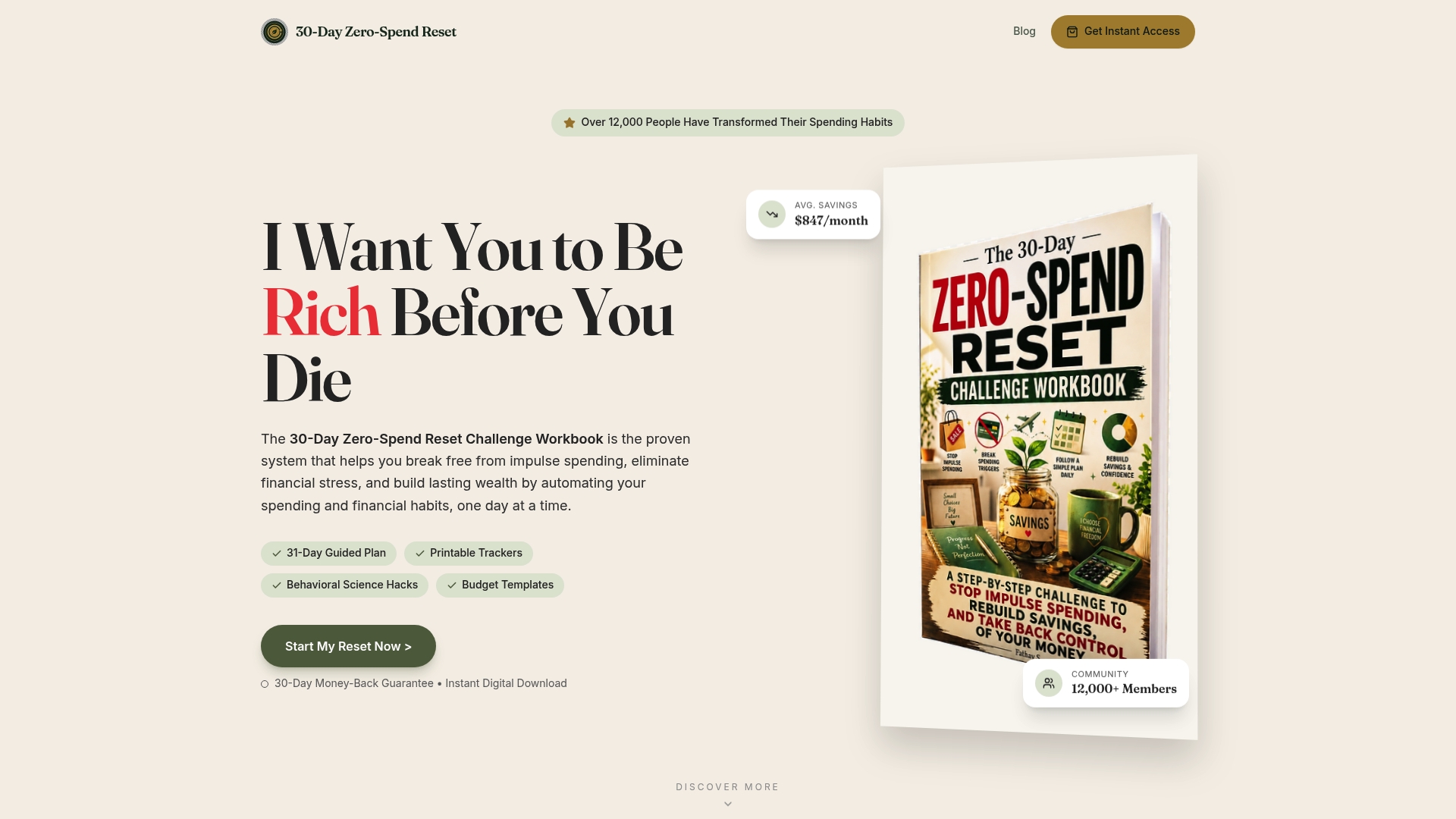
Canceling is the first win. Keeping the money is the harder part. Our 30-Day Zero-Spend Reset Challenge Workbook walks you through a structured month of daily challenges, including a subscription audit, printable trackers, social scripts for money conversations and tools for impulse and emotional spending, so the savings from every canceled charge land somewhere on purpose.
If you want extra trackers, meal planning guides and the companion tools, look at the Zero-Spend Accelerator Vault. You can also read our zero-spend guide first to see how the method works.
FAQ
How do I write a subscription cancellation email?
Use a subject line that names the service and your account, then state your full name and account details. Say plainly that you want to cancel the whole subscription, and ask for a written reply confirming it, including the date of your last charge. Keep a copy of what you sent.
What if I cannot find the subscription in my account?
Check your statement for the exact name of the biller, then look in your Apple or Google subscription lists. If you find an Apple receipt, cancel through your Apple Account. If there is no receipt, contact the company named on your statement directly.
Do I have to give a reason for canceling?
No. A polite “I’d rather not say, I just need to cancel today” is enough. Giving a reason usually opens the door to a sales pitch.
What should I do if I am billed after I canceled?
Contact the company with your cancellation record, then dispute the charge with your card issuer or bank. If the company withdraws money straight from your bank account, revoke authorization and tell your bank in writing. You can also report the problem to the FTC and your state attorney general.
Sources
- How to Find and Cancel Unwanted Online Subscriptions, Consumer Reports
- Cancel a subscription from Apple, Apple Support
- Canceling subscriptions and memberships: How to do it properly, U.S. PIRG
- Cancellation email: 12 examples and a template, Maestro Labs
- How do I stop automatic payments from my bank account?, CFPB
- FTC announces final click-to-cancel rule, Federal Trade Commission
- Negative Option Rule, Federal Register
- Getting In and Out of Free Trials, Auto-Renewals, and Negative Option Subscriptions, FTC Consumer Advice
Ready to reset your spending?
Get the 30-Day Zero-Spend Reset Workbook and turn these ideas into a daily action plan.
Start the 30-Day ResetThis article is part of the 30-Day Zero-Spend Reset method. Explore the complete day-by-day system behind these ideas.
Read the full guideKeep reading


Join the conversation
Be the first to share your thoughts on this article.