
Zero-Based Budget vs. 50/30/20: Which One Fits You?

Zero-based budget vs. 50/30/20: see how each splits the same paycheck, which handles impulse buys and debt better, and how to pick one this week.
Zero-Based Budget vs. 50/30/20: Which One Fits You?
The 50/30/20 rule gives you three buckets and a quick check on your spending. A zero-based budget gives every dollar a specific job. If your money leaks through impulse buys, forgotten subscriptions, grocery runs or debt payments, the zero-based method gives you more control, and it works best when it is paired with a short, structured reset so the habits change along with the spreadsheet. Below is how each method splits the same paycheck, where each one breaks down, and how to start.
TL;DR
- 50/30/20 splits take-home pay into 50% needs, 30% wants and 20% savings and debt paydown. It is fast to set up but loose.
- Zero-based budgeting assigns every dollar of income to a category until income minus planned spending equals zero. It takes more effort and shows you much more.
- If you are in debt, building an emergency fund, or leaking money on impulse spending and subscriptions, the detail of a zero-based plan is usually what you need.
- You can start with 50/30/20 as a sketch, then convert it into a zero-based plan once you see your real numbers.
- A 30-day structured reset helps the habits stick, which a budget format alone does not do.
Table of Contents
- What each method actually is
- The same paycheck, two ways
- Where the two methods differ
- Impulse spending, subscriptions and groceries
- Adapting either method for debt and an emergency fund
- How to choose and start
- Our perspective
- Put the plan into practice
- FAQ
- Sources
What each method actually is
The 50/30/20 rule
The rule was popularized by Elizabeth Warren in her book All Your Worth, according to a summary of her proposal: divide after-tax income into 50% for needs, 30% for wants and 20% for savings. NerdWallet's budget calculator guide describes the 20% bucket as covering both savings and debt paydown, and notes that you should add back payroll deductions such as health insurance and 401(k) contributions when you work out your net income.

"Needs" are things you would struggle to go without: housing, utilities, groceries, transportation, insurance and minimum debt payments. "Wants" are everything that makes life nicer but is not essential: dining out, streaming, travel, hobbies.
Zero-based budgeting
In a zero-based budget, income minus expenses equals zero by design. That does not mean you spend everything. Savings, debt payoff and fun money all count as expenses in the plan, so every dollar has a purpose before the month begins. If a category comes in under budget, you move the leftover to next month or to another goal, such as your emergency fund.
There are no preset percentages. You build the plan from your own bills and goals.
The same paycheck, two ways
Say your take-home pay is $4,000 a month and you carry some credit card debt.
50/30/20 version
| Bucket | Share | Amount | |---|---|---| | Needs | 50% | $2,000 | | Wants | 30% | $1,200 | | Savings and debt paydown | 20% | $800 |
Now list your real needs: rent $1,300, utilities $220, groceries $520, transportation $380, insurance $180 and minimum debt payments $200. That is $2,800, or 70% of your pay. The rule says needs should be 50%, so the plan is already off before you buy anything fun. This happens often in high-cost areas, and it is why the percentages need to be adjusted rather than followed blindly.
Zero-based version
| Category | Amount | |---|---| | Rent | $1,300 | | Utilities | $220 | | Groceries | $520 | | Transportation | $380 | | Insurance | $180 | | Minimum debt payments | $200 | | Dining out | $250 | | Subscriptions | $60 | | Fun money | $200 | | Shopping | $150 | | Emergency fund | $300 | | Extra debt payment | $240 | | Total | $4,000 |
Income minus every planned dollar is zero. Notice that the zero-based plan does not pretend your rent is 50% of anything. It starts from what you actually owe and decides where the remaining $1,200 goes. You can see exactly how much is going toward debt and the emergency fund, and what each of those choices costs your wants.
Where the two methods differ
| | 50/30/20 | Zero-based | |---|---|---| | Setup time | Minutes | An hour or two the first time | | Categories | Three | As many as you need | | Ongoing effort | Low, check totals monthly | Higher, track and adjust through the month | | Flexibility | Percentages are fixed unless you change them | Fully customized to your bills | | Visibility | Broad view of where money goes | Line-by-line view | | Handles irregular income | Awkward | Workable with a baseline month | | Best for | Getting started, stable finances | Debt, leaks, tight margins, specific goals |
The real trade-off is detail against effort. 50/30/20 tells you whether your overall balance looks healthy. Zero-based budgeting tells you what to do with Tuesday's grocery trip.
Impulse spending, subscriptions and groceries
These three leaks are small, frequent and invisible, which is why the level of detail matters.
Impulse spending. Under 50/30/20, a "wants" bucket of $1,200 is one big pool. You can burn through it on takeout and online orders by the 15th and not notice which habit did it. In a zero-based plan, you give shopping $150 and dining out $250. When a category is empty, the decision is made for you. You are not relying on willpower in the moment.
Subscriptions. Subscription creep sits inside "wants" in 50/30/20 and rarely gets examined. A zero-based budget forces you to write each one down as a line item, and that is usually when the forgotten ones show up. Our guide to cutting expenses you will not miss walks through what to look for, and this breakdown of spending categories helps you name the lines.
Groceries. Groceries are a need, so 50/30/20 treats them as fixed. In practice they are the most flexible part of a family budget. A zero-based plan gives food its own number, and you can adjust it week to week. If you shop with children, this guide to grocery shopping with kids during a no-spend month shows how to keep that number honest.
The 50/30/20 rule can still work as a gut check. If your wants alone are over 30%, you know where to look. But it does not tell you which wants.

Adapting either method for debt and an emergency fund
The percentages are a starting point, not a law. NerdWallet's guide says you can change them, for example by shrinking wants and growing the savings and debt bucket when paying down debt is the priority.
With 50/30/20: try 50/20/30 or even 60/10/30. Keep needs honest, cut wants hard for a few months, and send the difference to debt or savings.
With zero-based: list your minimum payments as needs, then decide an extra payment amount as its own line. Give the emergency fund a line too. Because every dollar is assigned, you can see the trade-off in real time: another $50 on the card means $50 less somewhere else.
A few practical points:
- Pay at least the minimums on every account, then aim extra dollars at one target. Paying only minimums is expensive over time, as we explain in the minimum payment trap.
- Build a small starter cushion alongside the debt payments, so a surprise bill does not go back on the card.
- Plan for lumpy costs. A car repair or a medical bill can arrive without warning, and a plan for budgeting a $2,000 deductible shows how to turn that kind of hit into a monthly line item.
- If your income varies, build the plan on your lowest typical month and treat anything above it as a bonus to assign later.
Because a zero-based plan displays each trade-off, it is the more natural fit for people who are trying to get out of debt or build savings quickly.
How to choose and start
Ask yourself three questions.
Is my money mostly fine, and I just want a sanity check? Start with 50/30/20. Ten minutes and a bank statement will tell you whether you are close.
Do I run out of money before the month ends, or carry debt? Go zero-based. The detail is the point.
Do I know the plan but keep breaking it? The problem is habits, not format. Pick either method and add a structure that changes behavior, such as a defined 30-day period where you cut optional spending and track every dollar.
To start a zero-based plan this week:
- Calculate your take-home pay for a typical month, using your lowest month if income varies.
- List fixed bills first: housing, utilities, insurance, minimum payments.
- Add variable needs: groceries, fuel, household basics.
- Add goals: emergency fund, extra debt payment.
- Assign what is left to wants, then adjust until the total is zero.
- Track spending weekly and move money between categories rather than abandoning the plan when one runs out.
If your bank makes the categories hard to see, this guide to zero-based budgeting with envelopes in digital banking explains how to set it up.
Our perspective
Most people who tell us a budget "didn't work" did not have a math problem. They had a behavior problem. The spreadsheet was fine. The Friday-night order, the free trial that renewed, the grocery run on an empty stomach were not in it.
That is why we build around daily action instead of percentages. The 50/30/20 rule and zero-based budgeting both tell you where money should go. Neither one, by itself, changes what your hand does at checkout.
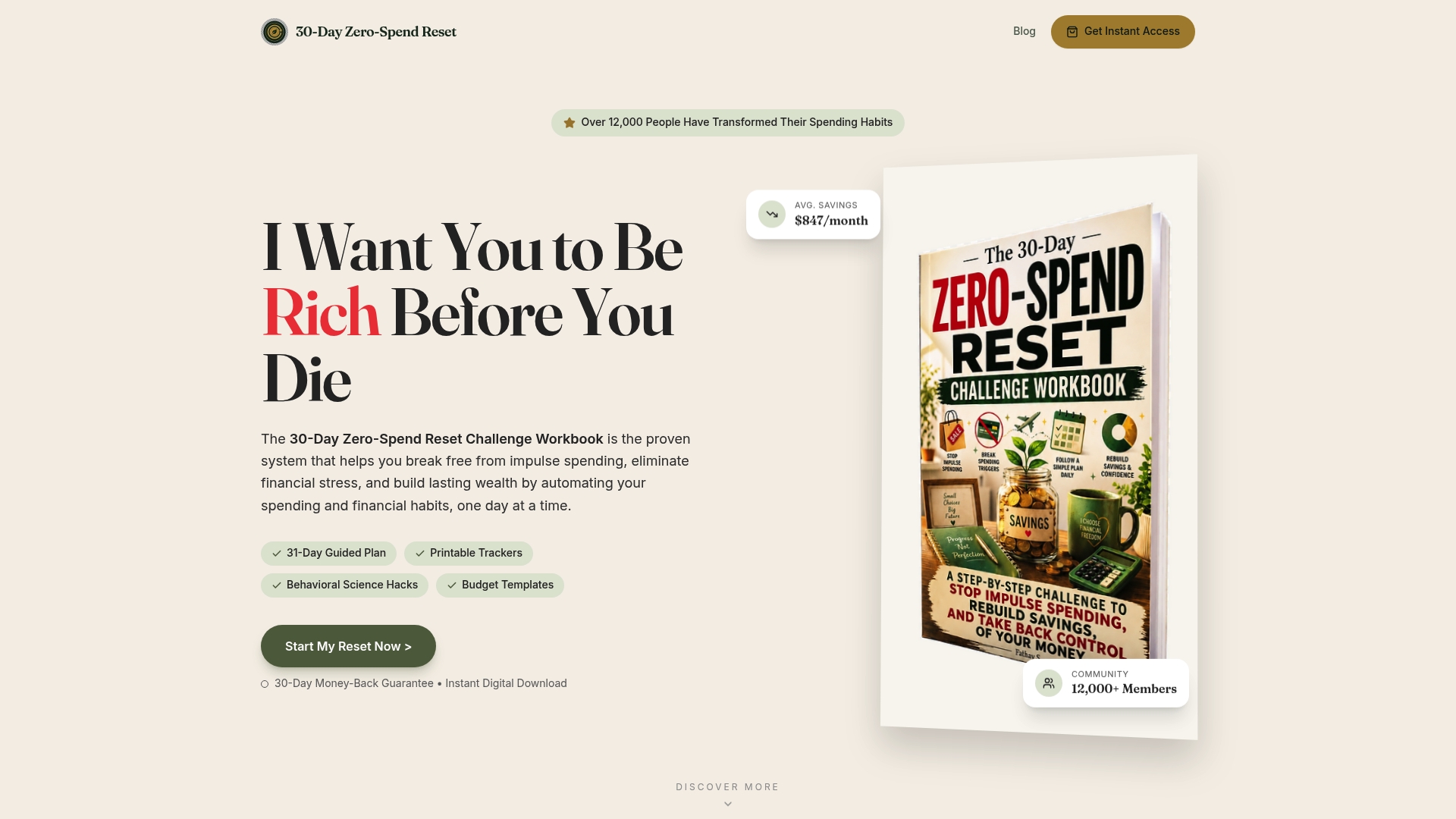
Our workbook is built on behavioral psychology, with a step-by-step daily system that is designed to work without relying on willpower or guilt. You audit subscriptions, retrain spending triggers, and use trackers and meal plans that make a zero-based way of thinking routine. Users have reported saving an average of $847 per month.
If you are choosing between the two methods, choose the one that shows you your real numbers. Then give yourself 30 days to practice it.
Omar
Put the plan into practice
The 30-Day Zero-Spend Reset Challenge Workbook gives you a daily challenge, printable trackers, budget templates, subscription audits, meal planning guides and social scripts for money conversations, plus a private companion webapp. It is built for people dealing with impulse spending, subscription creep, emotional spending and debt who want a plan they can follow one day at a time. Extra tools are in the Zero-Spend Accelerator Vault.
FAQ
Is zero-based budgeting better than 50/30/20?
It is better when you need control: paying off debt, building an emergency fund, or stopping small leaks. 50/30/20 is better as a quick starting sketch. Many people begin with the percentages and move to a zero-based plan once they see their actual numbers.
Does zero-based budgeting mean I spend every dollar?
No. It means every dollar is assigned a job before the month starts, and savings and debt payments are jobs. If you finish a category with money left, you roll it forward or move it to another goal such as your emergency fund.
What if my needs are more than 50% of my income?
That is common, especially with high rent. Do not force the rule. Write down your real needs, see what is left, and shrink wants first. A zero-based plan handles this naturally because it starts from your actual bills.
Can I use both methods together?
Yes. Use 50/30/20 as a check on the big picture, for example whether wants are creeping above 30%. Use a zero-based plan for the month-to-month detail. Together they show whether the overall balance is healthy and where each dollar went.
Sources
- Zero-Based Budgeting: What It Is and How to Start, NerdWallet
- Monthly Budget Calculator, NerdWallet
- Why the 50/30/20 Rule Proposed by Elizabeth Warren Can Hurt Your Finances, Wealthtender
- Budget a $2,000 Deductible, Deductibleassist
Recommended
Ready to reset your spending?
Get the 30-Day Zero-Spend Reset Workbook and turn these ideas into a daily action plan.
Start the 30-Day ResetThis article is part of the 30-Day Zero-Spend Reset method. Explore the complete day-by-day system behind these ideas.
Read the full guideKeep reading

Join the conversation
Be the first to share your thoughts on this article.