
How to Reset Your Money Mindset: A 30-Day Practical Plan

Reset your money mindset in 30 days: trace where your money beliefs came from, run simple exercises, and turn new thinking into daily spending habits.
How to Reset Your Money Mindset: A 30-Day Practical Plan
Resetting your money mindset means tracing where your beliefs about money came from, noticing how they drive what you buy today, and replacing them with a story and a set of habits you choose on purpose. Insight alone rarely changes a bank balance, so the reset works best when each new belief is tied to a small daily action. This guide walks through both halves: the thinking exercises and the behavior changes that make them stick.
TL;DR
- A money mindset is the set of beliefs and emotions you carry about money, usually formed in childhood. You reset it by examining that story and writing a new one.
- Your transaction history is the fastest honest mirror of those beliefs. Start there, not with a blank journal page.
- Pausing before nonessential purchases, auditing recurring charges and giving savings a specific purpose turn insight into action.
- Debt and emergency savings belong in the reset: start with a small cushion, then go after high-interest balances.
- Thirty days of structured daily practice beats one big burst of motivation.
Table of Contents
- What it means to reset your money mindset
- Why willpower is the wrong tool
- Money mindset exercises that work
- Turn the new story into a spending plan
- Include debt and emergency savings from day one
- A 30-day shape for the reset
- What we have learned about money mindset
- Make the reset structured with the workbook
- FAQ
- Sources
What it means to reset your money mindset
America Saves describes a money story as the personal and emotional script, shaped by family values, struggles and experiences, that influences how people earn, spend, save and think about money. Resetting it means reflecting on that story and where it came from, recognizing how it affects what you do now, and writing a new version built on clarity, empowerment and intention.
That is a more modest idea than the internet makes it sound. You are not trying to become a different person or adopt an abundance slogan. You are trying to see why you do what you do with money, and to decide whether those reasons still serve you.
A few examples of what a money story can sound like:
- Money is always tight, so there is no point tracking it.
- Treating myself is the only way I get through a hard week.
- Talking about money is rude, so I will never ask for a better rate or a fair split.
- Debt is a personal failure, so I avoid opening the statements.
Each of these produces predictable behavior: avoidance, reward spending, silence, shame. Change the sentence and the behavior has room to change with it.
Why willpower is the wrong tool
Bank of America's financial education site notes that attitudes about money, shaped by childhood family habits, values and culture, can become deeply ingrained and affect adult financial behavior. The same page cites experts who say roughly 90% of financial behaviors are driven by emotions such as happiness, sadness or fear rather than pure self-discipline.
Psychologist Nathan Astle makes a related point in Psychology Today: changing behavior is not about increasing self-discipline, but about using practical tools to process the unmet emotional needs that drive spending.
This is why a stricter budget so often fails. If a purchase is soothing loneliness or stress, cutting the purchase without addressing the feeling just moves the pressure somewhere else. A good reset gives you two things at once: a way to see the feeling, and a replacement action when it shows up.

Money mindset exercises that work
Most of the advice that ranks for this topic boils down to a handful of exercises. Here are the ones with the strongest backing, in the order we would do them.
1. Read your own transactions
Before journaling about beliefs, look at evidence. Financial planner Robert Belle argues in a TED talk that reviewing your transaction history can reveal the hopes, fears and dreams behind how you spend and save.
Pull the last 60 to 90 days from your bank and card statements. Then:
- Circle every purchase that felt automatic or regrettable.
- Next to each, write the feeling you had just before buying (bored, stressed, rewarded, left out).
- Count how many circles share the same feeling.
Most people find one or two dominant triggers. That is your starting map.
2. Write a money autobiography
Truist describes the money autobiography as an exercise for examining the early experiences and beliefs that may have influenced you. Its source, Valterra, notes that money scripts become lodged in the brain when strong emotions attach to early experiences, which is why simply knowing better often is not enough.
Set a timer for 20 minutes and answer these in plain sentences:
- What did the adults around me say about money, and what did they do?
- What was my first money memory, and how did it feel?
- When did money last cause a fight, a fear or a win?
- Which belief from childhood do I still act on without questioning?
Then rewrite one belief. Not a grand affirmation, just a sentence you could believe on a Tuesday. Replace Money always runs out with Money runs out when I do not give it a job, and I can give it one.
3. Name the feeling, then wait
America Saves recommends a 24-hour pause before nonessential purchases, tracking your emotional triggers, replacing spending with low-cost or free alternatives, and giving savings a specific purpose. Psychology Today's piece on the same theme adds that stepping away for at least 24 hours lets the initial emotional surge subside.
Put it into practice with a note on your phone titled Wait List. Anything nonessential goes on the list with the date and the feeling. After 24 hours, ask whether you still want it. Many items quietly disappear.
4. Face your fears in the present tense
SoFi's guidance, updated in 2026, recommends exploring financial fears and where they come from, then focusing on concrete present actions instead of dwelling on past mistakes. Write down the fear (I will never get out of debt), then the smallest action that addresses it today (list every balance and its rate). Forgiving the past is useful only if it frees you to act now.
5. Choose a strategy that fits you
Do not worry about picking the perfect technique. A meta-analysis of financial self-control strategies by Davydenko and colleagues found that proactive and reactive strategies were similarly effective at reducing spending or increasing saving. Proactive means designing the environment so temptation never shows up (unsubscribing, deleting saved cards). Reactive means handling temptation when it arrives (the 24-hour wait). Use whichever you will actually repeat.

Turn the new story into a spending plan
A reset that stays in a notebook is just a pleasant evening. Within the first week, convert it into numbers.
Audit what charges you automatically
The FDIC suggests reviewing recurring charges to check whether you still get value or need those products and services. Open your last two statements and highlight every repeating charge: streaming, apps, gym, cloud storage, free trials that converted. Cancel what you have not used in 30 days. Our guide to expenses to cut first shows where most households find the quickest wins, and the spending categories list helps you sort what you find into needs, wants and leaks.
Pick a rule, then adjust it
The 50/30/20 rule uses take-home pay as the base: 50% for needs, 30% for wants, 20% for savings goals. The CFPB's own budgeting materials present it as one rule among several, not one everyone can follow, and recommend choosing a personal rule that fits your situation. SoFi adds that the percentages can be unrealistic where housing costs are high, so you can start saving at 5% or 10% and revisit the budget every six to 12 months.
The mindset point: a rule you can keep at 10% beats a rule you abandon at 20%. If you want more options, see our list of spending rules.
Trim the grocery line
Food is the flexible category where most families can move quickly. Plan meals around what is already in the pantry, shop with a list, and treat the first week of the reset as a pantry-first week. If you shop with children, our post on grocery shopping with kids during a no-spend month covers how to keep the trip short and the cart on plan.
Include debt and emergency savings from day one
A mindset reset that ignores debt and savings is incomplete, because these are where the new beliefs get tested.
Pay yourself first. The CFPB's financial empowerment toolkit suggests treating savings like a mandatory bill, and the FDIC gives the same advice: pay yourself first, even when funds are tight. Set a small automatic transfer on payday, before you can talk yourself out of it.
Start the emergency fund small. The CFPB toolkit suggests starting with achievable goals such as $500 to $1,000. People in CFPB focus groups mentioned guidelines ranging from a fixed $1,000 to three to twelve months of living expenses. Treat the first $1,000 as a milestone, not the finish line.
Go after high-interest balances. The same toolkit notes that investment returns can be canceled out by credit card interest of 18% or 21%, so paying off card balances comes before a long-term investment program. If you are only making minimums, read the minimum payment trap to see how slowly balances fall.
Be careful with fast cash. If you are short right now, the CFPB lists alternatives to a payday loan, including employer advances and negotiating a smaller repayment amount with a creditor or debt collector. If you are being contacted by collectors or cannot cover essentials, a nonprofit credit counselor can review your whole picture before you commit to anything.
Automate, then adjust. Fidelity's financial-reset guidance recommends taking inventory of accounts, automating contributions, building emergency savings, setting specific goals and adjusting timelines when circumstances change. Adjusting is part of the plan, not a failure of it.
A 30-day shape for the reset
Thirty days is long enough to repeat a behavior until it feels normal and short enough to see the end. Here is a simple arc you can follow on your own.
| Week | Focus | What you do | |---|---|---| | 1 | See | Read 60 to 90 days of transactions, log triggers, list every recurring charge and every debt with its rate | | 2 | Interrupt | Cancel unused subscriptions, start the 24-hour Wait List, unsubscribe from promotional email, plan meals from the pantry | | 3 | Replace | Swap each trigger for a free alternative (walk, call, bath, library), write your money autobiography and rewrite one belief | | 4 | Direct | Automate a savings transfer, set the $500 to $1,000 target, choose a spending rule and decide the next 90 days |
The goal is not a perfect month. It is a month in which you notice, in real time, the moment between feeling and spending. Our write-up on running a low-spend month shows what that looks like in practice, including the days that go badly and what to do next.
What we have learned about money mindset
We built our program around one observation: people do not fail at money because they lack information. They fail because a feeling arrives at 9 p.m. on a Thursday and the card is already saved on the site.
That is why we do not start with a budget spreadsheet. We start with the trigger. A daily challenge is small enough to finish on a bad day, specific enough that you know when you are done, and repeated enough that the new response begins to feel like yours. Guilt does not appear anywhere in that design, because guilt tends to push people back toward the very spending it condemns.
We also think a mindset reset should leave a trail. Write down what you cut, what you felt, what you kept. After a few weeks the pattern is in front of you in your own handwriting, and that is more persuasive than any article, including this one.
The last piece is honesty about limits. A reset will not fix an income that does not cover essentials, and it will not replace advice from a credit counselor when debt is out of control. What it can do is make sure the dollars you do have are going where you decide.
, Omar
Make the reset structured with the workbook
If you want the exercises above laid out day by day, our 30-Day Zero-Spend Reset Challenge Workbook is built for exactly that. It pairs daily behavioral challenges with printable trackers, budget templates, social scripts for money conversations, meal planning guides and a subscription audit, so you are never staring at a blank page wondering what to do today.
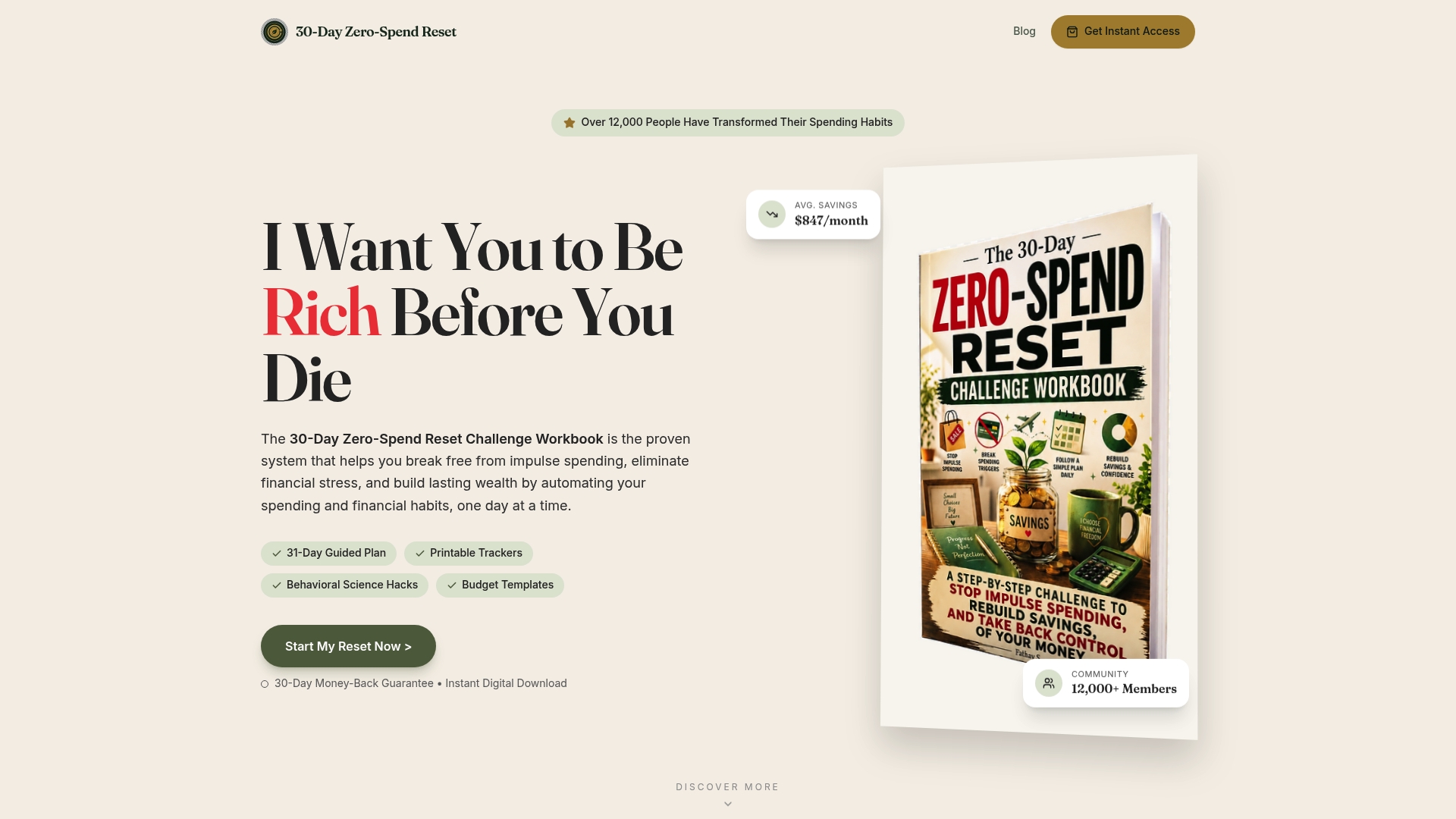
It comes with a companion webapp for tracking your progress, and the Zero-Spend Accelerator Vault adds further resources if you want to go deeper. Some users have reported saving an average of $847 per month, though results depend on your income, expenses and how closely you follow the plan. You can also read our zero-spend guide for an overview before you decide.
FAQ
How long does it take to change your money mindset?
There is no fixed timeline, and beliefs formed in childhood do not vanish in a week. What you can change in 30 days is behavior: pausing before purchases, cutting recurring charges and automating savings. As those actions repeat, the beliefs behind them usually shift too.
What is the first money mindset exercise I should try?
Review your last 60 to 90 days of transactions and write the feeling next to every purchase you regret. It takes under an hour, uses real data and shows you which trigger to tackle first. After that, move on to a money autobiography.
Can I reset my money mindset if I am in debt?
Yes, and debt is often where it matters most. Start with a small emergency cushion in the $500 to $1,000 range, then prioritize high-interest credit card balances. If you feel overwhelmed or collectors are involved, talk to a nonprofit credit counselor about your options.
Is the 50/30/20 rule right for everyone?
No. The CFPB describes it as one budgeting rule among many, and it can be unrealistic when housing costs take a large share of income. Begin with whatever savings percentage you can sustain, such as 5% or 10%, and revisit it every six to 12 months.
Sources
- How to Heal Your Money Story and Rewrite Your Financial Narrative, America Saves
- How to Improve Your Money Mindset and Make Better Choices, Bank of America
- Want to Spend Smarter? Start by Naming Your Feelings, Psychology Today
- The emotions behind your money habits, Robert A. Belle, TED
- How money scripts shape your financial habits, Truist
- 6 Ways to Break the Emotional Spending Cycle, America Saves
- Money Mindset: How to Change Your Financial Thinking, SoFi
- A meta-analysis of financial self-control strategies, PMC
- Getting Beyond the Tough Times, FDIC
- Analyzing budgets, CFPB
- Needs vs Wants: Knowing the Difference for Budgeting, SoFi
- Your Money, Your Goals: A financial empowerment toolkit, CFPB
- Consumer Voices on Financial Rules to Live By, CFPB
- Should I get a payday loan if I need money now? CFPB
- 5-step tune-up for a fresh money mindset, Fidelity
Recommended
Ready to reset your spending?
Get the 30-Day Zero-Spend Reset Workbook and turn these ideas into a daily action plan.
Start the 30-Day ResetThis article is part of the 30-Day Zero-Spend Reset method. Explore the complete day-by-day system behind these ideas.
Read the full guideKeep reading



Join the conversation
Be the first to share your thoughts on this article.