
Payday Spending Traps: How to Spot Them and Keep Your Paycheck

Payday spending traps drain your paycheck before the next one arrives. Learn the six most common ones and a simple plan to stop each before it costs you.
Payday Spending Traps: How to Spot Them and Keep Your Paycheck
Payday spending traps are the habits and short-term loans that empty your account within days of a deposit. They work because the money feels spendable the moment it lands, while rent, utilities, debt payments and groceries are still due. You beat them by deciding where each dollar goes before payday arrives, so the deposit is already spoken for. That is the idea behind a structured reset such as our 30-Day Zero-Spend Reset Challenge Workbook, which replaces willpower with a daily routine.
This guide covers the six traps we see most often, what the evidence says about each, and a plan you can start with your next paycheck.
TL;DR
- Spending tends to spike when income arrives. In one academic study, more than half of the people studied raised payday spending by over 25%.
- Saving "whatever is left" usually means saving nothing. Move money to savings on payday, automatically.
- A payday loan can cost $15 per $100 borrowed, and Pew finds about 80% are renewed or quickly reborrowed.
- Subscriptions, food and minimum-only debt payments quietly take the rest. Audit them once, then review monthly.
- A written plan for bills, debt, savings and a capped "wants" amount turns payday from a spending signal into a routine.
Table of Contents
- Why payday is the riskiest day of your month
- Trap 1: The payday high
- Trap 2: Saving whatever is left
- Trap 3: The payday loan cycle
- Trap 4: Subscriptions that renew while you are not looking
- Trap 5: Grocery and food spending that balloons after payday
- Trap 6: Paying only the minimum
- A payday-proof plan in six steps
- How to stop emotional spending after payday without feeling deprived
- Building an emergency fund so payday loans stop looking necessary
- Our perspective
- Start your reset before the next paycheck
- FAQ
- Sources
Why payday is the riskiest day of your month
A paycheck is the one moment when your account looks healthiest and your obligations are least visible. Rent is not due for a week, the card bill is on another date, and the balance is the biggest you will see for a month. Your brain reads that number as permission.
There is research behind the feeling. A Columbia Business School summary of an Icelandic study reports that more than half the population increased spending by over 25% around payday, especially on discretionary goods. That is a study of Iceland, not a US estimate, so treat it as evidence of a human pattern rather than a number for your household. The same account links the splurge partly to a feeling of being flush when income arrives, even though the income was fully expected.
That last point matters. You are not spending because you are careless. You are spending because a predictable event feels like a windfall. A predictable event can be planned for, which is why the fix is structure, not guilt.

Trap 1: The payday high
The first trap is the reward spend. You have worked two weeks, the deposit hits, and dinner out, a delivery order or a small online purchase feels earned. None of these is large. The damage comes from repetition: twelve to twenty-six paydays a year, each with its own "treat."
How it goes wrong: the treat is unplanned, so it never appears in a budget, and the money it takes was already assigned to something else.
What to do instead:
- Decide on a payday amount for wants before the deposit arrives, and write it down.
- Pay it to yourself in a separate account or cash envelope so you can see when it is gone.
- Wait 24 hours before any purchase that was not on your list. Most impulses fade by then.
If this is your main leak, the daily challenges in our workbook are built to break the cue-and-reward loop around spending, so the habit changes instead of just being suppressed for a week.
Trap 2: Saving whatever is left
The second trap is the most common and the quietest. You plan to save what remains at the end of the pay period. Nothing remains.
The FDIC's Money Smart guide, Pay Yourself First, recommends direct deposit or automatic transfers to savings at the time you are paid. The logic is simple: money that never sits in your checking account cannot be spent on payday impulses.
Pick an amount you will not notice, even $10 or $25 per paycheck, and automate it. If you want to see how a small recurring transfer adds up toward a target, a savings goal calculator shows the timeline for any amount and deadline. Raise the transfer whenever a debt is paid off: the FDIC guide presents saving as an ongoing habit, so redirecting a finished loan payment into savings keeps the same cash-flow commitment working for you.

Trap 3: The payday loan cycle
This is the trap the search results warn about most, and the costliest. A payday loan looks like a bridge to your next paycheck. In practice it often becomes a second bill that arrives with that paycheck.
The Consumer Financial Protection Bureau (CFPB), the federal agency that oversees consumer lending, says a typical payday-loan fee is $15 per $100 borrowed. Borrow $300 and you owe $345 in a couple of weeks. The same CFPB page explains that in states that do not ban or limit rollovers, paying a $45 fee to extend that $300 loan can leave $345 still due, so a month of borrowing $300 would cost $90 in fees.
Here is a worked example:
| Step | What happens | You owe | |---|---|---| | Day 1 | Borrow $300 at $15 per $100 | $345 due in about two weeks | | Payday 1 | Cannot cover $345 and still pay bills, so pay $45 to extend | $345 still due | | Payday 2 | Repay in full or extend again | $345, plus another $45 if extended | | After one month | Total fees if you extended once | $90 |
Why does this happen so often? Pew Charitable Trusts' 2023 analysis says about 80% of payday loans are renewed or quickly reborrowed, because a lump-sum repayment takes about a third of a typical borrower's next paycheck and opens a new cash gap. In other words, reborrowing is a predictable response to the structure of the loan, not a personal failing.
If you are already in this cycle, the way out is to stop the gap from reopening. That means building a plan in which the next paycheck covers essentials first, then the loan, with a small buffer. The step-by-step plan below does exactly this. For the rules in your state, including limits on rollovers, check the CFPB page linked above and your state's financial regulator.
Trap 4: Subscriptions that renew while you are not looking
Subscription creep is a payday trap because charges cluster around the first and the fifteenth, right when your balance looks safe. A streaming service here, an app there, a free trial that quietly converted. Each is small, so none triggers a decision.
Run a one-time audit:
- Pull the last three months of bank and card statements.
- Highlight every recurring charge, including annual ones that appear once.
- Sort into three groups: used weekly, used rarely, forgotten.
- Cancel the forgotten group today and put the rarely used group on a 30-day test.
- Move the saved amount into savings on the same day, so it does not drift back into spending.
The CFPB's Your Money, Your Goals toolkit includes a spending tracker and a tool for cutting expenses, which are useful for this kind of audit. Our own list of expenses to cut first and a guide to unsubscribing from marketing emails help reduce the nudges that lead to the next impulse purchase. The workbook includes a subscription audit as part of the 30 days, so you do this once, thoroughly, instead of piecemeal.
Trap 5: Grocery and food spending that balloons after payday
Food is the largest flexible expense for most households, and it is the one most affected by payday. You shop bigger, add convenience items, and order out more in the first days after a deposit, then eat down the pantry at the end of the cycle.
Parents feel this most. Shopping with children adds unplanned items, and a half-empty fridge on a Thursday leads to delivery. A few habits that help:
- Plan meals before you shop, using what you already have. A written list is a spending cap.
- Shop once, not three times. Each extra trip is another chance for impulse items.
- Keep a backup meal list of cheap dinners you can make from pantry staples, so a tired night does not become a $40 delivery.
- Set a weekly food amount and track it against actual receipts, not estimates.
Our article on grocery shopping with kids during a no-spend month walks through this for families, and the workbook includes meal planning guides that tie your menu to your weekly food amount.
Trap 6: Paying only the minimum
When payday is tight, the minimum payment on a credit card feels like the responsible choice. It keeps the account current and avoids a late fee. But it also keeps the balance, and the interest, alive for years, and that balance is a recurring claim on every future paycheck.
The FDIC guide notes that paying bills on time avoids late fees, extra finance charges and utility disconnection costs, so minimums matter for staying current. They are a floor, not a plan. Once the essentials and minimums are covered, direct any extra to one debt on purpose. We explain how the minimum payment trap works and how to get out of it.
The same FDIC guide advises against borrowing for short-lived consumption such as vacations, clothing or restaurant meals, and separates that from borrowing for longer-term assets or needs. If you are using a card to cover a payday gap for those items, that is the first habit to redirect.
A payday-proof plan in six steps
The CFPB toolkit linked above lays out a practical order for a spending plan. Here it is, adapted for a payday routine.
- Write down your take-home income and the date each paycheck arrives.
- List every expense with its due date, plus every debt with its balance, minimum payment and interest rate. A bill calendar turns this into a single view of the month, and the CFPB toolkit includes one. If a payment is already slipping, this guide to what to do first when a payment is in trouble helps with the order of priorities.
- Reserve money for bills and debt minimums first, on payday, before anything else.
- Choose a repayment approach. The avalanche method targets the highest interest rate first and costs the least in interest. The snowball method targets the smallest balance first and gives faster visible wins. Either works if you stick to it.
- Set a realistic savings transfer and automate it for payday.
- Give yourself a bounded amount for wants, then review the plan monthly and adjust it to your actual cash flow.
That last step is what keeps the plan alive. People who budget to zero with no room for wants tend to break the plan on the first stressful week. A defined fun amount, spent without guilt, protects everything else. If you want a method for assigning every dollar a job, see our guide to zero-based budgeting with digital banking, and our spending categories list can help you name the categories.
How to stop emotional spending after payday without feeling deprived
Most payday overspending is emotional, not logical: relief after a hard stretch, stress from bills, a reward for getting through the week. Telling yourself to stop rarely works, because the feeling returns on the next payday.
What works better is giving the feeling somewhere to go:
- Name the trigger. Before buying, note what you feel: tired, stressed, bored, celebrating.
- Delay by a day. Add the item to a list instead of a cart.
- Replace, do not remove. Pick a free or cheap reward you actually enjoy, such as a walk, a call with a friend or a favorite home-cooked meal.
- Plan the treat. A small, budgeted payday treat feels different from an unplanned one, because it does not come with the guilt that fuels the next binge.
If frugality has left you feeling anxious about money, our piece on overcoming a scarcity mindset after frugality addresses the opposite swing.
Building an emergency fund so payday loans stop looking necessary
The real fix for the payday loan trap is a buffer. Even a small one changes what a surprise car repair or medical bill means for you. Start with a first goal that feels almost too easy, such as $100 or one week of essential expenses, and build from there.
Fund it the same way you fund any payday priority: an automatic transfer on the day you are paid. Keep it in a separate account so it is harder to spend, and when you use it, refill it before restarting other goals. Every dollar there is a dollar you will not borrow at $15 per $100.
Our perspective
Payday is not a willpower problem. It is a design problem. When money arrives with no plan attached, almost everyone spends it faster than they meant to.
That is why we built the workbook around 30 days of small, daily actions instead of a spreadsheet you open once. Each day targets a specific leak: an impulse category, a subscription, a grocery habit, a social situation where money gets awkward. Our approach draws on behavioral psychology, because changing the routine around spending works better than punishing yourself for it.
The companion webapp, the printable trackers and the meal plans exist to make the plan easy to follow on a tired Thursday, not just a motivated Sunday. The goal is a sustainable mindset reset, without guilt or deprivation, so payday becomes the day your plan runs rather than the day it breaks.
Omar
Start your reset before the next paycheck
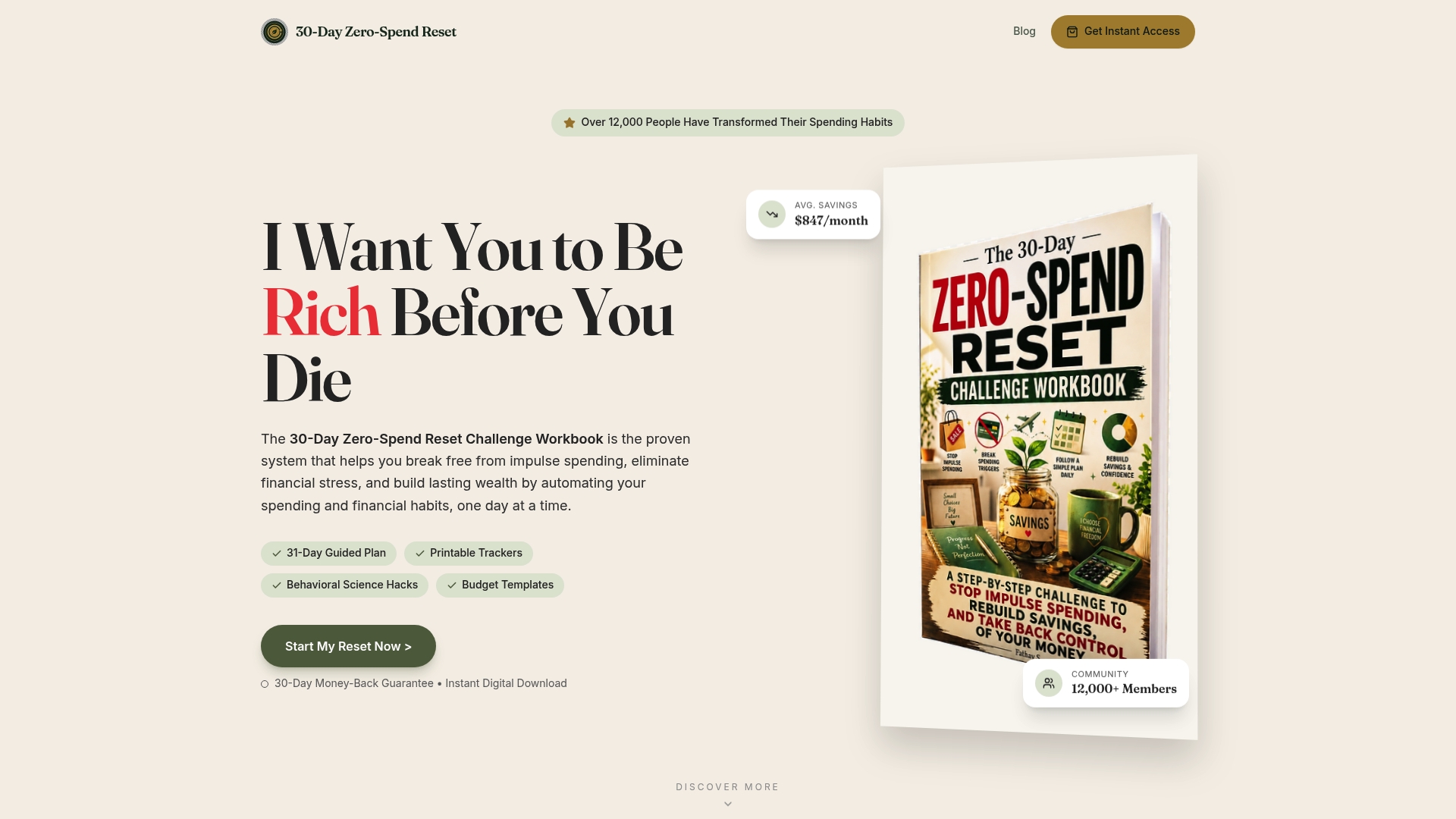
If you want the plan, the trackers and the daily structure in one place, the 30-Day Zero-Spend Reset Challenge Workbook walks you through 30 days of behavioral challenges, subscription audits, budget templates, meal planning and scripts for money conversations. A private companion webapp keeps your progress together, and the Zero-Spend Accelerator Vault adds extra resources. Users have reported saving an average of $847 per month.
Begin on a day that is not payday, so you set your rules while the pressure is low.
FAQ
What are the most common payday spending traps?
The most common are the payday splurge, saving only what is left over, taking a payday loan to bridge a gap, forgotten subscriptions, higher food spending and paying only minimums on debt. They overlap, so fixing one often frees money to fix the next.
Why do I spend more right after I get paid?
A full account feels like permission to spend, even when the income is expected. Research summarized by Columbia Business School describes this feeling of being flush, though the study was in Iceland. The practical answer is to assign the money before it arrives.
How much does a payday loan really cost?
The CFPB says a typical fee is $15 per $100 borrowed, so $300 costs $345 to repay in a couple of weeks. In states that allow rollovers, extending the loan can add $45 each time. Check your state's rules with its financial regulator.
How do I stop living paycheck to paycheck?
Cover bills and debt minimums on payday, automate a small transfer to savings, cap your wants, and review the plan monthly. Over time, redirect finished debt payments into your emergency fund, so the buffer grows without a bigger budget.
Sources
- On Payday, Consumers Feel a License to Spend, Columbia Business School
- Pay Yourself First, FDIC Money Smart participant guide
- Should I get a payday loan if I need money now? CFPB
- Payday Loans and Overdraft: A Short History and What's Next, Pew Charitable Trusts, 2023
- Your Money, Your Goals: A financial empowerment toolkit, CFPB, June 2020
Ready to reset your spending?
Get the 30-Day Zero-Spend Reset Workbook and turn these ideas into a daily action plan.
Start the 30-Day ResetThis article is part of the 30-Day Zero-Spend Reset method. Explore the complete day-by-day system behind these ideas.
Read the full guideKeep reading

Join the conversation
Be the first to share your thoughts on this article.