
Down Payment Savings: How to Build Yours Faster in 2026
Set a realistic down payment target, free up cash from subscriptions and impulse buys, and keep the money safe while it grows. A practical US plan.
Down Payment Savings: How to Build Yours Faster in 2026
Most people don't miss their down payment goal because the number is too big. They miss it because the money keeps leaking out through impulse buys, forgotten subscriptions and grocery runs that go over budget. The fastest way to build down payment savings is to pick a target you can defend, turn it into a weekly amount, and free up that amount from spending you will not miss. A structured 30-day reset like our 30-Day Zero-Spend Reset Challenge Workbook is built for that second part: finding the cash and keeping it.
TL;DR
- Most loans need at least 3% down, many need 5% or more, and 20% saves the most, according to the CFPB.
- Your real down payment is what is left after closing costs, moving costs and a three to six month emergency cushion.
- Divide your target by the number of weeks you have, then match that weekly figure with specific cuts.
- Keep the money in a separate, federally insured account with automatic transfers.
- Tax refunds and documented gifts can top up the fund, and local assistance programs may add more.
Table of Contents
- How much do you actually need to save?
- Turn the target into a weekly number
- Where the money comes from: impulse buys, subscriptions and groceries
- Save automatically and keep it separate
- Balance the down payment with debt and an emergency fund
- Windfalls: tax refunds and gifts
- Assistance programs worth looking up
- What a realistic timeline looks like
- Start your reset with the workbook
- Our perspective
- FAQ
- Sources
How much do you actually need to save?
The Consumer Financial Protection Bureau (CFPB), the federal agency that publishes homebuying guidance, says that in most cases you need at least 3% of the home price. Many loans require 5% or more, 10% often saves you money, and 20% saves the most. Lenders generally evaluate down payments in 5% steps, so putting down 8% instead of 10% usually earns you nothing extra. If you are close to a step, it is worth reaching it.
Here is what those percentages look like on a $300,000 home:
| Down payment | Amount | |---|---| | 3% | $9,000 | | 5% | $15,000 | | 10% | $30,000 | | 20% | $60,000 |
The CFPB suggests running the same math on your own target price: multiply the price by 5, 10 and 20 percent, then add 2 to 5% of the price for closing costs. On that same $300,000 home, closing costs would be roughly $6,000 to $15,000 on top of the down payment.
Start from what you can really spend
The CFPB's method works backward. Add up your savings and investment statements, subtract other savings goals, moving costs and an emergency cushion of three to six months of expenses, then subtract estimated closing costs. What remains is your maximum down payment. In the CFPB's own example, a buyer of a $200,000 home with $30,000 available and about $10,000 in closing costs can put down $20,000, or 10%.
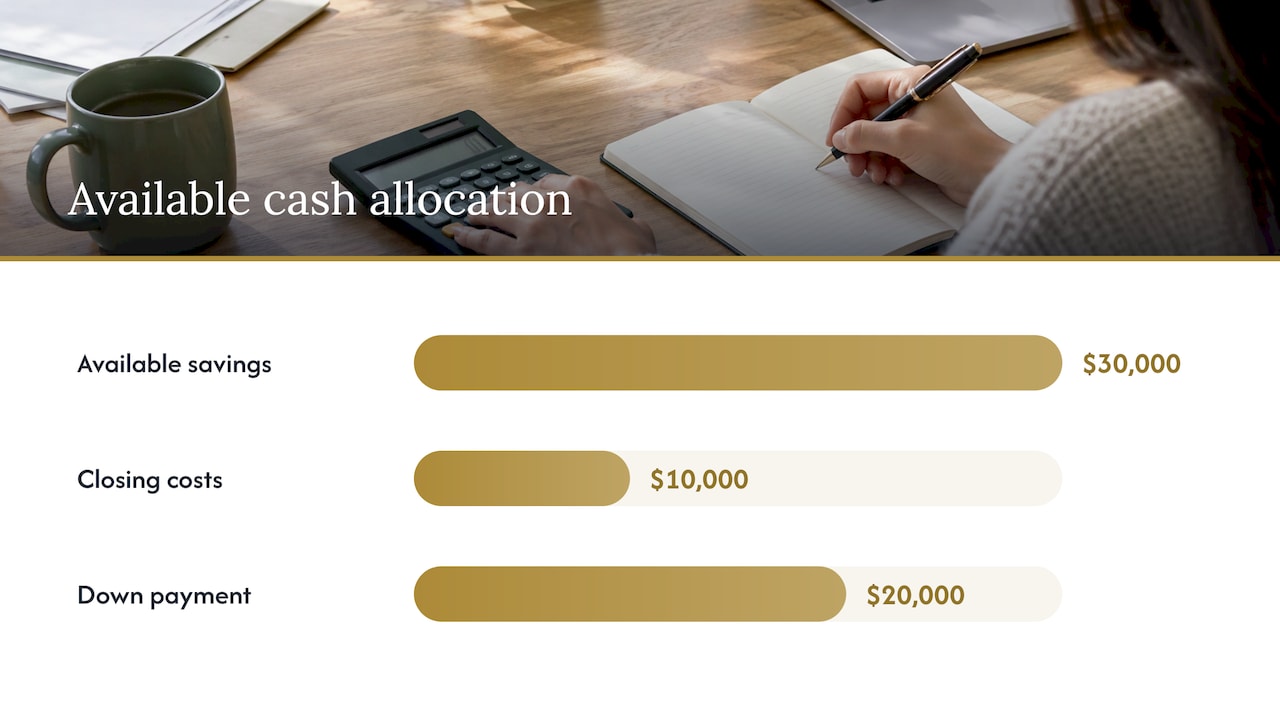
That is why the headline percentage is only half the picture. Saving 20% and arriving at closing with no cash left for repairs or a job gap is a fragile place to be.
Turn the target into a weekly number
A $20,000 goal feels abstract. A weekly figure is something you can act on. The CFPB's financial empowerment toolkit uses a simple formula: divide the total you need by the number of weeks you have. Its example is $1,000 over 40 weeks, which comes to $25 a week.
Apply it to a bigger goal:
- Pick the down payment amount from the section above.
- Choose a deadline. Two years is 104 weeks.
- Divide. $20,000 over 104 weeks is about $192 a week.
- Subtract anything that arrives on its own, such as a tax refund or a planned gift.
- Find the weekly cuts that cover the rest.
The toolkit points out that there are only two levers: spend less or earn more. For most households the faster one is spending, because a single unused expense can cover a big share of the weekly target.
The American Bankers Association (ABA) adds a motivation tip worth using: break the goal into milestones and reward yourself modestly at each one, for example a nice meal at every $5,000 saved toward $30,000. Plan the reward at a cost that does not erase the progress.
Where the money comes from: impulse buys, subscriptions and groceries
The CFPB's toolkit says the easiest cut is often one major expense: dropping a service or membership you don't use, or downgrading, such as moving from premium to basic cable, which is worth $40 a month or $10 a week. After that, small cuts across categories like eating out and combining errands to save gas add up. The ABA also recommends tracking discretionary spending through online banking and shopping around on car, renter's and health insurance, cable, internet and cell plans, which can save hundreds of dollars.
Knowing what to cut is the easy part. Actually doing it every week, without sliding back into old habits, is where most plans stall. Three leaks matter most for down payment savers.
Subscription creep
Small recurring charges are easy to forget because they never ask for a decision. A one-time audit of every monthly and annual charge, followed by cancelling what you don't use, turns directly into weekly savings. Our subscription audit is part of the workbook, and our guide to which expenses to cut first shows how to rank them. If email promotions keep pulling you back to shop, unsubscribing from marketing emails removes a trigger.
Impulse and emotional spending
Impulse purchases rarely come from a lack of math. They come from stress, boredom or a bad day. Willpower tends to run out by evening, which is why our workbook uses daily behavioral challenges instead of a rule to try harder. A low-spend month is a good way to see how much of your normal spending was automatic. Writing your own spending rules in advance means you decide once, not at the checkout.
Groceries
Food is the category where parents often find the most room, because it is flexible every single week. Meal planning guides are included in our toolkit, and our post on grocery shopping with kids during a no-spend month covers the practical side of getting through the store without extras.
Save automatically and keep it separate
The CFPB recommends setting up a regular paycheck deduction into a separate down payment account, because automation makes you more likely to stick to the plan. The ABA likewise suggests a dedicated savings account with automatic monthly contributions. Keeping the fund apart from everyday checking makes progress visible and takes away the temptation to dip into it.
If your income arrives irregularly, or your bank statements are a blur, a method that assigns every dollar a job helps. We cover how to do that with a zero-based budget and digital envelopes. Setting up a timeline and automated contributions is also the core of this first-time buyer budgeting guide, which is written around Manhattan co-ops and condos but applies to the saving habit anywhere.
Keep it somewhere insured
A down payment fund should be boring. FDIC insurance covers savings accounts, checking accounts, money market deposit accounts and certificates of deposit up to at least $250,000 per depositor, per insured bank, per ownership category. You can confirm that a bank is insured with the FDIC's BankFind tool or by calling 1-877-275-3342, and the NCUA insures credit union deposits under similar rules, per the FDIC's Money Smart materials. A savings account gives you easy access, and interest is paid as a percentage of your balance, which is the basic growth mechanism for money you will need within a few years.
Balance the down payment with debt and an emergency fund
If you carry debt, the instinct is to choose between the down payment and paying it off. In practice, the two compete for the same dollars, so decide the order on purpose.
The CFPB is clear on one point: subtract an emergency cushion of at least three to six months of expenses before you decide how much to put down, and remember that money put into a home is not easy to get back. Its toolkit suggests starting an emergency fund with a $500 goal, then raising it to $1,000 once you reach it.
A workable sequence for most readers with debt:
- Build a starter emergency fund of $500, then $1,000.
- Stop the leaks that add to debt. Paying only minimums keeps balances alive, as our post on the minimum payment trap explains.
- Put the money you freed up toward the debt that is costing you most, while still funding your emergency cushion.
- As balances fall, redirect those same payments to the down payment fund.
Step 4 is the quiet advantage: the payment you already made does not need to be found again. It just changes destination.
Owning a home also adds costs that renting never had. Lining up the insurance to buy before closing belongs in your cash plan, so the cushion you keep is sized for a real homeowner's bills.
Windfalls: tax refunds and gifts
A tax refund is the simplest accelerator. Freddie Mac's My Home page says a refund can go toward your down payment, and notes that its Home Possible and HomeOne mortgages require only 3% down. It also states that buyers typically pay 2% to 5% of the price in closing costs, which is $7,000 to $17,500 on a $350,000 home, so a refund can cover those too.
Gifts work, but they come with paperwork. For an FHA loan, HUD's handbook says a gift must come from a relative, employer, labor union, a close friend with a clearly defined interest in the borrower, a charity or a government homeownership program. It cannot come from the seller, agent, builder or a connected party. The lender needs a signed gift letter naming the donor, amount and relationship, and stating that no repayment is required. Ask your lender about its own documentation rules before the money moves.
The same HUD page lists other acceptable sources of funds, including savings and checking accounts, savings bonds, retirement accounts and stocks and bonds. Check with your lender on how each is counted.
Assistance programs worth looking up
Down payment assistance (DPA) is usually run by counties, cities and state housing agencies, and the rules differ widely. Two 2026 examples show the pattern:
- Gwinnett County, Georgia's Homestretch program offers income-eligible first-time buyers up to $10,000 as a 0% interest, no-payment loan, forgiven 20% a year if the home is the primary residence. Buyers complete an 8-hour HUD-approved counseling class and contribute 1% of the price or $1,000, whichever is smaller. Underwriting conditions include a minimum credit score of 580.
- Nebraska's First-Time Homebuyer Savings Account Act (LB 803) creates accounts that open January 1, 2027, with contribution limits of $5,000 a year for individuals and $10,000 for married couples. Contributions are deductible from Nebraska income tax and earnings grow state tax-free for a Nebraska primary residence.
These are not national programs. Search your own county and state housing finance agency for what exists where you plan to buy, and note the income limits, the first-time buyer definition and how long you must live in the home. Also check whether your loan type has its own rules: Alaska's housing agency, for instance, allows gift funds to meet its 5% minimum on certain loans.
If you are carrying debt, note that many programs set credit and debt-to-income limits. Lowering balances and avoiding new impulse charges helps on both fronts.
What a realistic timeline looks like
Timelines depend on your target and on how much you free up each week. Using the earlier math, the same $15,000 goal looks like this:
| Weekly savings | Time to $15,000 | |---|---| | $100 | about 150 weeks (roughly 2.9 years) | | $150 | 100 weeks (about 1.9 years) | | $200 | 75 weeks (about 1.4 years) |
These figures ignore interest, refunds and gifts, so they are the conservative case. Notice what a $50 weekly improvement does: it shortens the wait by almost a year. That is why a one-time cleanup of subscriptions and impulse habits is worth more than it looks. It compounds across every week that follows.
Start your reset with the workbook
If you can name your target but not where the weekly money will come from, the gap is behavior, not arithmetic. The 30-Day Zero-Spend Reset Challenge Workbook gives you a daily system for eliminating impulse spending, a subscription audit, printable trackers, budget templates, meal planning guides and social scripts for money conversations, plus a private companion webapp. It is built on behavioral psychology principles so the plan does not depend on willpower or guilt.
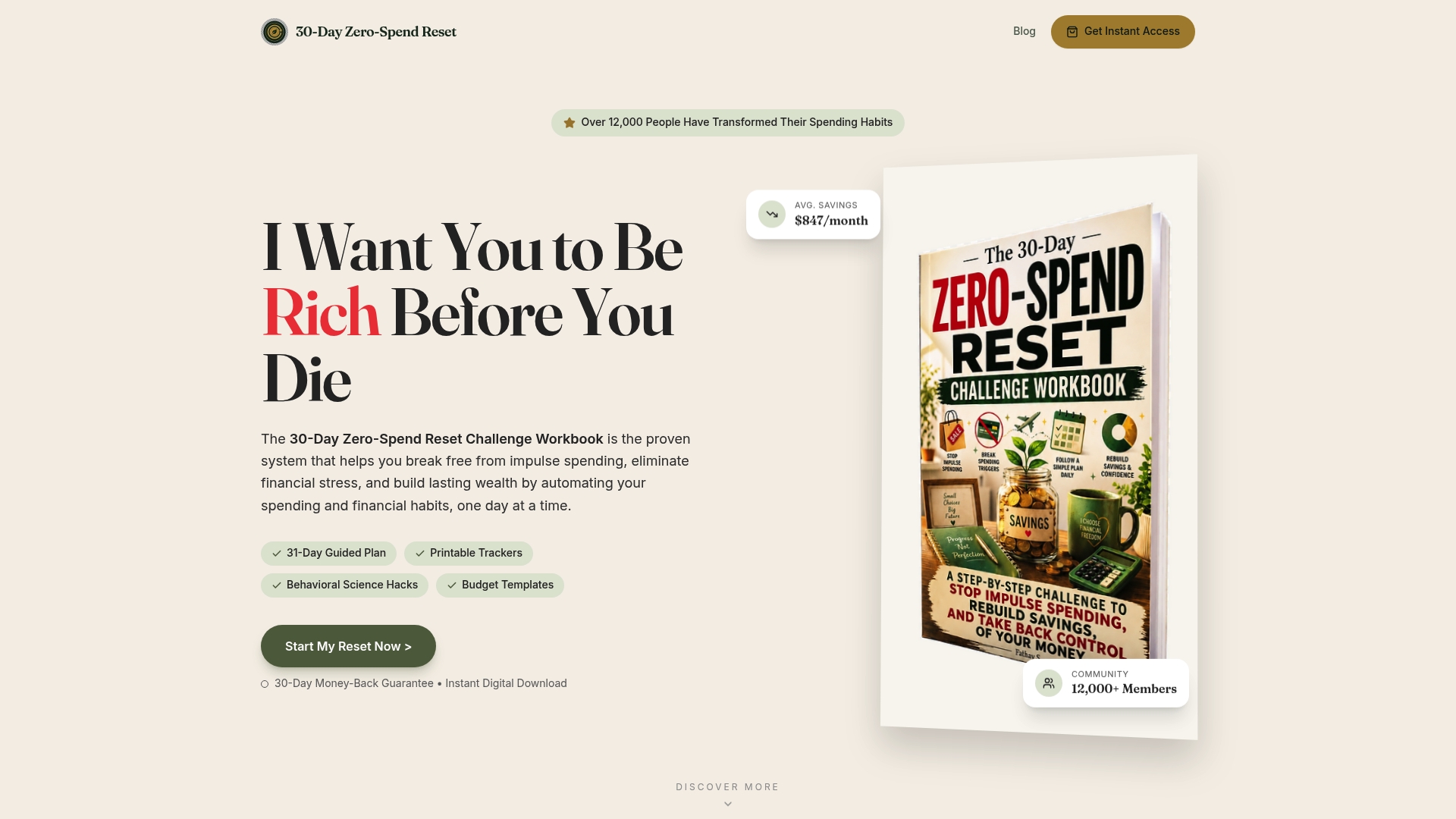
When you want more tools to keep the habit going after the first 30 days, the Zero-Spend Accelerator Vault adds further resources.
Our perspective
Every down payment plan we see starts with a percentage and ends with a feeling: the money should be there by now, and it isn't. The percentage was never the problem.
The CFPB's own method, dividing the goal by the number of weeks and matching it with cuts, is sound. Where people stall is the matching. A cut that depends on remembering to say no every day does not last. A cut that is built into a daily routine does.
That is why we designed the workbook around 30 days of structured challenges instead of another spreadsheet. Thirty days is long enough to see which spending was automatic, to audit subscriptions, and to replace the trigger-and-purchase loop with something else. Our approach is to change the behavior first and let the savings follow, without guilt or deprivation.
If a house is the goal, treat the 30 days as the start of the savings habit, not a stunt. The weekly transfer you set up on day 30 is the one that buys the home.
Omar
FAQ
How much should I save for a down payment?
The CFPB says most loans need at least 3% of the home price, many need 5% or more, and 20% saves the most. Add 2% to 5% of the price for closing costs and keep a three to six month emergency cushion on top. Your own target is whatever remains after those subtractions.
How do I save for a down payment on a tight budget?
Convert the goal to a weekly figure, then find cuts to match it, starting with one unused subscription or membership. Automate a transfer to a separate account on payday so the money moves before you can spend it. Small category cuts, such as eating out and extra car trips, fill the rest.
Should I pay off debt before saving for a down payment?
Start with a small emergency fund of $500 to $1,000, then stop adding to balances. Keep paying down the debt costing you most while you build your cushion. As each balance clears, point that payment at the down payment fund. Many assistance programs also set credit and debt-to-income limits, so lower balances help you qualify.
Where should I keep my down payment savings?
Use a separate savings account at an FDIC-insured bank or an NCUA-insured credit union. Coverage is at least $250,000 per depositor, per insured institution, per ownership category. A separate account also makes automatic deposits and progress tracking easier.
Can I use a tax refund or a gift toward my down payment?
Yes, in many cases. Freddie Mac notes that a refund can go toward a down payment or closing costs. Gifts must come from allowed donors and be documented with a signed gift letter, so talk to your lender before the funds are transferred.
Sources
- CFPB: Determine your down payment
- CFPB: How to decide how much to spend on your down payment
- CFPB: Your Money, Your Goals toolkit
- ABA: 6 Tips for Saving for Your Down Payment
- FDIC: Banking Services Instructor Guide
- FDIC: Money Smart Module 2
- Freddie Mac My Home: How to Use Your Tax Refund to Buy a Home
- HUD 4155.1: Acceptable Sources of Borrower Funds
- Gwinnett County: Homestretch Down Payment Assistance Overview
- Nebraska State Treasurer: First-Time Homebuyers Savings
- AHFC: Section 4006, Documentation of Required Funds
Recommended
Ready to reset your spending?
Get the 30-Day Zero-Spend Reset Workbook and turn these ideas into a daily action plan.
Start the 30-Day ResetThis article is part of the 30-Day Zero-Spend Reset method. Explore the complete day-by-day system behind these ideas.
Read the full guideKeep reading






Join the conversation
Be the first to share your thoughts on this article.