
Pay Yourself First With $1–$5 Per Paycheck Without Risking Rent

Start saving while broke by automating tiny payday transfers ($1–$5), prioritizing rent and utilities first, and scaling your emergency buffer without...
Pay Yourself First With $1–$5 Per Paycheck Without Risking Rent
Yes, you can pay yourself first when you're broke by starting with a tiny, automated transfer timed to your payday, even $1 or $5, while making sure urgent bills like rent and utilities stay covered. The habit matters more than the amount right now. Triage your bills before you automate anything, then let the transfer run in the background so saving stops depending on willpower.
TL;DR:
- Paying yourself first regardless of income level is possible by automating small transfers, such as $1 or $5, timed with payday to avoid overdrafts.
- Prioritizing essential bills like rent and utilities before saving ensures survival needs are covered, with optional pauses during true emergencies.
- Keeping small savings in a separate FDIC-insured account and using low-balance alerts prevents accidental overspending and overdrafts.
- Starting with tiny, consistent transfers and gradually increasing savings based on triggers like raises or windfalls builds lasting habits over time.
- Automation and behavioral challenges together outperform willpower alone, but progress remains slow and requires patience and flexibility to setbacks.
Table of Contents
- What paying yourself first actually means on a tight budget
- Step-by-step plan to pay yourself first on your next paycheck
- Protect survival needs before you divert any money
- Where to keep small savings and how to automate safely
- How much to start with and when to increase it
- Why small automated habits work better than willpower
- Realistic expectations and common obstacles
- A structured option if you want daily guidance
- Sources
- FAQ
What paying yourself first actually means on a tight budget
Paying yourself first traditionally means setting aside a percentage of income before spending on anything else.
The CFPB reframes the goal around resilience rather than a fixed rate. Any affordable amount, moved consistently, shortens how long it takes to recover from a surprise expense. That shift changes what you're aiming for:
- Save a small, repeatable amount instead of chasing a percentage.
- Treat the habit itself as the win, not the dollar total.
- Let consistency, not size, build the buffer over time.
A $2 transfer every payday for three months teaches your brain that saving happens automatically. That habit is what eventually makes larger amounts possible.
Step-by-step plan to pay yourself first on your next paycheck
This is the order that keeps you from overcommitting money you don't actually have.
- Triage your bills first. List every bill and rank it by what happens if it goes unpaid: losing housing or utilities ranks above a subscription or late fee.
- Pick a starter amount. Choose something small enough that you won't notice it, like $1, $5, or $10 per payday, or a flat amount such as $20 a month.
- Automate it around payday. Set up split direct deposit or a recurring transfer that moves the money the moment your paycheck lands, before you see it in your checking account.
- Free up the cash. Cut one discretionary line, like a $5 coffee habit or an unused streaming subscription, and route exactly that amount into savings.
- Check weekly, scale monthly. Look at your balance once a week; increase the transfer only after you've built a small buffer and gone a full month without an overdraft.
Pro Tip: Schedule the transfer for the same day your direct deposit hits, not a few days later. The money you never see in your checking account is the money you never spend.
Automation removes the daily decision to save, which is exactly the point. The CFPB's guidance on automatic saving notes that scheduling transfers for payday, paired with low-balance alerts, keeps the habit running without you having to remember it or fight the urge to spend first.

Protect survival needs before you divert any money
Saving should never come at the cost of losing your home or your utilities. Before you automate a single dollar, rank your bills by consequence: housing and utilities first, transportation needed for work second, essential medical costs third, everything else after that.
If you can't cover the essentials, call your landlord, lender, or utility provider before a payment is due. Many will offer a hardship plan or short extension, but only if you ask early.
- Check eligibility for SNAP, unemployment benefits, and rental assistance before pulling money from savings.
- Look into LIHEAP or Weatherization Assistance Program help to keep utilities on while you stabilize.
- Contact creditors directly to ask about hardship deferrals rather than missing a payment silently.
- Pause your savings transfer for a cycle if a true emergency hits, then restart at the same small amount once the crisis passes.
Pausing isn't failing. It's the plan working as intended, protecting what matters most first.
Where to keep small savings and how to automate safely
Keep your starter savings in a separate, FDIC-insured savings account, not folded into your checking account where it's easy to spend without noticing. Skip CDs or other commitment products for this money: you may need it on short notice, and early withdrawal penalties defeat the purpose.
- Use split direct deposit so a portion of every paycheck lands in savings automatically.
- Set up a recurring transfer timed to hit right after payday, before other spending happens.
- Turn on round-up features if your bank offers them, since spare change adds up without effort.
- Set a low-balance alert on checking so a scheduled transfer never triggers an overdraft.
In 2022, 24% of consumers reported having no emergency savings at all, while 39% had some savings but less than a month's worth of expenses. Moving from the first group into the second is the realistic, achievable goal when you're just starting out.
The FDIC's guidance on starting small recommends exactly this pairing: a separate account plus automated, recurring transfers, increasing the amount as other debts get paid down.
How much to start with and when to increase it
Start absurdly small if that's what it takes to actually stick with it. A few workable starting points:
- $1 to $5 per paycheck, or a flat $10 to $20 a month.
- 1% of take-home pay if a percentage feels more natural than a flat number.
- Round-up savings from debit purchases, which requires no active decision at all.
Aim for staged targets rather than one big goal: a small cushion first, then one week of expenses, then one month. Increase the transfer amount when a specific trigger happens, a raise, a paid-off debt, or a one-time windfall, rather than on a schedule. And once you hit a small milestone, keep the transfer running instead of redirecting it back into spending; that's the habit that compounds.
Why small automated habits work better than willpower
Behavioral research on saving consistently points to the same lesson: automation beats intention. When the transfer happens without a decision, the habit survives bad weeks, low motivation, and forgetfulness. Structured challenges add a second layer, daily prompts and trackers that make the habit visible instead of invisible.
Reducing the gap between "no savings" and "some savings" is the meaningful first milestone, not hitting a specific dollar target.
A 30-day structured approach, like the daily challenges and tracking built into the Zero-Spend Accelerator Vault, works alongside automation by giving the habit a visible daily checkpoint instead of leaving it to memory alone.
Realistic expectations and common obstacles

Progress here is slow and uneven, and that's normal, not a sign you're doing it wrong. If a transfer bounces or you have to skip a month, pause, contact any affected creditor, and restart at the same small amount rather than quitting.
Three obstacles come up constantly: irregular income (anchor transfers to your most predictable paycheck or payout), overdraft risk (set alerts and leave a buffer), and social spending pressure (decide your limit before the invite, not during it). Small, forgiving about the fact that you'll miss weeks and keeping the habit alive anyway is the actual skill here.
, Omar
A structured option if you want daily guidance
Tiny automated transfers handle the mechanics of saving, but they don't address the impulse buys, subscription creep, or emotional spending that quietly drain the money you meant to save. That's the gap the 30-Day Zero-Spend Reset Challenge Workbook was built to close, with a daily structure instead of a spreadsheet you have to remember to update.
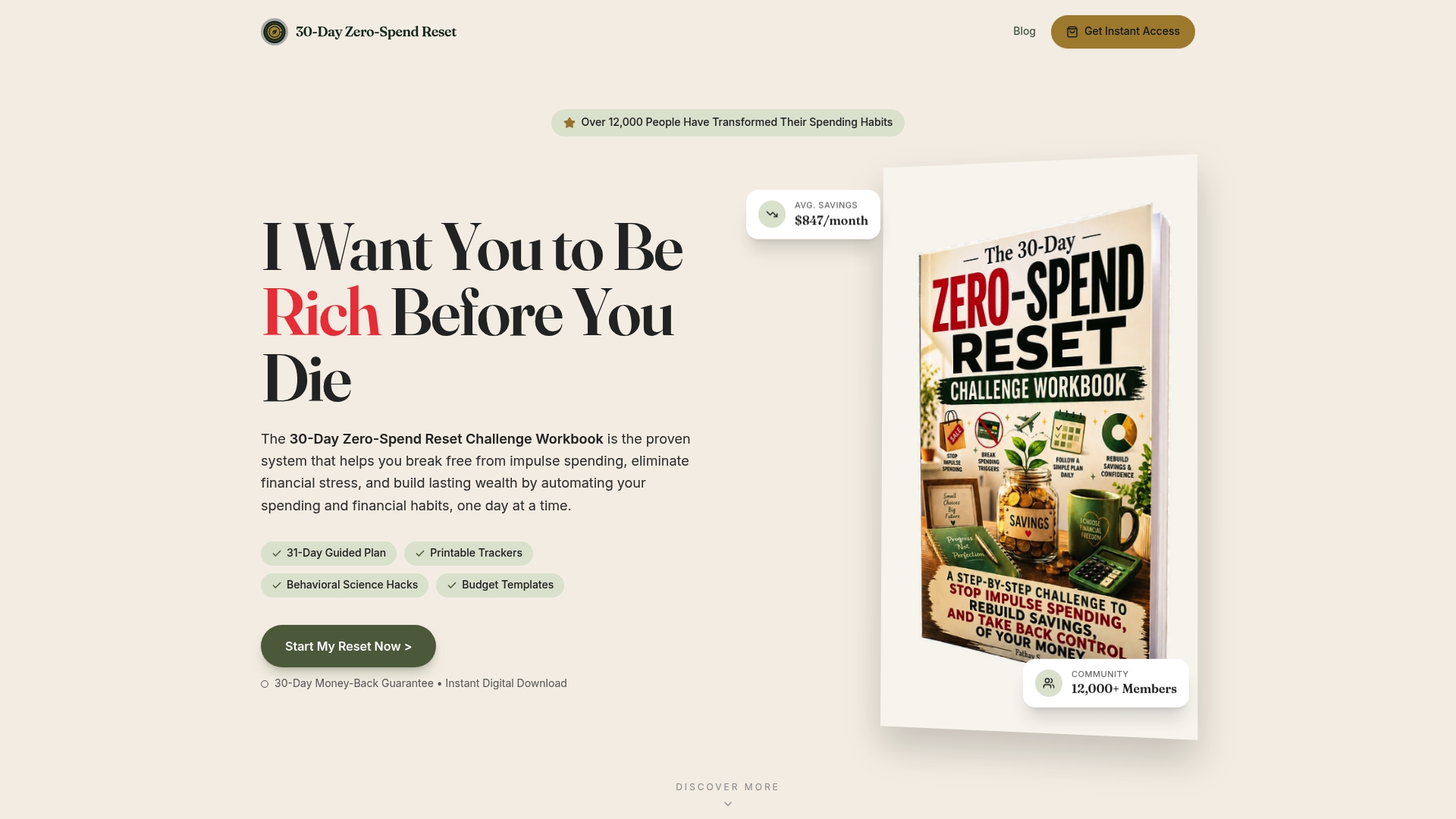
- Daily behavioral challenges that target impulse buying and emotional spending directly.
- Printable trackers and budget templates that pair naturally with your automated transfer.
- Social scripts for money conversations, plus meal planning guides to cut food costs.
- A private companion webapp for tracking progress without extra spreadsheets.
If you want the scaffolding rather than building the system yourself, start with the 30-Day Zero-Spend Reset Challenge Workbook or explore the Zero-Spend Accelerator Vault for extended tools. If a setback knocks your habit off track, the recovery guidance walks through restarting a small emergency fund step by step.
This article is general information, not a substitute for advice from a qualified financial advisor. Consult a qualified financial professional about your own circumstances before acting on anything here.
Sources
- An essential guide to building an emergency fund | Consumer Financial Protection Bureau
- Usa
- Starting small can lead to big savings | FDIC
FAQ
What is the $27.40 rule?
It's a motivational approach to break a large savings goal into a daily amount, but no official CFPB or FDIC recommendation suggests a specific daily figure, which can be too aggressive for someone with a tight or irregular income.
What are the disadvantages of paying yourself first?
If applied rigidly, paying yourself first can pull money away from urgent bills like rent or utilities, which is why prioritizing survival expenses first matters. It can also lead to overdraft fees if transfers aren't timed carefully around payday and account balances.
How to live on $500 a month after bills?
There's no official government formula for a fixed monthly budget since needs vary widely by household and location. The practical approach is the same triage used throughout this guide: rank remaining expenses by consequence, protect food and transportation needed for work, and automate even a $1 or $5 savings transfer once bills are covered.
How many Americans have at least $100,000 in savings?
That specific figure isn't tracked in the CFPB's emergency-savings research. What the CFPB does report is that 37% of consumers had at least one month of expenses saved, while 24% had no emergency savings at all, which is a more relevant benchmark for most people starting from zero.
Recommended
Ready to reset your spending?
Get the 30-Day Zero-Spend Reset Workbook and turn these ideas into a daily action plan.
Start the 30-Day ResetThis article is part of the 30-Day Zero-Spend Reset method. Explore the complete day-by-day system behind these ideas.
Read the full guideKeep reading





Join the conversation
Be the first to share your thoughts on this article.