
Save Money With One Automated Transfer and Tiny Habits

Build money saving habits with one automated transfer, tiny repeatable actions, weekly reviews, and subscription checks, then follow a 30 day plan.
Save Money With One Automated Transfer and Tiny Habits
The most reliable path to savings combines one automated transfer with one repeatable behavior, like a weekly no-spend day. The Consumer Financial Protection Bureau recommends automatic recurring transfers as the easiest way to build an emergency fund, and a simple framework like 50/30/20 gives that automation somewhere to go. Start there, then layer in weekly reviews and subscription audits.
TL;DR:
- The CFPB’s example turns a $10 transfer from a $245 weekly paycheck into over $500 yearly; schedule transfers after payday to avoid overdrafts.
- Treat 50/30/20 as a flexible guide, not a fixed rule, and fund annual bills through regular sinking fund contributions before they arrive.
- Wait 24 to 48 hours before buying nonessential items over $50, and remove saved card details or promotional emails to add friction when urges hit.
- Audit bank and card statements for recurring charges, including annual fees; cancel or downgrade anything unused in the past 30 days, and check again weekly.
Table of Contents
- 1. Daily, weekly, and monthly habits that move the needle
- 2. How to make these habits stick using behavioral techniques
- 3. Choose a simple budgeting method and turn it into repeatable actions
- 4. Automation and account setup: where to put savings and how to automate safely
- 5. A lightweight monitoring routine: weekly reviews and metrics to keep momentum
- 6. The psychological triggers behind impulse and emotional spending
- 7. Practical techniques to curb impulse and emotional spending
- 8. Tracking and reducing subscription creep specifically
- 9. Strategies to replace spending habits with non-monetary rewards
- 10. How to build accountability and stay motivated over 30 days
- What actually separates savers from everyone else
- Put these habits into a structured 30-day plan
- FAQ
- Sources
1. Daily, weekly, and monthly habits that move the needle
Not every money habit deserves the same attention. Some work best as a daily reflex, others as a once-a-week checkpoint, and a few only need monthly attention. Sorting them this way keeps the list from feeling like a second job.
Daily habits take seconds and build awareness: track purchases in a notes app, pack lunch instead of buying it, plan errands into one route to cut fuel costs, and shop from a list instead of browsing. The metric to watch is simple: did you write it down?
Weekly habits create structure: pick one no-spend day, review which subscriptions you actually used, and transfer a fixed amount to savings right after payday. The CFPB's guide to building an emergency fund uses an example of automatically moving $10 from a $245 weekly paycheck, which adds up to more than $500 over a year if left untouched. That's an illustration of how small transfers compound, not a target everyone should copy.
Monthly habits catch what weekly check-ins miss: reconcile your accounts against your budget, set aside money in sinking funds for quarterly or annual bills, and compare your insurance or phone plan against current rates.
A few smaller actions add up outside this rhythm:
- Round up purchases to the nearest dollar and let the difference land in savings.
- Sell items you no longer use before they lose value.
- Delay any nonessential purchase over $50 for 24 to 48 hours before buying.
For each of these, start with one exact action rather than a vague intention: set the transfer amount in your banking app today, not "soon." Watch for overdraft risk when automating; if your checking balance runs tight before payday, a scheduled transfer can bounce and trigger fees.
Pro Tip: Pick one habit from each frequency column this week instead of trying all of them at once.
2. How to make these habits stick using behavioral techniques
Willpower fades, but structure doesn't. Automation paired with a weekly check keeps transfers realistic and avoids overdrafts, since CFPB guidance points out that consistency matters more than a dramatic starting amount.
Environment changes do more of the work than discipline does:
- Unsubscribe from retail marketing emails that create unplanned urges.
- Delete saved payment info from shopping apps so purchases require extra steps.
- Set a spending rule, like a 24-hour rule for anything over a set amount.
Naming your accounts also matters. Labeling a savings account "Emergency Fund" or "Car Repair" taps into mental accounting, the tendency to treat money differently depending on its assigned purpose. Keeping that money in a separate account from everyday spending makes it harder to dip into by accident.
Pro Tip: Start with exactly one automated transfer and one no-spend habit for 30 days before adding anything else.
3. Choose a simple budgeting method and turn it into repeatable actions
You don't need a complicated system, just one you'll actually follow. Experian and Consumer.gov both recommend reviewing your actual spending before picking a method, and they describe common frameworks like zero-based budgeting (every dollar assigned a job) and the 50/30/20 approach (50% needs, 30% wants, 20% savings and debt) as flexible guides rather than fixed rules.

Consumer also warns that budgets fail when they ignore irregular expenses like car registration or annual subscriptions. The fix is a sinking fund: set aside a regular contribution toward the annual bill so the money is ready when it arrives.
A simple three-step plan turns any framework into a habit:
- Track your spending using a spending categories list to see where money actually goes.
- Pick one framework, zero-based or 50/30/20, and apply it to that week's numbers.
- Set automated transfers into both savings and your sinking funds so the plan runs without daily decisions.
If you want a minimalist version of this, a simple budget method can replace spreadsheets with a short weekly check.
4. Automation and account setup: where to put savings and how to automate safely
Automation works best when it's specific, not just "set it and forget it." The CFPB outlines a few concrete options:
- Set up a recurring transfer from checking to savings on a fixed day, ideally right after your paycheck lands.
- Split your direct deposit at the source so a portion never touches your checking account in the first place.
- Use a round-up feature that rounds purchases up and moves the difference automatically.
Safety checks matter as much as the setup. Schedule transfers for a day or two after payday, not before, and set a low-balance alert so you catch problems before they turn into overdraft fees. Keep emergency savings in a separate account specifically so it's less tempting to spend.
One-time windfalls, like a tax refund or work bonus, are a fast way to jump-start a fund that automation alone would take months to build.
If a large recurring cost like a mortgage payment is eating into what you can automate, comparing rates through a tool like HomePilot's mortgage calculators can reveal whether refinancing frees up room in your monthly budget.
5. A lightweight monitoring routine: weekly reviews and metrics to keep momentum
A short, scheduled review beats constant worrying about money. Practitioner guidance reported by the BBC and summarized by Columbia University's public health program recommends setting aside time each week to review accounts and outgoings rather than letting numbers pile up unchecked.
Three metrics are enough to track progress without turning it into a chore:
- Your monthly savings rate, as a percentage of take-home pay.
- Your emergency fund balance, compared to your target.
- The number of subscriptions canceled or no-spend days completed that week.
If you dip into emergency savings for a real expense, that's not a failure. CFPB guidance treats this as expected use, and the next step is resuming contributions.
6. The psychological triggers behind impulse and emotional spending
Impulse purchases rarely happen because of logic. They happen because of stress, boredom, loneliness, or even celebration, moments when spending offers a quick emotional payoff. Retailers design for this: limited-time offers create urgency, and frictionless checkout removes the pause that would otherwise let you reconsider.
Stress spending, sometimes called retail therapy, follows a predictable pattern: a bad day triggers a craving for control or comfort, and buying something feels like an immediate fix. The relief is real but short, which is why the same trigger tends to repeat. Our own piece on retail therapy urges under chronic stress walks through how that cycle forms.
Social triggers matter too. Scrolling through a feed full of purchases, vacations, or renovations creates comparison, and comparison creates a felt need to keep up. None of this means you lack discipline. It means your spending is responding to something other than a genuine need, and naming the trigger is the first step to interrupting it.
7. Practical techniques to curb impulse and emotional spending
Once you can name a trigger, you can build a small barrier against it. A few techniques work across most situations:
- Apply a 24 to 48 hour rule before any nonessential purchase over a set dollar amount.
- Leave the store, app, or tab, then revisit the item later with a clear head.
- Ask what feeling you're chasing. Boredom calls for a different fix than stress does.
Removing friction-reducing tools helps too: delete saved card numbers from shopping apps, unsubscribe from promotional emails, and turn off one-click checkout. Each extra step gives your brain a chance to catch up with the impulse. A documented list of spending rules can give you ready-made boundaries instead of having to invent them in the moment, which is exactly when willpower is weakest.
It helps to swap the habit rather than just suppress it. If evening scrolling reliably leads to a purchase, replace the scroll with a short walk or a call to a friend at that same time. The goal isn't to eliminate every impulse. It's to add enough of a pause that the choice becomes conscious again.
8. Tracking and reducing subscription creep specifically
Subscriptions are designed to be forgotten. A streaming service, a app upgrade, and a monthly box subscription each feel small on their own, but stacked together they quietly become one of the larger line items in a budget.
The fix starts with a full audit: list recurring charges from your bank and card statements, including annual ones that are easy to miss. For each one, ask a simple question: did you use this in the last 30 days? If not, cancel it or downgrade to a cheaper tier.
Build this into your weekly review instead of treating it as a one-time cleanup. Subscriptions creep back in constantly, through free trials that convert automatically or bundle upgrades you didn't request. A monthly check, paired with the weekly review covered earlier, can catch these before another bill arrives.
Set a calendar reminder a few days before any free trial ends. That single habit prevents more silent charges than almost anything else on this list, since trial-to-paid conversions are one of the most common sources of forgotten spending.
9. Strategies to replace spending habits with non-monetary rewards
Cutting spending without replacing the reward it provided tends to backfire. If shopping was your way of marking a good day or recovering from a bad one, you need a substitute that delivers a similar feeling without the charge.
Pick rewards that match the trigger. For stress relief, that might be a hot bath, a workout, or time outside. For celebration, it might be cooking a favorite meal at home or calling someone to share the news instead of buying something to commemorate it. For boredom, a hobby that requires your hands (drawing, an instrument, a puzzle) tends to work better than anything passive.
Visible progress can double as its own reward. Watching an emergency fund balance climb, or counting consecutive no-spend days, taps into the same satisfaction that a purchase once provided, just without the cost. Some people keep a simple tally on a calendar or a printed tracker specifically so the progress is visible rather than buried in an app.
The goal isn't to white-knuckle your way through deprivation. It's to find a reward that doesn't show up on a bank statement, so the underlying need still gets met.

10. How to build accountability and stay motivated over 30 days
A habit that depends entirely on memory rarely survives a busy week. Accountability structures fix that by putting a check-in point outside your own head.
The simplest version is a shared commitment: tell one person what you're attempting and ask them to check in with you weekly. Even a low-key accountability partner raises the odds you'll follow through, because you know someone will ask.
A visible tracker works as a second layer. Marking off no-spend days or logging a weekly transfer on paper or in an app turns an abstract goal into a line you don't want to break. Momentum builds from seeing the streak, not from willpower alone.
Expect some initial friction. That's normal, and it's exactly when a scheduled weekly review matters most, since it catches a slip before it turns into a full abandonment of the plan. Treat a missed day as data, not a reason to quit: note what caused it, adjust the rule if needed, and keep going. With consistent practice, a new behavior can become more routine, but only if the first lapse doesn't end the attempt entirely.
What actually separates savers from everyone else
Most financial advice treats saving like a math problem: cut this expense, increase that percentage. The real divide is simpler. People who save consistently aren't smarter with numbers. They've just made the decision once, through automation, instead of remaking it every payday. A revised NBER working paper found that automatic enrollment and auto-escalation modestly raised steady-state saving rates among retirement plan participants, which points to the same principle even though it concerns workplace plans rather than everyday bank savings: removing the decision point works better than relying on resolve. If you only adopt one piece of advice from this article, let it be that one, and commit to a single habit, backed by a weekly review, for the next 30 days.
, Omar
Put these habits into a structured 30-day plan
Reading about habits is easier than running them day to day, which is exactly the gap our Zero-Spend Reset Challenge Workbook was built to close. Instead of juggling the ideas above on your own, the workbook turns them into daily challenges with printable trackers, subscription audits, meal planning guides, and a companion webapp.
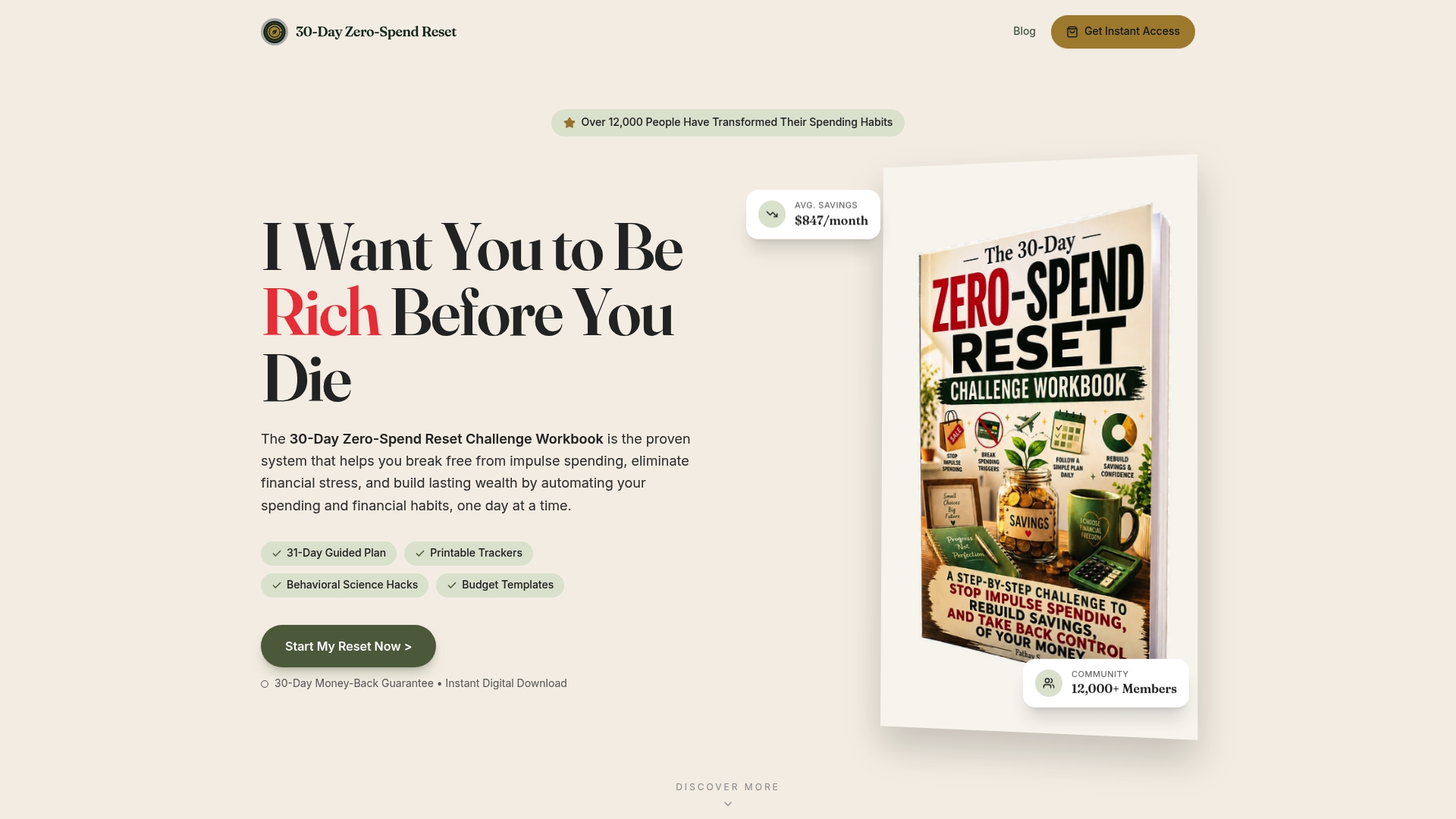
It maps directly onto what's covered here, turning the ideas into daily behavioral challenges instead of vague advice to "just be mindful." For readers who want the full toolkit, including social scripts for money conversations, the Zero-Spend Accelerator Vault bundles resources into one package. Start with the workbook and build the habit one day at a time.
This article is general information, not a substitute for advice from a qualified financial advisor. Consult a qualified financial professional about your own circumstances before acting on anything here.
FAQ
How do you develop the habit of saving money?
Start with one automated transfer right after payday and one repeatable behavior, like a weekly no-spend day, rather than trying to overhaul your whole budget at once. The CFPB notes that consistency in small, regular contributions matters more than the size of any single transfer.
What is the biggest money waster?
There's no single universal answer, since spending leaks differ by household, but forgotten subscriptions and impulse purchases driven by stress or boredom are consistently named as major drains. Auditing recent bank statements for recurring charges you no longer use is the fastest way to find your own biggest leak.
Why do younger savers struggle to build savings?
Lower starting incomes, higher living costs, and heavier reliance on digital spending with fewer physical cues all make saving harder for younger earners, though the exact mix varies by individual circumstance. Automating even a small transfer removes the need to rely on willpower against those pressures every payday.
What is a reasonable starting savings target?
There's no single fixed rule, but the CFPB's financial empowerment toolkit suggests starting with a small target like $500, then building toward $1,000, rather than aiming for months of expenses right away. Starting small and automating consistent contributions matters more than hitting a specific number immediately.
Sources
- An essential guide to building an emergency fund | Consumer Financial Protection Bureau
- Experian
- Publichealth
- Consumer
- NBER WORKING PAPER SERIES
Recommended
Ready to reset your spending?
Get the 30-Day Zero-Spend Reset Workbook and turn these ideas into a daily action plan.
Start the 30-Day ResetThis article is part of the 30-Day Zero-Spend Reset method. Explore the complete day-by-day system behind these ideas.
Read the full guideKeep reading



Join the conversation
Be the first to share your thoughts on this article.