
The Cashback Trap: How Rewards Cost You More Than They Pay

Cash back feels like free money, but carrying a balance or spending more to earn it can cost more than you get back. Here is how the trap works and how to avoid it.
The Cashback Trap: How Rewards Cost You More Than They Pay
The cashback trap is what happens when a small reward, usually 1% to 5% back, nudges you to spend more or to carry a card balance, so the interest and extra purchases cost far more than the rewards ever return. If you pay your full statement every month and spend only what you already planned, cash back is a modest bonus. If you carry a balance, it is almost always a losing deal. This guide shows the numbers, the behavior behind them and a 30-day way out.
TL;DR
- Cash back typically refunds 1% to 5% of what you spend. Credit card interest is typically many times larger than that.
- The FDIC says a 2% cash-back card loses to a 15% APR on any balance you carry, because interest exceeds the reward.
- A Federal Reserve Bank of Chicago study tied a 1% cash-back offer to higher monthly spending and higher card debt.
- The trap is as much about behavior as arithmetic: a reward makes extra spending feel justified.
- The fix is a reset: pause card spending, audit what you buy, and use rewards only on purchases you had already planned.
Table of Contents
- What the cashback trap actually is
- The interest trap: the math
- The spending trap: why rewards make you spend more
- Who falls into it most
- Five signs you are in the cashback trap
- How to get out: pause, audit, then use rewards on purpose
- Where a structured reset fits
- Our perspective
- FAQ
- Sources
What the cashback trap actually is
Cash back is usually a credit card benefit that returns a percentage of your spending. Investopedia's explainer describes typical rates of 1% to 5% and three common designs: a flat rate on everything, tiered rates by category, and temporary promotional categories. The same word can also mean taking cash out at the register when you pay with a debit card, which is a different thing and carries no trap.
The trap lives in the credit card version. A reward is a small, certain, visible gain. The costs sit elsewhere and arrive later: interest on a balance, spending you would not have done, fees, and the effort of tracking categories. Because the gain is vivid and the costs are scattered, your brain tallies the reward and forgets the rest.
There are two separate traps, and many people fall into both:
- The interest trap. You carry a balance, and interest outruns the reward.
- The spending trap. You spend more than you otherwise would because it "pays" you.
The interest trap: the math
Start with the simplest case. The FDIC's consumer guide Rewards Cards: Minimize the Pitfalls, Maximize the Rewards (March 2019) says a card offering 2% cash back is a losing deal if you carry a balance at 15% APR, since you pay more in interest than you earn. It also advises comparing the APR, annual fee, cash-advance fee, late fee and balance-transfer fee against the rewards before you commit.
APR means annual percentage rate: the yearly cost of borrowing on the card. Rewards cards tend to carry high ones. The CFPB's 2019 Consumer Credit Card Market report put the average 2018 APR at 20.3% for general-purpose cards and 26.4% for private-label cards.
A worked example with round numbers makes the gap plain. Say you charge $1,000 a month on a 2% cash-back card and carry a $5,000 balance at 22% APR:
| | Per year | |---|---| | Cash back on $12,000 of spending at 2% | $240 | | Interest on a $5,000 balance at 22% (approximate) | $1,100 | | Net result | About $860 worse off |
These figures are an illustration, not a quote from any card. Real interest depends on your daily balance and how your issuer compounds. The direction never changes: a reward of 2% cannot outrun an interest rate of 20% or more.
NerdWallet's analysis of the average rate, 23.37% as of August 2024 according to its study, makes the same point on a timeline. On a 2% cash-back card with $1,000 in monthly charges, interest overtakes the rewards in six months if you pay $500 a month, or in four months if you pay $50 a month. Average card rates are published by the Federal Reserve and change as it releases new data, so check the live figure rather than relying on any number printed in an article.
The CFPB reached the same conclusion in its May 2024 report on card rewards: consumers who carry revolving balances often pay more in interest and fees than they receive in rewards. The report also documented complaints about reward conditions, redemption obstacles, devaluation and forfeiture. In other words, even the reward you think you earned may not be worth what the ad said.
The spending trap: why rewards make you spend more
Even if you never carry a balance, a reward can change what you buy. The best-known evidence comes from the Federal Reserve Bank of Chicago. In a 2010 working paper using data from a large U.S. financial institution, a 1% cash-back offer was associated with average monthly spending rising $68 and card debt rising $115 in the first quarter after enrollment. Monthly payments fell by an average of $38. So debt grew by more than spending did. The authors also found that some spending and debt moved over from other cards. The study followed one institution's reward program, so it shows what can happen, not what happens to everyone.
The behavior has a name. In a 2020 peer-reviewed analysis in Financial Services Review, Noah MacDonald and Brent Evans used theoretical models to show that cash-back cards can increase spending and reduce savings for some consumers, even when those consumers are rational and choose the card over cash.
A second line of research points to mental accounting, the habit of treating money differently depending on where it came from or where it sits. A 2018 Journal of Marketing Research study of cashback shopping, summarized by the Tuck School of Business, found the authors' leading explanation was that returned money feels earmarked for more shopping at the same place, rather than interchangeable with any other dollar. In the study, each additional $1 in cashback was associated with $0.32 more spending on a later transaction (Journal of Marketing Research, 2018). That study covered cashback shopping sites, not credit cards, but the psychology rhymes: a rebate feels like permission.
You probably recognize the thought patterns:
- "I'll put the groceries and gas on the card, it pays me back."
- "It's 5% back this quarter, so now is a good time to buy."
- "I earned $40, so I can spend $40."
- "I'll pay it off next month." (And then the month after.)
Each one treats the reward as a reason to spend rather than a small discount on spending you had already decided to do.
Who falls into it most
Rewards cards are not a niche product. The CFPB's 2015 market report found that as of 2014, rewards accounts represented nearly two-thirds of all credit card balances and four-fifths of all credit card spending. It warned that consumers may not understand when rewards expire or are forfeited, which makes cards hard to compare, especially for people likely to carry a balance. The 2019 report added that rewards cards' share of spending kept rising, especially among consumers with lower credit scores.
The habit is common even among people already in debt. A NerdWallet survey of more than 2,000 U.S. adults, run by The Harris Poll, found that 21% of Americans had used a credit card to earn rewards in the past 12 months despite having card debt.

So if you are stuck in debt, impulse-prone, or buried in subscriptions, you are the person these programs are most likely to cost money.
Five signs you are in the cashback trap
- You carry a balance from month to month on a rewards card.
- You chose a card, or a store, because of a bonus category rather than a plan.
- Your monthly card total keeps surprising you.
- You use one card to pay off another.
- You can name your cash back for the year but not your interest charges.
Look at your last twelve statements and add up two numbers: rewards earned and interest plus fees paid. Many readers find the second number is the bigger one. Do it before you decide anything else.
How to get out: pause, audit, then use rewards on purpose
The advice from consumer finance sources is consistent. NerdWallet advises pausing card spending until existing debt is paid off, and using cash or debit for the categories where you struggle to control yourself. A credit union guide it cites adds a set of working rules: charge only what you could pay from checking today, pay the full statement balance or as much above the minimum as you can, keep utilization (the share of your limit you are using) below 30%, and use rewards only on planned purchases (NerdWallet's debt and rewards study).
Turn that into a sequence:
Step 1: Stop the inflow
Take the card out of your wallet and out of your phone's saved payment methods. Switch recurring bills to debit while you work on the balance. If the debt is large enough that selling an asset is on the table, it helps to understand selling a house to pay off debt as one of the bigger levers some people consider alongside everyday spending cuts.
Step 2: Audit the leaks
Pull three months of statements. Mark every recurring charge, every purchase you made because of a bonus or sale, and every delivery or convenience order. Subscriptions are the quiet part of the trap: small charges that renew automatically, and that you stop noticing because the card absorbs them.
Step 3: Run a spending reset
A one-time audit does not change the reflex behind the purchase. A short stretch of deliberately spending nothing beyond essentials does, because it makes each urge visible. Thirty days is long enough to break a routine and short enough to finish.
Step 4: Aim the freed money
Send what you no longer spend to the highest-APR balance first, then build a starter emergency fund so the next surprise does not land back on the card. A cushion is what lets you stop borrowing for ordinary shocks.
Step 5: Only then, use rewards deliberately
Once you pay in full every month and spend only what you had budgeted, a flat-rate cash-back card does what it was meant to do: a small discount. Keep the rule simple. If the reward changes whether you buy, it is no longer a reward.
Where a structured reset fits
Knowing the math rarely stops the behavior. What helps is a daily structure that replaces willpower with a routine, and that is what the workbook below is built to provide.
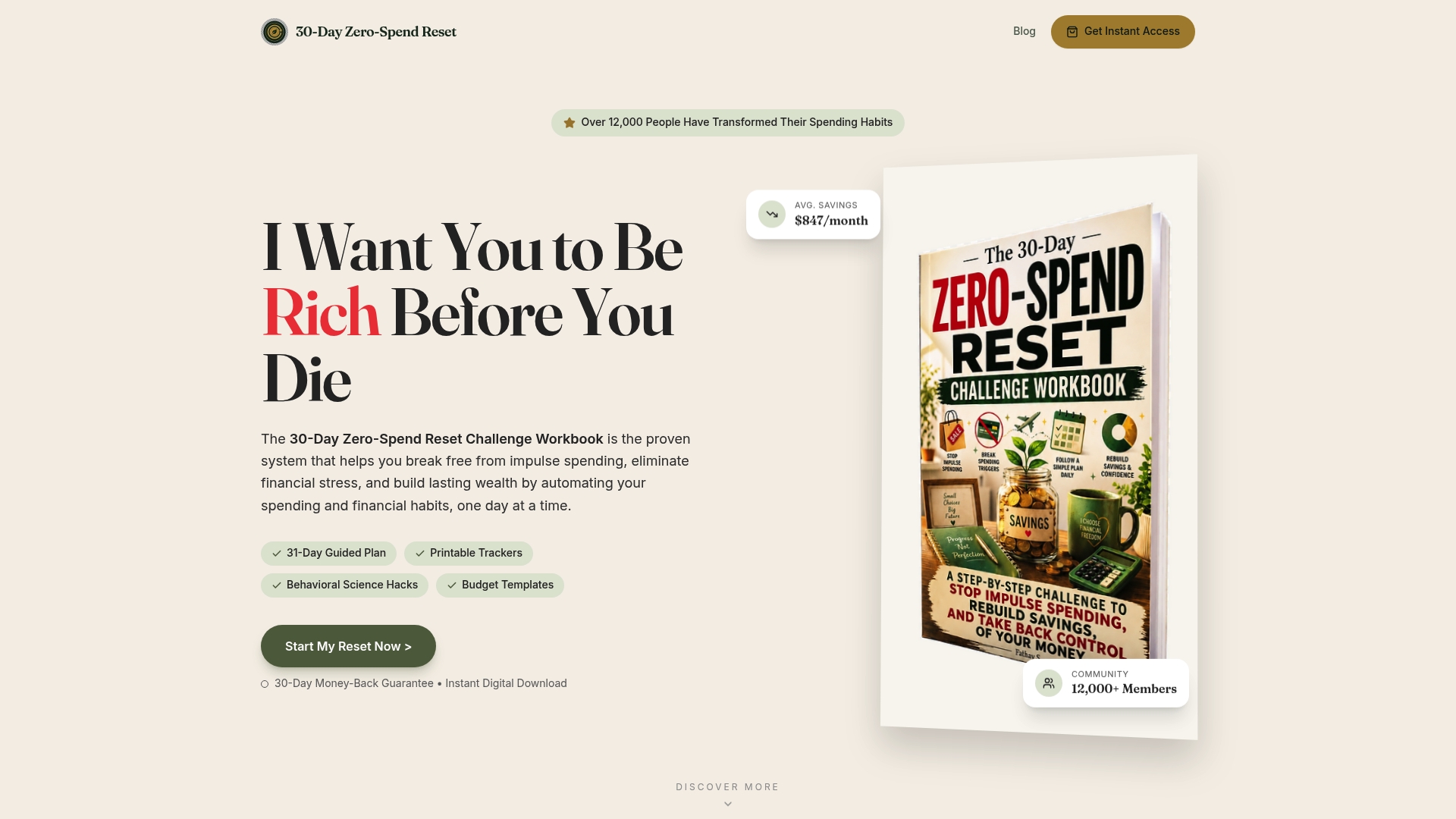
The 30-Day Zero-Spend Reset Challenge Workbook
The 30-Day Zero-Spend Reset Challenge Workbook takes you through structured daily challenges aimed at impulse buying, subscription creep and emotional spending. It comes with a companion webapp, printable trackers, budget templates, meal planning guides for bringing the grocery bill down, subscription audits, and social scripts for money conversations, such as telling family or friends you are sitting out the dinner or the shopping trip.
If you want the extras that go with it, the Zero-Spend Accelerator Vault bundles additional resources for the same goal. You can also read the Zero Spend Guide to see how the program is laid out.
Our perspective
We built this program around a simple observation: most people who fall into the cashback trap do not have a knowledge problem. They have a moment problem. At the checkout, the rewards feel like a discount, and the interest feels like next month's problem.
That is why we lean on behavioral psychology rather than another budget spreadsheet. A budget tells you what you should have spent. A daily challenge changes what you do at the exact moment you reach for the card, and it does so without guilt or deprivation. Thirty days of deliberately spending less gives you evidence about your own triggers: the late-night order, the subscription you forgot, the purchase you made because a category was paying extra.
We designed the workbook and the webapp to make that evidence easy to see and easy to act on, with trackers, templates and scripts for the awkward conversations. Our aim is that you finish with a reset you can sustain, so that rewards become a small bonus on spending you chose, never the reason for it.
Omar
FAQ
Is 2% cash back worth it?
It is worth it only if you pay the full statement balance every month and spend what you had already planned to spend. On a carried balance, typical card interest rates of 20% or more swamp a 2% reward. The FDIC's example shows a 2% reward losing to a 15% APR.
What is a credit card trap?
It is any feature that leads you to pay more than you realize: high interest on a carried balance, fees, rewards that expire or are forfeited, and spending pushed up by incentives. The CFPB has documented consumer complaints about reward conditions, redemption obstacles and devaluation.
Do cash-back cards make you spend more?
They can. The Chicago Fed study linked a 1% cash-back offer to $68 more monthly spending and $115 more card debt in the first quarter. Academic models show the same pattern for some consumers. Planned purchases and a firm monthly spending limit blunt the effect.
Should I use cash back while paying off debt?
Pause card spending until the debt is paid off, as consumer finance guidance advises, and use cash or debit for categories you struggle to control. Rewards on a card you are paying down are the weakest bargain there is, since interest is working against you every month.
How do I know if my rewards are worth more than my interest?
Add up twelve months of rewards earned, then twelve months of interest and fees from your statements. If interest and fees are larger, you are in the trap. Compare your card's APR to the current average published by the Federal Reserve.
Sources
- Understanding Cash Back, Investopedia
- Rewards Cards: Minimize the Pitfalls, Maximize the Rewards, FDIC (March 2019)
- The Consumer Credit Card Market, CFPB (2019)
- The Consumer Credit Card Market, CFPB (December 2015)
- CFPB report on credit card rewards (May 2024)
- Why Do Banks Reward their Customers to Use their Credit Cards?, Federal Reserve Bank of Chicago (2010)
- If You're in Credit Card Debt, Forget About Rewards, NerdWallet (2024)
- A theoretical examination of cash-back credit cards, Financial Services Review (2020)
- Cashback Is Cash Forward, Journal of Marketing Research (2018)
- Does Cashback Make Consumers Come Back?, Tuck School of Business
- Selling a house to pay off debt
Ready to reset your spending?
Get the 30-Day Zero-Spend Reset Workbook and turn these ideas into a daily action plan.
Start the 30-Day ResetThis article is part of the 30-Day Zero-Spend Reset method. Explore the complete day-by-day system behind these ideas.
Read the full guideKeep reading


Join the conversation
Be the first to share your thoughts on this article.