
Survival First: Budget for Irregular Income with a Baseline and Habits

Stabilize variable pay: set a realistic baseline, funnel income into a holding account, automate 25 to 30% for taxes, and run a 30 day habit reset to...
Survival First: Budget for Irregular Income with a Baseline and Habits
The simplest stable system for irregular income is to budget to your lowest reliable month, route every payment into a holding account, and pay yourself a steady baseline from it. Add two rules on top: set aside 25 to 30% of gross income for taxes, and build a one-month buffer before scaling further. Start by pulling 6 to 12 months of past income to find your number.
TL;DR:
- Setting a conservative income baseline based on your lowest reliable month ensures stability during slow periods and prevents overspending.
- Routing all payments into a dedicated holding account and paying yourself a fixed amount helps manage irregular cash flow and avoid impulsive decisions.
- Building a small, accessible emergency fund of at least one month, then gradually expanding to three to six months, provides crucial financial security.
- Automating tax savings and estimated payments minimizes surprises, with 25 to 30% of income set aside specifically for tax obligations.
- Using a cash-flow calendar and weekly reviews allows early detection of shortfalls and adjusting expenses proactively to maintain solvency.
Table of Contents
- How to pick a conservative baseline and use an income holding account
- List and prioritize fixed versus flexible expenses
- Tax obligations and simple habits to avoid surprises
- Build your buffer: start with one month and scale toward 3 to 6 months
- Use a cash-flow calendar and weekly checks to spot gaps early
- Allocation rules for surplus income (percentage framework)
- Concrete steps when you earn less than your baseline
- Behavioral tactics: daily habit experiments that make the system stick
- Why a survival-first system beats forecasting
- Try the 30-Day Zero-Spend Reset to put this into practice
- FAQ
- Sources
How to pick a conservative baseline and use an income holding account
A budget built on your average income looks fine on paper and fails in a slow month. A budget built on your worst reliable month survives both. This approach comes from financial educators who work specifically with variable earners, and the logic is straightforward: you spend based on what shows up even in a lean stretch, not what shows up when things go well.
Here's how to set it up:
- Pull your net income for the last 6 to 12 months from bank statements or invoices.
- Identify your lowest month that wasn't a fluke (ignore a single catastrophic month if it was a one-time event, but don't ignore a slow season that repeats).
- Set that figure, or a slightly more conservative version of it, as your baseline.
- Open a separate account, an "Income Holding Account," and route every client payment or commission into it first.
- Pay yourself a fixed amount from that account on a set schedule, monthly or biweekly, regardless of when the money actually arrived.
Say your last 12 months of net income ranged from $2,100 to $5,800, with most months landing between $3,000 and $3,400. A conservative baseline would be around $3,200. You'd transfer that amount to your personal checking account every month, no matter what came in, and let the holding account absorb the gaps.
Pro Tip: Automate the transfer from your holding account to checking on the same date every month, so "paying yourself" stops being a decision you have to make.
List and prioritize fixed versus flexible expenses
Once your baseline is set, you need to know exactly what it has to cover. Separate your spending into two buckets.
- Fixed essentials: rent or mortgage, utilities, insurance premiums, minimum debt payments, groceries, and transportation.
- Flexible spending: subscriptions, dining out, entertainment, and nonessential shopping.
Periodic bills like car insurance, annual software fees, or holiday spending deserve their own line. Take the yearly total and divide by 12, then set that amount aside monthly so a single annual charge never blows up your budget in the month it lands.
When a lean month hits, fund things in this order: essentials first, then your tax set-aside and buffer contribution, then any debt above the minimum, and only then flexible spending. That sequence keeps you housed and solvent even when flexible categories get cut to zero for a few weeks.
Tax obligations and simple habits to avoid surprises
Self-employment tax runs 15.3% of net earnings, covering Social Security and Medicare, on top of regular income tax. That's the figure that catches a lot of new freelancers off guard, since no employer is withholding it for you.
The IRS requires quarterly estimated payments once you expect to owe $1,000 or more for the year.
Freelancers who expect to owe $1,000 or more in tax for the year generally need to make estimated tax payments each quarter.
A practical habit: open a dedicated, high-yield savings account for taxes and automate a transfer of 25 to 30% (https://www.irs.gov/filing/federal-income-tax-rates-and-brackets) of every payment into it the day it arrives. If your income is especially uneven, the annualized income installment method described in Form 1040-ES lets you match each quarterly payment to what you actually earned that period, which can reduce penalties compared to paying the same flat amount every quarter. Put the four payment deadlines on a calendar now, rather than relying on memory later.
Build your buffer: start with one month and scale toward 3 to 6 months

Don't aim for six months of savings on day one. Start with a one-month, bare-bones buffer inside your holding account first. It's a smaller, faster target, and it's the cushion that actually prevents you from reaching for a credit card during your first slow month. Once that's in place, extension-based financial educators recommend building toward a 3 to 6 month emergency fund over time.
A few ways to fund it without feeling it:
- Send a fixed percentage of every payment above your baseline straight to savings.
- Round up invoices and funnel the difference into the buffer.
- Treat any large or unusual payment, a bonus project, a tax refund, as an automatic deposit rather than spending money.
Pro Tip: Keep your buffer in a separate, accessible high-yield savings account, not your checking account, so it's available in an emergency but not a tap away during a boring Tuesday. The CFPB's guidance on emergency funds notes that even small, consistent deposits build meaningful security over time, which matters if your income doesn't allow for large lump-sum savings right away.
Use a cash-flow calendar and weekly checks to spot gaps early

Switching from monthly thinking to a date-based view is one of the most useful changes a variable earner can make. A cash-flow calendar lists the actual dates you expect income to land next to the actual dates your bills are due, so you can see a shortfall coming weeks in advance instead of discovering it when a payment bounces.
A simple weekly 10-minute review keeps this current:
- Reconcile what actually came in against what you expected.
- Update your holding account balance.
- Move any surplus toward taxes, buffer, or debt before it blends into spending money.
- Flag any week where a bill due date lands before an expected payment.
A basic spreadsheet with columns for date, expected income source, amount, and bills due works fine. Penn State Extension's budgeting resources offer templates built around this same calendar logic for variable income. When a gap shows up, shift discretionary charges to a later date, pull from the buffer, or call the creditor before the due date, not after.
Allocation rules for surplus income (percentage framework)
A strong month creates a new problem: deciding what to do with the extra money before it quietly disappears into spending. A fixed percentage split removes that decision. One example framework recommended by financial educators splits surplus as follows:
- 40% to savings or buffer
- 30% to debt paydown
- 20% to taxes
- 10% to discretionary spending
Automating that split the moment a large payment lands means you never have to negotiate with yourself about it later, and that's the real value: removing the emotional decision point where overspending usually creeps in.
Pro Tip: Set up the split as an automatic transfer rule tied to your holding account, so a big invoice gets divided before you ever see the full amount in your checking account. If a seasonal spike brings in triple your baseline one month, the same ratios still apply, just on a bigger number.
Concrete steps when you earn less than your baseline
A month that falls short of your baseline calls for a short, specific checklist, not panic.
- Pay essential bills first: housing, utilities, insurance, minimum debt payments.
- Pull the difference from your one-month buffer rather than a credit card.
- Contact lenders or landlords proactively if a due date needs to shift a few days.
- Pause flexible subscriptions and nonessential spending for the month.
- Consider short-term income options, but evaluate any borrowing carefully. High-cost credit card debt or payday-style loans can turn one slow month into a multi-month problem.
Only lower your baseline if several months in a row confirm a lasting drop in income, not after a single rough one. When you do adjust it, recalculate conservatively using the same 6 to 12 month method you started with.
Behavioral tactics: daily habit experiments that make the system stick
The mechanics above (baseline, holding account, allocation rules) work better when paired with small daily habits that catch overspending before it happens. Short, structured challenges tend to work well for this because they're specific and time-boxed rather than open-ended resolutions.
A few to try this week:
- Pick one day and spend nothing beyond fixed bills, then notice what you were tempted to buy and why.
- Audit every active subscription and cancel anything you haven't used in 30 days.
- Do a five-minute balance check every Friday against your cash-flow calendar.
Structured, day-by-day programs built around exactly this kind of micro-habit, daily prompts, printable trackers, and subscription audits, can make the difference between knowing what to do and actually doing it consistently.
Why a survival-first system beats forecasting
I've found that people with variable income spend a lot of energy trying to predict next month's earnings, when the bigger lever is simply refusing to let spending expand with a good month. Forecasting helps at the margins, but a conservative baseline and a holding account protect you even when the forecast is wrong, which it often is.
Pick one piece of this system, the baseline, the holding account, or the tax set-aside, and run it for 30 days. Track what changes before adding the next piece.
, Omar
Try the 30-Day Zero-Spend Reset to put this into practice
Knowing the system is one thing. Running it for 30 straight days with daily prompts is what actually makes it stick, and that's exactly what the 30-Day Zero-Spend Reset Challenge Workbook is built for.
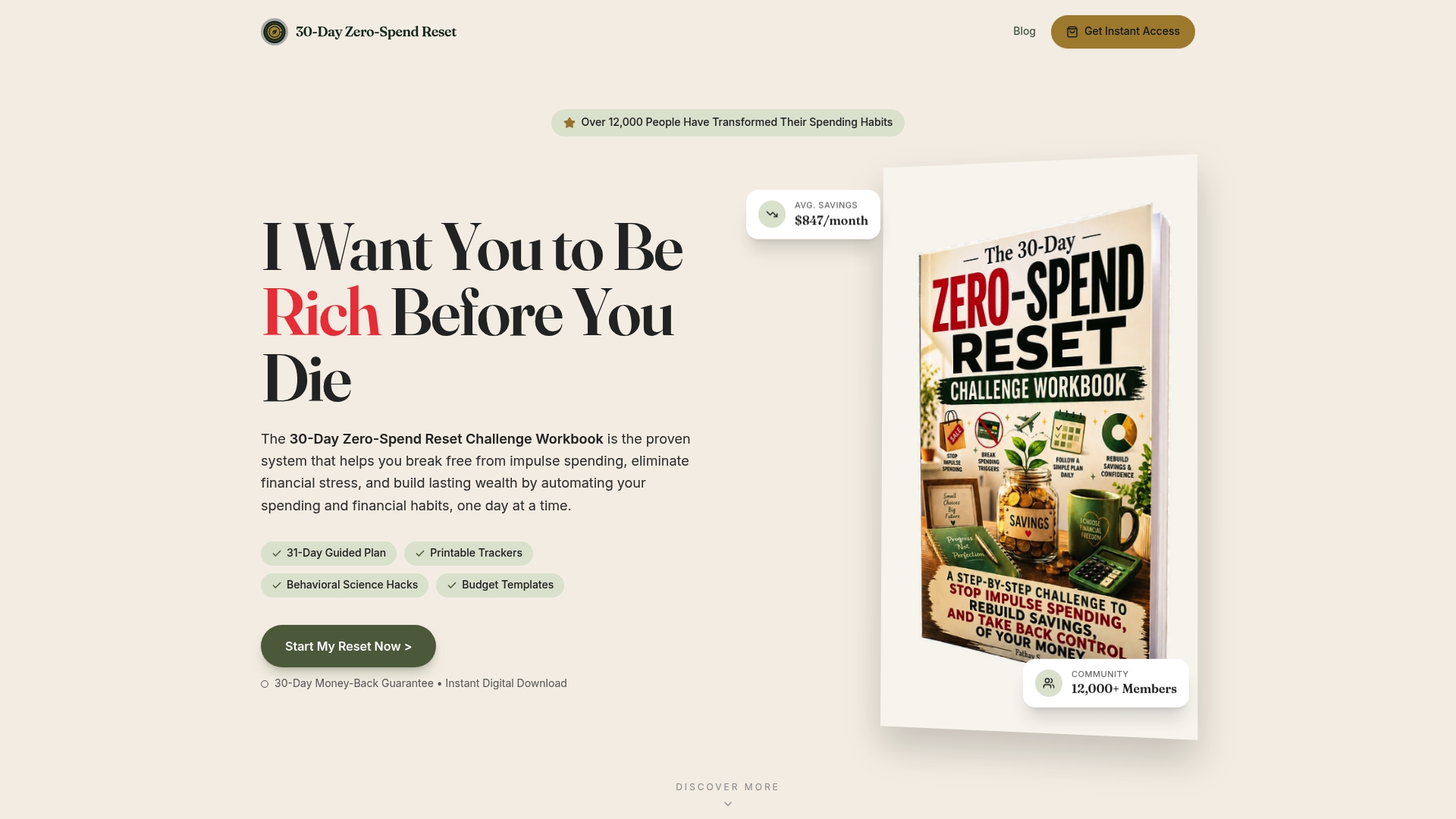
The workbook pairs directly with the cash-flow mechanics in this guide:
- Daily challenges that mirror the micro-habits above, including subscription audits and no-spend days.
- Printable trackers for your baseline, holding account balance, and weekly cash-flow check.
- Budget templates you can adapt to the fixed-versus-flexible split described earlier.
- Social scripts for money conversations, useful when you need to renegotiate a due date or explain a spending pause to family.
- A companion webapp for daily tracking without rebuilding a spreadsheet from scratch.
A low-friction starting point: run a 7-day micro-challenge using one tracker, build your cash-flow calendar alongside it, and see how the two reinforce each other. For a higher-tier bundle with additional tools, the Zero-Spend Accelerator Vault builds on the same workbook. Either way, the next step is the same: start the reset and track what shifts in your spending over the first week.
This article is general information, not a substitute for advice from a qualified financial advisor. Consult a qualified financial professional about your own circumstances before acting on anything here.
FAQ
What is the 70-10-10-10 budget rule?
It works best as a rough starting ratio, which you can adjust using the surplus allocation approach described above for months when income varies widely.
What percent of people who make $100,000 live paycheck to paycheck?
This figure isn't something we can confirm from a government or primary source, so it's not publicly listed here with confidence. What matters more for irregular earners is cash-flow timing, not income level: a baseline budget and holding account address that regardless of how much you earn.
What is the best budgeting method for people with fluctuating income?
The most commonly recommended method is building a baseline budget from your lowest reliable month over the past 6 to 12 months, then funneling income through a holding account and paying yourself a fixed amount. This approach, combined with a cash-flow calendar, is better suited to irregular income than average-based budgeting.
What is the 3-6-9 rule in finance?
Definitions of this rule vary and there's no single authoritative version, so treat any specific figure attached to it with caution. If you're looking for an emergency fund target instead, the well-documented guidance is to start with a one-month bare-bones buffer and build toward 3 to 6 months of expenses over time.
Do I really need to pay estimated taxes every quarter?
Yes, if you expect to owe $1,000 or more in tax for the year, the IRS requires quarterly estimated payments rather than one lump sum in April. If your income is uneven quarter to quarter, the annualized installment method on Form 1040-ES can help match payments to actual earnings and may reduce penalties.
Sources
- Self-Employment Tax (Social Security and Medicare) | Internal Revenue Service
- How to Budget Effectively with an Irregular Income | Nebraska Banking and Finance
- An essential guide to building an emergency fund | Consumer Financial Protection Bureau
Recommended
Ready to reset your spending?
Get the 30-Day Zero-Spend Reset Workbook and turn these ideas into a daily action plan.
Start the 30-Day ResetThis article is part of the 30-Day Zero-Spend Reset method. Explore the complete day-by-day system behind these ideas.
Read the full guideKeep reading


Join the conversation
Be the first to share your thoughts on this article.