
Zero-Based Budgeting: Save $400–$700 With a 30-Day Habit Reset
Use zero based budgeting to run a 30-day habit reset that pairs preset exceptions, same day savings transfers, and a day 31 debrief. Workbook and webapp...
Zero-Based Budgeting: Save $400–$700 With a 30-Day Habit Reset
A 30-day zero-spend reset is a short diagnostic sprint, not a lifetime budget overhaul: you cut nonessential spending for one month, log every trigger, and move whatever you save into a separate account the same day you would have spent it. Success looks like a clear number saved, two or three subscriptions or habits permanently cut, and a day-31 decision about what stays gone. The 30-Day Zero-Spend Reset Challenge Workbook gives you the daily structure to run it without inventing rules as you go.
TL;DR:
- Predefine essential expenses and a few specific exceptions to ensure compliance during the challenge’s first 72 hours.
- Use weekly subscription audits and daily logging to prevent impulse spending and reinforce accountability.
- Cancel unused subscriptions and transfer saved money into a dedicated savings account on the same day to maximize the impact.
- Focus on tracking and categorizing your actual savings at the end of 30 days to create a sustainable long-term spending strategy.
- Build in long-term habits by automating transfers, setting rules for no-spend days, and reviewing your progress around day 66.
Table of Contents
- What to Set Up Before Day 1 of Your Zero-Spend Reset
- How Does the 30-Day Structure Actually Work Week by Week?
- What's the Simplest Way to Track Savings and Automate the Payoff?
- What Should You Do on Day 31 to Make It Stick?
- Building a Simple Zero-Based Budget Worksheet for the Month
- How the Workbook and Vault Support Every Step of the Reset
- What Actually Trips People Up During a Reset
- Sources
- FAQ
What to Set Up Before Day 1 of Your Zero-Spend Reset
Most zero-spend challenges fail in the first 72 hours because people start without deciding what "essential" actually means for them. Fix that before day 1, not during it.
Build your essentials list now and cap your exceptions:
- Write down what you'll still pay for: rent or mortgage, groceries, utilities, minimum debt payments, medications.
- Name two or three specific exceptions in advance (a standing coffee with a parent, gas for a work commute) and write them on the list itself.
- Anything not on that list is off-limits for 30 days, full stop.
Then clear the friction that makes impulse buying easy:
- Run a 10 to 20 minute subscription audit through your bank or card statement and cancel anything you haven't used in 60 days.
- Delete saved payment cards from shopping apps and browsers.
- Uninstall delivery and shopping apps you check out of boredom.
- Decide your savings destination now (a separate high-yield account works well) and set a rule that anything you don't spend gets transferred that same day.
- Pull two to three months of bank statements so you have real baseline numbers instead of a guess.
Pro Tip: Screenshot your subscription list before you cancel anything. You'll want it on day 31 to decide what's worth reactivating and what you never actually missed.
How Does the 30-Day Structure Actually Work Week by Week?
The month breaks into four distinct phases, and each one has a different failure risk. Treating all 30 days the same way is why most people quit around day 12.
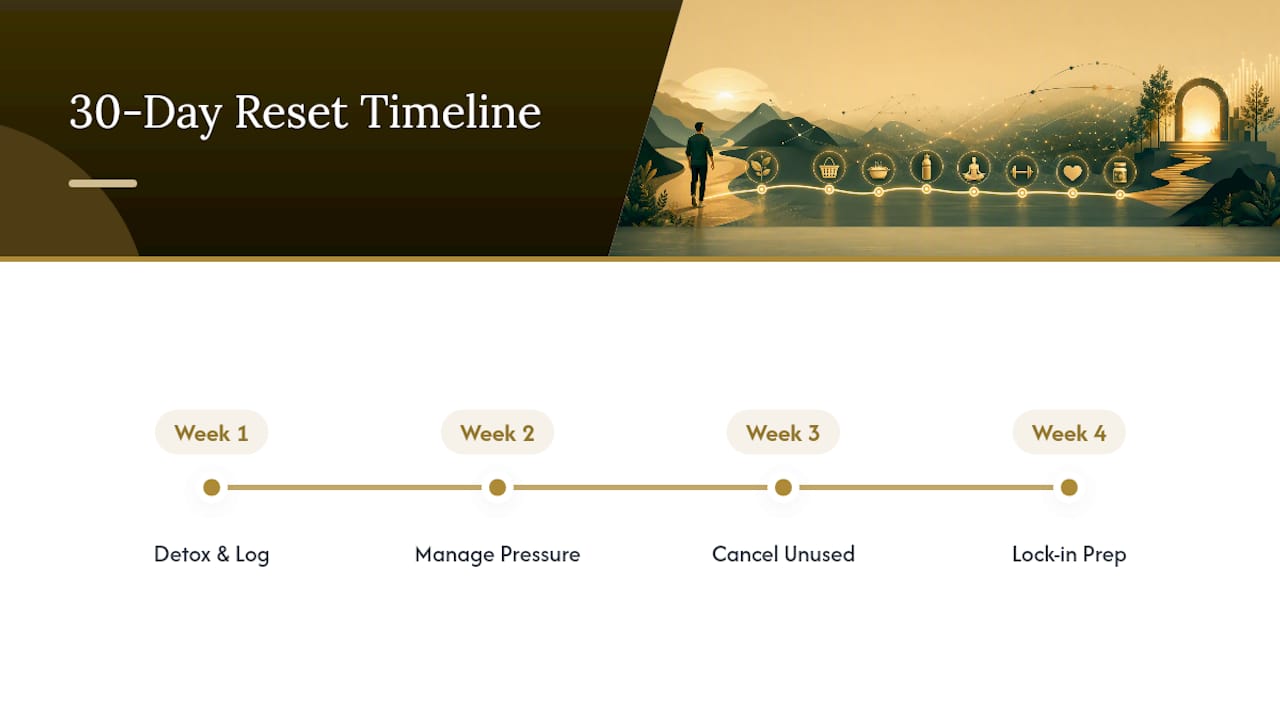
Week 1: Detox. This is about noticing, not perfecting. Log every urge to spend, even the ones you resist, and write down what triggered it, boredom, a sale email, a bad day at work. Lean on your written rules instead of willpower, and practice a 24-hour delay on anything that feels like an exception.
Week 2: The wall. This is where self-regulatory depletion actually shows up. Research on impulse buying found that people whose mental resources were worn down spent more, and the effect hit hardest in people who already struggled with impulse control. This is exactly why your two or three pre-planned exceptions matter, they're not cheating, they're pressure release valves. Use your one weekly planned exception deliberately this week, check in on social situations where spending pressure is high (birthdays, group dinners), and glance back at your subscription list to see if anything auto-renewed.
Week 3: The shift. By now you'll notice something specific: a handful of things you thought you'd miss haven't crossed your mind once. That's your signal. Cancel any subscription or habit that fell into that category permanently, not just for the month.
Week 4: Lock-in prep. Start planning your exit before the month ends, not on day 30. Run through your essentials list one more time, transfer whatever you've saved into your target account the same day you calculate it, and start deciding which caps you'll keep long term.
Every day, three small rituals keep the whole system honest: a quick spending log, a one-line trigger note, and one small non-spending reward that still fits your rules, a walk, a show, a call with a friend. If you slip, log it, note what triggered it, and keep going the next day. One randomized trial found that goal-setting with tracking and explicit targets cut spending significantly, while vague habit-substitution prompts alone did not move the needle. Tracking is not busywork here. It's the mechanism that makes the whole month work.
What's the Simplest Way to Track Savings and Automate the Payoff?
You don't need complicated software for this. A basic tracker with four columns does the job: date, what you would have spent, what triggered the urge, and the amount moved to savings. Review it once a week in under five minutes.
The single most important habit in the entire program is transferring saved money the same day you decide not to spend it. Delayed transfers get absorbed back into checking accounts and disappear. Practical no-spend guides that track this closely report typical monthly savings in the $400 to $700 range, and nearly all of them flag same-day transfer as the step people skip and later regret.
For the subscription side, a five-minute audit through your bank's transaction search or an app like your phone's subscription manager usually surfaces more recurring charges than people expect.
- A basic spreadsheet works fine if you're consistent with it.
- Calendar reminders help enforce the weekly review ritual.
- The webapp companion built into the workbook automates the daily prompts if you don't want to build your own system from scratch.
Pro Tip: Set your savings transfer to happen automatically at the same time each day you log a "no spend" win, so the habit and the reward land together.
What Should You Do on Day 31 to Make It Stick?
Day 31 is where most no-spend challenges quietly fail. People finish the month, feel proud, and slide right back into old spending patterns within two weeks because nothing was set up to make the change stick.
Run this checklist the day the challenge ends:
- Total what you actually saved and compare it to your baseline statements from before day 1.
- Sort every paused purchase or subscription into three buckets: keep canceled, restore, or modify (a cheaper plan, a shared account).
- Set up automated transfers for your new savings rate immediately, don't wait for "next month" to start it.
From there, build a steady-state rule you can actually sustain: a set number of no-spend days each week, a 72-hour cooling-off rule on purchases over a dollar threshold you choose, and a short subscription review once a month.
One thing worth being honest about: 30 days is a diagnostic window, not the finish line. Habit research puts the median time to near-automatic behavior at around 66 days, so treat this month as the data-gathering phase, not the whole project. Many people run a second, narrower month targeting one category, dining out or online shopping, once the first reset proves what's actually worth cutting.
| Day-31 action | Why it matters | |---|---| | Total savings and compare to baseline | Turns a vague feeling of progress into a real number | | Categorize paused purchases | Prevents blanket reactivation of things you didn't miss | | Automate the new transfer rate | Removes the decision point where old habits creep back | | Schedule a follow-up review | Keeps the 66-day habit window from lapsing unsupervised |
Building a Simple Zero-Based Budget Worksheet for the Month
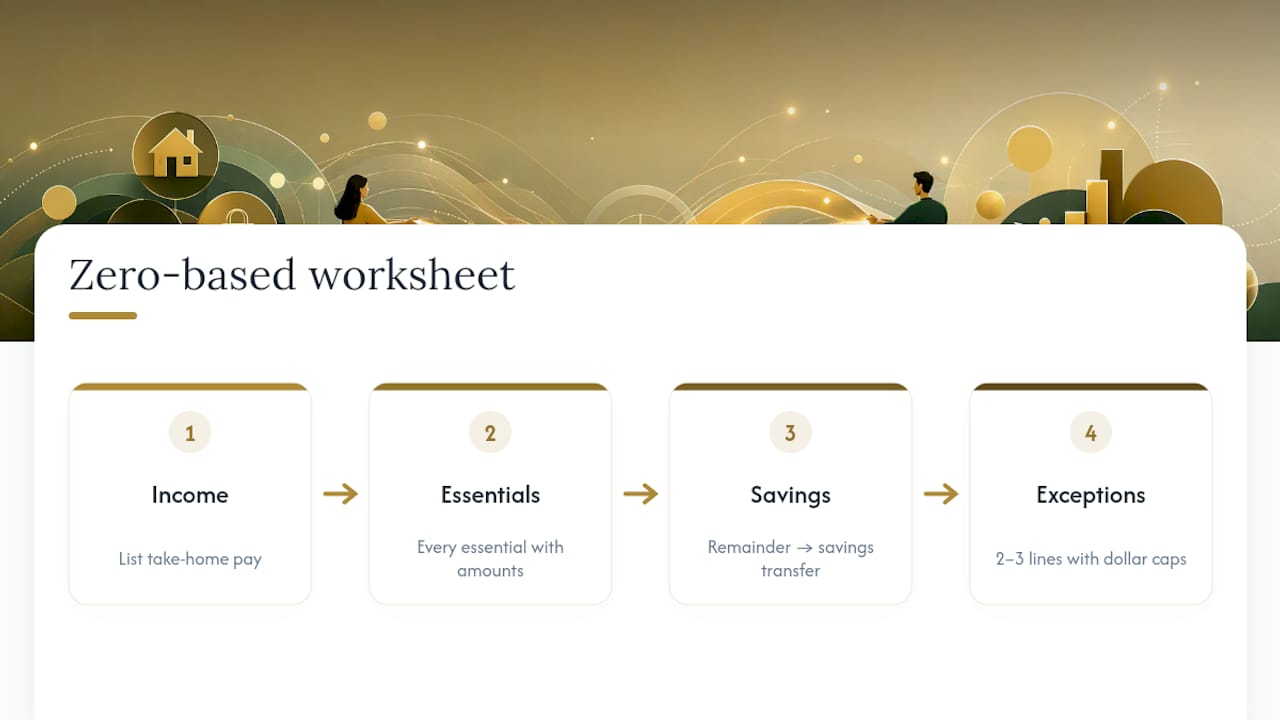
A zero-based worksheet for this challenge is simpler than a full annual budget. Every dollar of income gets assigned somewhere, essentials, savings, debt, exceptions, so nothing is left "unassigned" and quietly spent.
Set up four columns: income, essential expenses, the savings transfer, and your pre-approved exceptions. List your take-home pay at the top. Underneath, list every essential from your prep checklist with its actual dollar amount. Subtract that from income, and the remainder becomes your savings target, not a leftover number you decide on later.
Your two or three exceptions get their own small line with a hard dollar cap, not an open-ended allowance. If your income is irregular, use your lowest recent month as the baseline so the worksheet holds up even in a lean week.
The math should land at zero: income minus essentials minus savings minus exceptions equals nothing left over to spend impulsively. That's the entire point of the exercise. A modified rule set that targets two or three leakage categories and builds in one planned exception consistently outperforms strict all-or-nothing versions, because it gives people a released valve instead of a wall they eventually crash through.
Update the worksheet weekly rather than setting it once and forgetting it. Numbers shift as you cancel subscriptions and your essentials total shrinks, and that recalculated gap is exactly what should flow into your savings transfer.
How the Workbook and Vault Support Every Step of the Reset
Everything above works as a do-it-yourself system, but the 30-Day Zero-Spend Reset Challenge Workbook packages it so you're not building trackers and rules from scratch at 11pm on day 1. It includes daily challenge prompts, printable trackers, a built-in subscription audit worksheet, meal planning guides to cut one of the biggest leak categories, social scripts for the awkward "why aren't you coming to dinner" conversations, and the interactive webapp companion for daily check-ins.
Each piece maps directly to a phase of the program: the prep checklist becomes a printable worksheet, the daily rituals get a built-in log, and the day-31 debrief has its own guided worksheet instead of a blank page. Users of the program have reported saving a notable amount each month, a figure worth treating as a self-reported outcome from people who finished the program rather than a guaranteed result for everyone who buys it.
For readers who want more structure after the first reset, the Zero-Spend Accelerator Vault extends the toolkit with additional resources for running targeted follow-up months. You can also start with the free zero-spend guide to see the method before deciding whether the full workbook is worth it for your situation.
What Actually Trips People Up During a Reset
Flexibility beats willpower every time. The people who finish this month aren't the ones with iron discipline, they're the ones who built in two planned exceptions and moved money the same day they saved it. All-or-nothing rules collapse the first time real life intrudes.
The most common failure isn't a slip, it's what happens after one: skipping the savings transfer, letting exceptions quietly multiply, or quitting entirely because day 14 went sideways. If a full month feels impossible right now, run a smaller experiment first, one week, one category, and build from there.
, Omar
Sources
- Vohs et al., Self‑Regulatory Resources and Impulse Buying (2007)
- Goal-setting vs habit-based interventions: randomized trial (2026)
- Geico: 8 tips for doing a no-spend month (2026)
- Money&Planet: Modified no-spend challenge rules (2026)
FAQ
What Counts as an Essential Expense?
Essentials are recurring, non-negotiable costs: housing, utilities, groceries, insurance, minimum debt payments, and medications. Anything outside that list belongs in your capped exceptions or gets paused for the month.
How Do I Handle a True Emergency During the Challenge?
Emergencies aren't exceptions, they're outside the rules entirely: car repairs, medical costs, or urgent home fixes get paid without guilt or logging as a slip. The challenge targets discretionary and impulse spending, not genuine need.
Is 30 Days Long Enough to Change Spending Habits?
Thirty days is enough to diagnose which purchases you actually miss and which were just habit, but full habit formation typically takes longer, research puts the median around 66 days. Treat the month as the first phase, not the finish line.
What Should I Do If I Slip Up Mid-Challenge?
Log the slip, note what triggered it, and start the next day fresh instead of abandoning the whole month. One skipped rule doesn't erase the data you've already gathered.
Does Nospendreset's Workbook Replace a Traditional Budget?
The 30-Day Zero-Spend Reset Challenge Workbook isn't a monthly budgeting system, it's a structured diagnostic month that identifies what to cut before you build a longer-term budget. Current pricing and bundle details can be found on the client's website.
Ready to reset your spending?
Get the 30-Day Zero-Spend Reset Workbook and turn these ideas into a daily action plan.
Start the 30-Day ResetThis article is part of the 30-Day Zero-Spend Reset method. Explore the complete day-by-day system behind these ideas.
Read the full guideKeep reading


Join the conversation
Be the first to share your thoughts on this article.