
Build a Budget for ADHD Adults in 30–60 Minutes That Runs Itself
Practical budgeting for ADHD adults: set up an automated three bucket system in 30–60 minutes, protect bills and savings with a 5–10 minute payday check.
Build a Budget for ADHD Adults in 30–60 Minutes That Runs Itself
Automate your bills, split every paycheck into three visible buckets (Bills, Savings, Spending), and run a five to ten minute money check-in every payday. That's the whole system. It works because it removes the two things ADHD brains struggle with most: remembering to act and deciding in the moment. A setup checklist follows so you can build it in one sitting.
TL;DR:
- Automating bill payments, savings, and spending buckets helps mitigate ADHD challenges like forgetting due dates and impulsive spending.
- The three-bucket system prioritizes bills and savings before spending, ensuring funds are protected through automatic transfers on payday.
- Setting up the system takes about 30 to 60 minutes, including account organization, transfer automation, and a subscription review to prevent forgotten charges.
- Using visual tools or physical envelopes enhances clarity and reduces mental load, making money management more tangible and manageable.
- Regular five-minute routines, like confirming automations and checking for surprises, maintain system integrity without overwhelming daily efforts.
Table of Contents
- Why Traditional Budgets Fail for ADHD Adults
- The Three-Bucket, Auto-First Money System
- The 30 to 60 Minute Setup Checklist
- Tools and Tech That Reduce the Load Instead of Adding to It
- Impulse Control and Emotional Spending, ADHD-Style
- The Five-Minute Weekly Money Date
- What the Research Says About ADHD and Money Habits
- Budgeting When Your Focus and Energy Change Day to Day
- Handling Emotional Spending Without Shame Spirals
- Building in Flexibility So the System Doesn't Burn You Out
- A Note on Flexibility Over Perfection
- Want the Daily Version of This System?
- Sources
- FAQ
Why Traditional Budgets Fail for ADHD Adults
Most budgeting advice assumes a brain that tracks time, holds numbers in working memory, and pauses before buying something. ADHD often disrupts all three. The CDC notes that ADHD frequently persists into adulthood, and its hallmark symptoms, inattention, impulsivity, and executive-function difficulty, directly interfere with everyday financial tasks like paying bills on time or sticking to a spending plan.
Time blindness means a due date three weeks out feels like it doesn't exist until the late fee hits. Working-memory limits make a 12-category spreadsheet budget collapse within a week, because remembering to log every coffee purchase competes with everything else your brain is juggling. Decision fatigue turns "should I buy this" into an exhausting question asked fifty times a day, and impulsivity often answers it before logic gets a vote.
Here's how the barriers map to fixes:
- Time blindness gets solved by automation, not willpower or reminders you'll forget to read.
- Working memory limits get solved by visual separation, so your eyes do the tracking instead of your brain.
- Impulsivity gets solved by friction, small obstacles that buy you a pause before you spend.
Practitioner guidance from ADHD Advisor points to the same pattern: slowing down purchases and automating savings before you ever see the money produces steadier results than tracking every transaction after the fact.
The Three-Bucket, Auto-First Money System
This is the core of budgeting for ADHD adults done right: money gets sorted before you have a chance to make a decision about it. ADDitude's guidance on ADHD budgeting frames this as separation, splitting funds into distinct pots so your brain never has to calculate what's "safe" to spend from a single mixed balance.
The three buckets work like this:
- Bills and fixed costs. Rent, utilities, insurance, subscriptions. Fully automated, sitting in its own account so you never see it as spendable.
- Savings and safety net. An automatic transfer, ideally to a separate bank, so it's not one tap away when you're tempted to move it back.
- Spending and enjoyment. Whatever is left after the first two. This money is yours to spend with zero guilt, because it's already been protected from the bills and savings you need.
The order matters as much as the buckets themselves. On payday, money should move to Bills first, then Savings, and only what remains lands in Spending. ADDRC's "no-budget" approach describes this exact sequence: a small amount of setup work up front replaces the need for constant tracking later, because the sorting already happened before you could interfere with it.
If digital pots feel abstract, try physical envelopes, color-coded bank tabs, or a dedicated debit card per bucket. Pick whichever version you can actually see and feel, since the goal is reducing the mental math, not adding a new system to maintain.
Pro Tip: Name your Spending bucket something specific, like "Fun Money" or "Guilt-Free Cash," instead of leaving it labeled "Checking." A named bucket feels like permission; an unlabeled balance feels like a number you're not sure you're allowed to touch.
The 30 to 60 Minute Setup Checklist
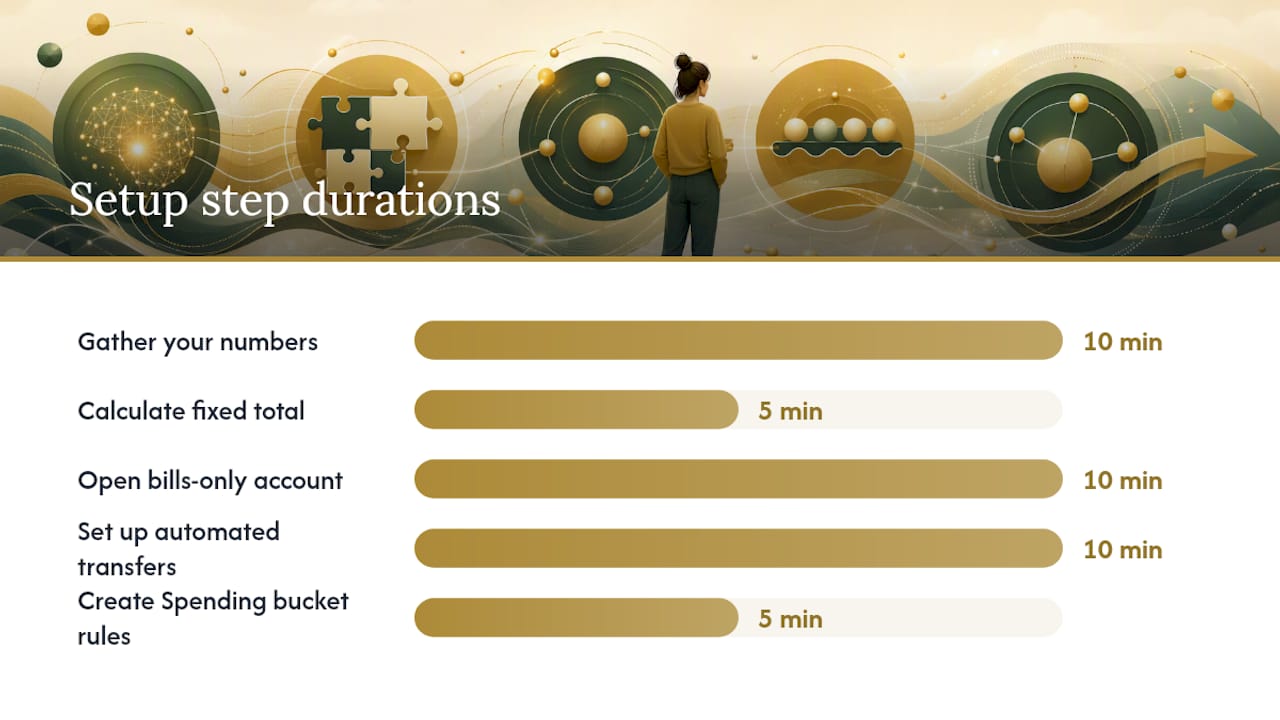
You don't need a weekend for this. Block out one uninterrupted hour, silence your phone, and work through it in order.
- Gather your numbers (10 minutes). Pull up your last two pay stubs and list every fixed bill: rent, utilities, phone, insurance, subscriptions, minimum debt payments.
- Calculate your fixed total (5 minutes). Add it up. This is the exact amount that moves to your Bills bucket every pay cycle. A basic budget worksheet from Consumer.gov works fine for this if you want a template instead of a blank page.
- Open or designate a bills-only account (10 minutes). A second checking account, ideally at a different bank than your main spending account, so it's out of sight.
- Set up automated transfers (10 minutes). Schedule the Bills amount and a Savings percentage to move out on payday, before you touch anything else.
- Create your Spending bucket rules (5 minutes). Decide what's fair game (nights out, hobbies, impulse buys) with zero rule beyond "it's already been set aside."
If your income is irregular, work off a three to six-month average instead of a single paycheck, and consider a percentage rule, 40 to 60% to fixed costs first depending on your obligations, rather than a fixed dollar figure that won't survive a slow month.
Before you finish, run a subscription audit. Scroll your last two bank statements for recurring charges you forgot existed, cancel what you don't use, and set a recurring quarterly reminder to repeat the scan. CHADD's guidance on money management for adults with ADHD points to exactly this kind of small, scheduled check-in as more sustainable than daily tracking.
Tools and Tech That Reduce the Load Instead of Adding to It
The right tool doesn't ask you to make more decisions. It makes decisions for you, once, and then gets out of the way.
Most major banks now offer built-in "pots," "buckets," or sub-accounts alongside scheduled transfers and autopay. Use them before downloading a third-party app. Fewer logins mean fewer places for a system to quietly fall apart.
If you do want an app layer on top, look for:
- Visual goal bars over spreadsheet-style category breakdowns. A progress bar reads instantly; a table of numbers requires interpretation.
- Auto-categorization so you're not manually tagging every transaction.
- One dashboard view, not five tabs. Feature-heavy apps that demand daily input tend to get abandoned within a month by ADHD users specifically because they add a task instead of removing one.
A few low-tech habits do more work than any app:
- Put one recurring "money date" on your calendar every payday, same time, same day.
- Use a single debit card tied to your Spending bucket only, so a bad night can't touch your Bills money.
- Delete stored card numbers from Amazon, DoorDash, and other one-click checkout sites. That thirty-second delay of retyping your card number is often enough friction to interrupt an impulse buy.
Impulse Control and Emotional Spending, ADHD-Style
Impulsivity isn't a willpower problem. It's a brain that acts faster than it evaluates. The fix isn't more discipline, it's more friction between the urge and the purchase.
Concrete tactics that work:
- The 24-hour wishlist rule. Add the item to a cart or list and walk away. If you still want it in a day, buy it from your Spending bucket, guilt-free.
- Delete saved payment methods on shopping sites and apps. Retyping sixteen digits is a small enough obstacle to break the automatic click.
- Require a manual login rather than staying signed in on shopping apps, especially the ones you browse when bored or upset.
Emotional spending gets a different kind of support: company. Financial planners who work with ADHD clients report that body-doubling, doing a task alongside another person, and visual aids consistently improve follow-through compared to advice delivered alone. A quick call with a friend before a big purchase, or a short accountability check-in, does the same job a financial advisor's presence does.
Build in a reward that isn't spending. A visible savings thermometer, a sticker chart, or a small planned treat from your own Spending bucket reinforces the behavior without undoing it. And set up what some ADHD money coaches call an "emergency cushion", a small, separate fund earmarked purely for the moments life goes sideways, so a crisis doesn't become the excuse that blows up the whole system.
Pro Tip: Keep your emergency cushion at a round, memorable number, like $300, not $327.42. A clean number is easier to mentally track and easier to feel proud of rebuilding after you dip into it.
The Five-Minute Weekly Money Date
The system only survives if maintenance takes less effort than the money itself. Here's the full payday routine:
- Confirm the automations ran. Thirty seconds, just check the Bills and Savings transfers actually happened.
- Move any leftover cash from last cycle's Spending bucket into Savings, or spend it, so nothing sits around creating decision fatigue.
- Scan for surprise charges. Look at the last week's transactions for anything unexpected, don't audit every line.
- Top up a savings goal if you have one, even by a few dollars. Visible progress matters more than the amount.
- Do one small enjoyable thing from your Spending bucket. This isn't optional fluff, it's what keeps the system feeling like freedom instead of restriction.
If something slipped, an autopay failed, you overspent, a bill got missed, fix it in that same five-minute window and move on. No spiral, no all-night spreadsheet audit. CHADD's research on ADHD financial habits backs this up directly: low-shame recovery steps and visible progress tracking sustain motivation far better than punishing yourself back into compliance.
What the Research Says About ADHD and Money Habits
The pattern across ADHD financial research is consistent: remove the moment where a decision has to happen, and outcomes improve. ADDitude's coverage of ADHD-friendly budgeting identifies automation timed to payday, moving money before you see it in a spendable account, as one of the single most effective levers available, because it takes the decision out of your hands entirely rather than asking you to resist a temptation.
A structured, daily behavioral-challenge format takes this same principle and breaks it into small enough pieces that no single day requires much willpower. Instead of "fix your finances," a workbook-style program gives you one narrow task at a time, cancel a subscription today, skip discretionary spending tomorrow, which matches how ADHD brains tend to succeed: in short, concrete bursts rather than sustained abstract effort.
Budgeting When Your Focus and Energy Change Day to Day
A rigid budget assumes you have the same amount of mental energy every day. You don't, and pretending otherwise is often what causes ADHD budgeting attempts to collapse by week three.
Build slack into the system on purpose. Your automation handles the days you have zero bandwidth, bills and savings move regardless of how your brain is functioning that week. Your weekly money date should have a floor version: on a low-energy day, "confirm automations ran" is enough. Skip the deeper scan and catch it next week.
Batch any task that requires real focus, canceling a subscription, comparing insurance quotes, into your highest-energy windows, whenever those tend to fall for you. Don't schedule financial admin for the hour you usually crash.
Give yourself permission to run the system on autopilot for a stretch. If a demanding week means you don't open your banking app for ten days, that's fine, because the automation is still working in the background. The entire point of front-loading the setup is that the system doesn't need you to be sharp every single day to keep functioning.
Handling Emotional Spending Without Shame Spirals
Emotional spending isn't a character flaw for ADHD adults, it's often a dopamine-seeking response to boredom, stress, or a bad day, and it responds better to redirection than restriction.
Name your triggers specifically. "Late-night phone scrolling" and "stress after a hard meeting" are more useful than a vague sense that you "spend too much sometimes." Once you know the pattern, you can build a small buffer into that exact moment, deleting the shopping app from your home screen, or setting a house rule that any purchase over a set amount waits for your next money date.

Let your Spending bucket absorb the emotional purchases you do make. Because that money was already separated and approved, a stress buy from that bucket doesn't wreck your bills or your savings, it just means less left for something else this cycle. That containment turns a potential financial crisis into a minor budget adjustment.
Skip the post-purchase self-blame. Guilt rarely stops the next impulse buy, and it often triggers another one as a way to cope with the bad feeling the first purchase created. A brief, factual note, "spent $40 I hadn't planned on, moving on", closes the loop faster than a lecture to yourself ever will.
Building in Flexibility So the System Doesn't Burn You Out
A budget that has zero room for a bad month gets abandoned the first time a bad month happens. Build the give in before you need it.
Leave your Spending bucket genuinely unstructured. No sub-categories, no "this is for hobbies and this is for coffee." One flexible pool prevents the exact kind of granular tracking that ADHD brains tend to abandon within days.
Review the whole system monthly, not daily. A quick check of whether your fixed costs still match reality, and whether your savings percentage still feels doable, catches drift without demanding constant attention. If a bucket amount stops working, change the number. The system exists to serve you, not the other way around.
Plan for at least one "off" month a year where the ritual slips entirely. Automation still runs in the background even when you don't show up for your money date, which means a burnout month doesn't have to become a financial setback, just a pause you pick back up from.
A Note on Flexibility Over Perfection
Rigid systems break the first time life gets messy, and life with ADHD gets messy often. Flexible systems bend and keep working. Pick one automation to set up this week, just one, and watch what happens before adding anything else. If it slips, that's data, not failure, and it's fixable by next payday.
, Omar
Want the Daily Version of This System?
Everything in this guide works as a self-built system, but some people do better with the decisions pre-made for them, day by day, instead of designed once and maintained solo. That's exactly what the 30-Day Zero-Spend Reset Challenge Workbook turns this article into: a structured program of daily behavioral challenges, printable trackers, subscription audits, and even social scripts for the awkward money conversations ADHD adults tend to avoid.

It's built for anyone who wants the three-bucket, auto-first system laid out above but would rather follow a daily prompt than design the whole thing from scratch. Each day tackles one narrow habit, skipping a takeout order, canceling a forgotten subscription, running a no-spend day, so no single task demands more focus than you have that day. The companion webapp tracks your progress visually as you go, and readers who want a lighter first step can start with the Zero Spend Guide before committing to the full 30-day version.
Sources
FAQ
What are some effective hacks for adults with ADHD managing money?
Automate bills and savings on payday, split funds into visible buckets, delete saved payment cards, and use a 24-hour rule before non-essential purchases to add friction against impulsivity.
What is the 1/3/5 rule for ADHD?
There's no single agreed-upon financial definition of a "1/3/5 rule" for ADHD, so treat any version you see as informal advice rather than a clinical standard. A more reliable approach is the three-bucket system covered above: Bills, Savings, and Spending, each separated and automated.
What energizes people with ADHD financially?
Visible progress, like a savings thermometer or a goal bar in a banking app, tends to sustain motivation better than abstract numbers on a spreadsheet, since it turns saving into something you can see move.
What is the 10-3 rule for ADHD?
This isn't a recognized standard in ADHD financial guidance, so no reliable definition exists to cite. If you're looking for a simple numeric anchor, the fixed-cost percentage rule described in the setup checklist above, roughly 40 to 60% of income to essentials first, is a better-supported starting point.
How much time does it take to set up an ADHD-friendly budget?
Most people can build the full three-bucket automation system in 30 to 60 minutes using the checklist above, covering account setup, transfer scheduling, and a subscription audit in one sitting.
Ready to reset your spending?
Get the 30-Day Zero-Spend Reset Workbook and turn these ideas into a daily action plan.
Start the 30-Day ResetThis article is part of the 30-Day Zero-Spend Reset method. Explore the complete day-by-day system behind these ideas.
Read the full guideKeep reading

Join the conversation
Be the first to share your thoughts on this article.