
Save $450 in 30 Days With a Psychology Backed Spending Freeze
Try a psychology backed 30 day spending freeze to stop impulse buys, cancel wasted subscriptions, and save about $450 by logging avoided purchases.
Save $450 in 30 Days With a Psychology Backed Spending Freeze
A spending freeze is a set period, usually 48 hours to 30 days, where you stop all nonessential purchases and redirect that money to savings or debt. Bills, groceries, and medical needs still get paid. Everything else, takeout, new clothes, impulse buys, gets cut, which is exactly what resets spending habits fast and puts real cash back in your pocket.
TL;DR:
- A spending freeze can target specific categories like dining out or clothing, or last 48 hours to 30 days for larger savings and habit change.
- Canceling recurring charges and setting up automatic transfers into a separate account enhances the effectiveness of the freeze.
- Behaviorally, commitment devices, subscription audits, and substitution strategies help sustain the freeze and prevent rebound spending.
- Shorter freezes with recurring follow-ups tend to produce better long-term savings than a single month of restraint.
- A freeze that is overly strict, unrealistic, or treats saving as punishment risks failure and emotional backlash.
Table of Contents
- What Counts as a Spending Freeze, and When Should You Try One?
- Why Does a Spending Freeze Actually Work?
- How Do You Set Up and Run a Spending Freeze?
- What Behavioral Tricks Actually Keep People on Track?
- How Long Should a Freeze Last, and How Often Should You Repeat It?
- What Are the Downsides of a Spending Freeze?
- What Does the Research Say About Why Freezes Work?
- An Editorial Take on What Makes a Freeze Stick
- Ready for a Guided Reset Instead of Winging It?
- Sources
- FAQ
What Counts as a Spending Freeze, and When Should You Try One?
The core distinction in any spending freeze is essential versus nonessential. Rent, utilities, groceries, insurance, medications, and minimum debt payments stay untouched. Nonessential spending, the stuff a freeze targets, includes restaurant meals, new clothes, streaming add ons, impulse Amazon orders, and that daily coffee run you don't actually think about anymore.
Certain life moments make a freeze especially useful. A sudden financial squeeze, a debt balance that keeps climbing, a slow creep in lifestyle costs you can't quite pin down, or a transition month like moving or a job change are all good triggers to hit pause and reassess.
You don't need to pick one rigid format. Common scope templates include:
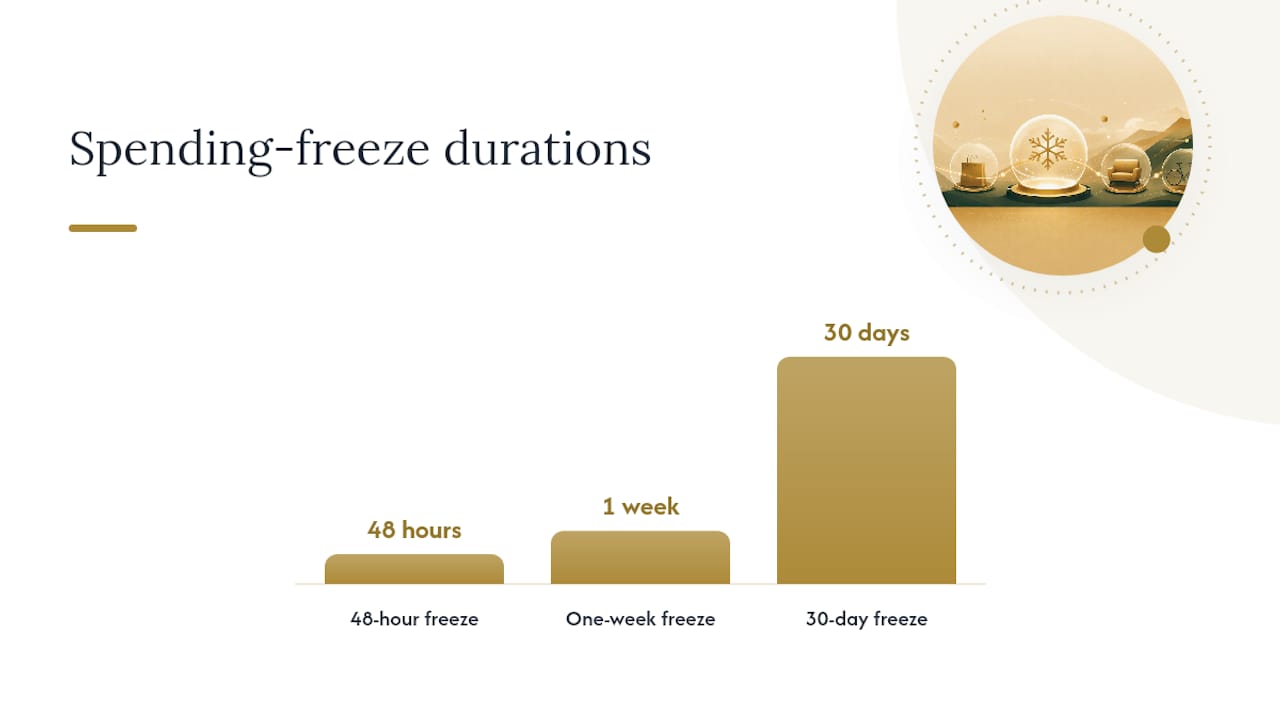
- 48-hour freeze: A quick reset after a spending binge or a rough financial week.
- One-week freeze: Enough time to break a daily habit like drive-through lunches.
- 30-day freeze: The standard length for a full habit reset and meaningful savings.
- Category freeze: Targeting one problem area, like clothing or dining out, while leaving the rest of your budget alone.
Pick the scope that matches the problem. A caffeine habit doesn't need a 30-day overhaul. A maxed-out credit card probably does.
Why Does a Spending Freeze Actually Work?
The obvious benefit is cash. Every dollar you don't spend on nonessentials goes straight into savings or toward debt, often within days of starting. But the bigger win is behavioral: a freeze forces you to notice purchases you'd normally make on autopilot, and that awareness sticks around long after the freeze ends.
A short freeze also builds momentum. Finishing even a 48 hour freeze proves you can say no to spending triggers, which makes the next challenge, a full month, a debt payoff plan, feel achievable instead of impossible.
Common reasons people run a freeze include:
- Building an emergency fund from scratch
- Saving for a specific goal, like a trip or a down payment
- Breaking a cycle of emotional or impulse spending
- Testing whether a "recurring" expense is actually necessary
Behavioral research shows that sunk-cost thinking is one of the biggest reasons people keep funding low-value habits. A freeze interrupts that pattern by forcing a clean break instead of a slow, guilt-driven decision to "use up" a subscription you're already paying for.
How Do You Set Up and Run a Spending Freeze?
A freeze fails when it's vague. "I'll spend less" doesn't work. A concrete plan does. Here's the sequence that holds up in practice.
- Pick your duration and scope. Use 48 hours for a quick reset, one week for breaking a daily habit, or 30 days for a full financial overhaul. If one category is the real problem (dining out, online shopping), freeze just that category instead of everything.
- Write your allowed list. One page, physically written or typed. List every essential: rent, utilities, groceries, gas, medications, minimum debt payments. Anything not on the list is off limits for the duration.
- Audit recurring charges before day one. Pull up your bank statement and cancel anything you wouldn't sign up for again today. This is the moment most people skip, and it's the one that saves the most money long term.
- Set up an automatic transfer. Route whatever you'd normally spend on nonessentials into a separate savings account. Automating it removes the temptation to "decide later."
- Log every avoided purchase daily. Didn't buy the $6 latte? Write it down as $6 saved. This single habit turns willpower into a visible, growing number.
- Plan for friction points in advance. Know which triggers, boredom scrolling, stress, social pressure, tend to open your wallet, and have a substitute ready before the moment hits.
- Do a short wrap-up review. At the end of the freeze, total your logged savings and decide what becomes permanent.
The math is simpler than most people expect. If you normally spend $15 a day on lunch out and skip it for 30 days, that's $450. Add a $60 monthly subscription you cancel for good, and you've banked $510 before touching anything else in your budget.
- Track every "no" as a dollar amount, not a vague win.
- Keep the allowed list visible, on your fridge, your phone lock screen, wherever you'll see it daily.
- Separate the freeze savings account from your regular checking to avoid quiet leakage.
Pro Tip: Move your grocery and gas money into a separate account before the freeze starts. When the "spendable" account hits zero, the decision to skip a nonessential purchase makes itself.
What Behavioral Tricks Actually Keep People on Track?
Most freezes don't fail because the plan was wrong. They fail because nobody built in friction against quitting. A few tactics consistently work better than raw willpower.
Commitment devices raise the cost of quitting early. Tell a friend you're doing a 30-day freeze. Block off the dates on a shared calendar. Some people even put a small deposit on the line with an accountability app, money they lose if they break the freeze.
Organized abandonment solves the subscription problem instantly. Peter Drucker's old test for business costs works just as well for personal budgets: would you start this today? If the answer is no, cancel it now instead of waiting for the next billing cycle.
Substitution beats deprivation every time:
-
Swap takeout for a simple meal-prep Sunday
-
Replace the coffee shop run with home brewed coffee and a nicer mug
-
Trade paid entertainment for a walk, a library book, or a free local event
-
Tell one specific person your plan and ask them to check in weekly.
-
Set a recurring phone reminder that asks "essential or nonessential?" before any purchase over $20.
-
If you share finances with a partner, agree on the rules together before day one so nobody feels ambushed mid-freeze.
Pro Tip: If you and a partner manage money jointly, run the freeze as a shared challenge rather than a rule one person enforces on the other. Freezes framed as punishment rarely survive past week one.
How Long Should a Freeze Last, and How Often Should You Repeat It?
Duration depends on the problem you're solving. A 48-hour freeze works for cooling off after a spending binge. A one-week freeze breaks a specific daily habit. A full 30-day freeze delivers the deepest reset, covering multiple spending categories and giving enough time for new habits to feel normal instead of forced.
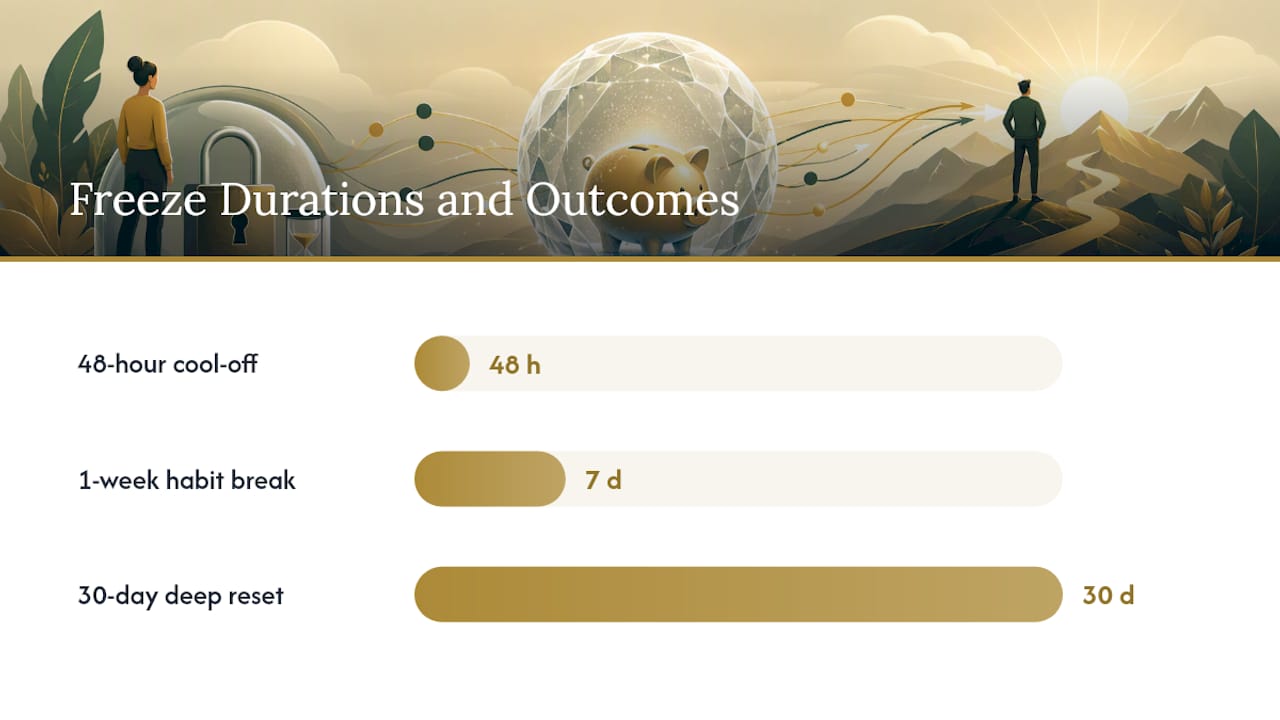
The savings math scales with duration. Someone spending $20 a day on nonessentials saves roughly $140 in a week, or close to $600 across 30 days, before counting any canceled subscriptions.
Most people get the best long-term results from repeating shorter freezes rather than running one marathon month. A reasonable cadence:
- Run a 30-day freeze once, then a 48-hour "tune-up" freeze monthly
- Repeat a full 30-day reset every quarter if debt payoff is the goal
- Graduate to ongoing budget rules once avoided spending becomes automatic
Cost-reduction research backs this up: without follow-up structure, most short-term savings gains quietly revert within 12 to 18 months. A freeze without a maintenance plan is a temporary fix, not a permanent one.
What Are the Downsides of a Spending Freeze?
A freeze that's too strict backfires. Cut too much too fast, and you risk emotional reactance, the psychological pushback that shows up as a rebound spending spree once the freeze ends.
A freeze also fails when it ignores the real problem. If subscriptions never get canceled, or if the "essential" list is unrealistic for your actual life, you'll white-knuckle through 30 days and land right back where you started.
Watch for these pitfalls:
- Making the allowed list so restrictive it becomes unsustainable
- Skipping the subscription audit and missing the biggest recurring drain
- Treating a freeze as punishment instead of an experiment
- Using a freeze to avoid a structural problem, like debt that needs a real payoff plan or income that doesn't cover fixed costs
If your issue is a persistent budget shortfall rather than impulse spending, a freeze alone won't fix it. That calls for a full budget rework, or in serious cases, talking to a credit counselor.
What Does the Research Say About Why Freezes Work?
Two behavioral concepts explain most of why a spending freeze succeeds where a vague resolution fails. The first is sunk-cost thinking: people keep paying for gym memberships, subscriptions, and habits they no longer value simply because they've already invested in them. Naming that bias makes it easier to cut clean.
The second is organized abandonment, Drucker's rule that if you wouldn't start something today, you should stop funding it now rather than later. Paired with a commitment device, a public pledge, a calendar block, a shared challenge, these two ideas turn a freeze from a willpower test into a structured decision process.
The 30-Day Zero-Spend Reset Challenge Workbook builds directly on this. It breaks the reset into daily behavioral tasks instead of one overwhelming rule, includes a subscription audit built around the "would you start it today" test, and provides social scripts for the awkward conversations that come up when friends invite you somewhere that costs money.
Users of similar spending freeze programs have reported saving an average amount of several hundred dollars a month during the program, reflecting both cut spending and redirected savings during the 30-day period.
- Daily micro-tasks beat a single vague goal for sticking power
- Trackers turn abstract willpower into a visible, growing dollar total
- Meal plans and scripts target the two biggest friction points: food and social pressure
An Editorial Take on What Makes a Freeze Stick
Most advice on cutting spending treats willpower as the whole game. It isn't. The people who actually finish a freeze are the ones who removed decisions in advance, not the ones who gritted their teeth harder than everyone else.
Here's a script worth stealing: "I'm doing a spending freeze through [date]. If I bail on plans that cost money, that's why, not because I don't want to see you." Say it once, up front, and half the social friction disappears.
Treat the whole thing as an experiment, not a moral test. A freeze that ends in a guilt spiral over one slipup has already failed at its real job, which is teaching you what you can live without.
, Omar
Ready for a Guided Reset Instead of Winging It?
Figuring out your own rules, tracking sheets, and cancellation lists from scratch works, but it eats up the exact willpower you're trying to save for the freeze itself. The 30-Day Zero-Spend Reset Challenge Workbook hands you that structure already built: daily behavioral challenges, printable trackers, a subscription audit, meal planning guides, and social scripts for the money conversations that usually derail people around day ten.
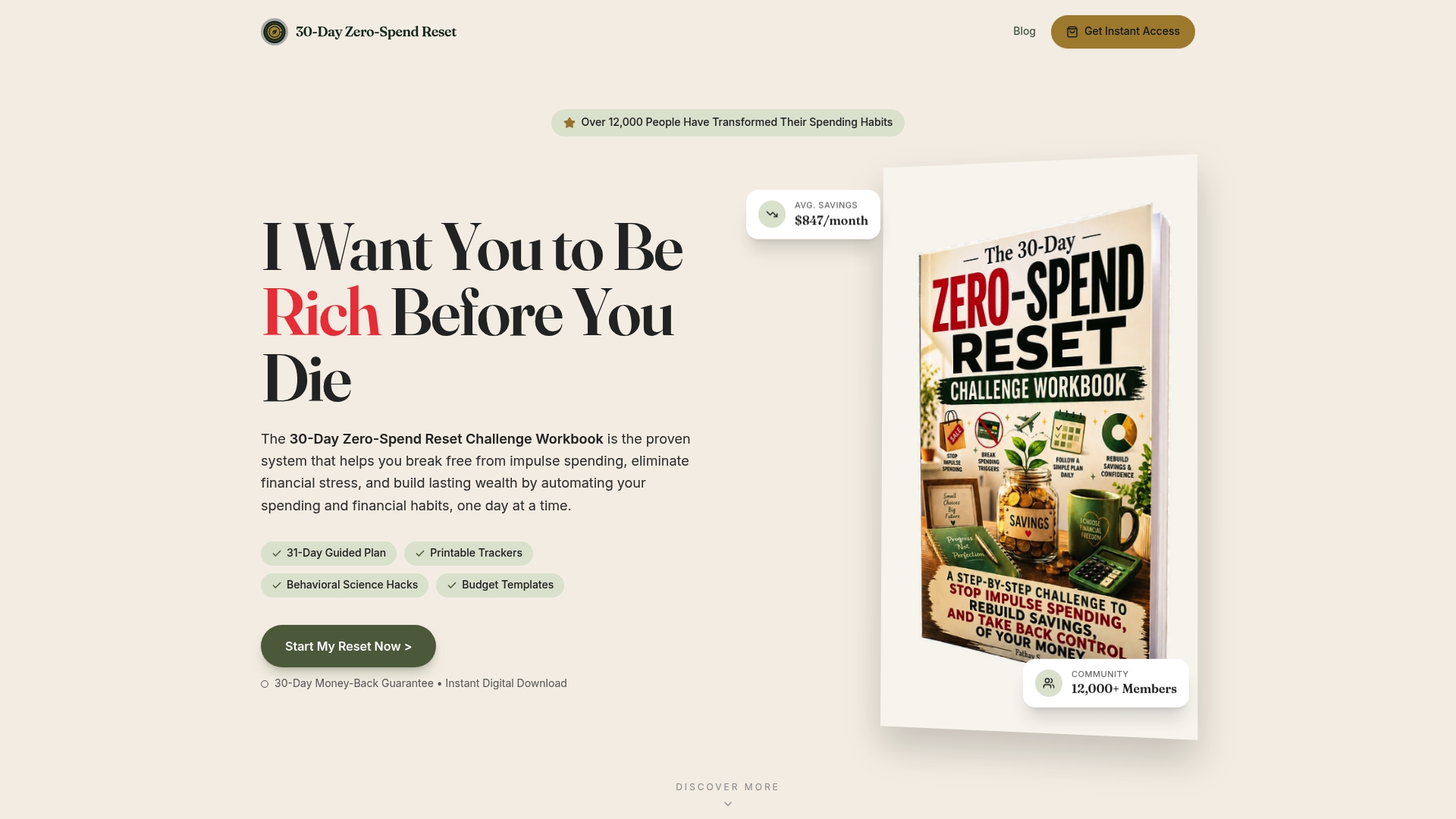
It's built on the same behavioral principles covered above, sunk-cost awareness, organized abandonment, commitment devices, turned into a day-by-day system instead of a list of ideas you have to remember on your own. Readers who finish the full program and want to keep the momentum going can move into the Zero-Spend Accelerator Vault for deeper tools once the initial reset is done. Start with the zero-spend guide if you want a lower-friction first look before committing to the full 30 days.
Sources
This article draws on behavioral research into sunk-cost thinking and organized abandonment, government fiscal policy documents distinguishing personal from institutional spending freezes, cost-reduction research on habit reversion, and the client's own reported program data.
- The sunk cost fallacy (Asana resource)
- Peter Drucker tells small and large businesses: innovate or fade away (Forbes)
- OMB memo: Frequently asked questions related to fiscal year 2024 discretionary spending limits (White House)
This article is general information, not a substitute for advice from a qualified financial advisor. Consult a qualified financial professional about your own circumstances before acting on anything here.
FAQ
What Is a Spending Freeze?
A spending freeze is a set period where you stop all nonessential purchases, dining out, new clothes, impulse buys, while still covering bills, groceries, and other essentials. It's designed to redirect that money to savings or debt and reset automatic spending habits.
What Is the $27.40 Rule?
There's no single, widely documented financial framework known as this rule backed by a credible source, so treat any claim about it with caution. If you've seen it referenced as a spending guideline, it's best understood as an informal budgeting tip rather than an established rule.
What Are Things Frugal People Rarely Buy?
Frugal spending habits tend to avoid extended warranties, bottled water, name-brand pantry staples, daily coffee shop drinks, and impulse subscription services. The common thread is skipping convenience markups in favor of planning ahead, exactly the mindset a spending freeze is designed to build.
Is There a Government Spending Freeze in the United States?
Government spending freezes are a different concept from a personal spending freeze. They refer to discretionary spending limits and agency-level directives set through federal budget policy, not a household decision to pause nonessential purchases.
How Much Can I Save With a 30-Day Spending Freeze?
Savings depend entirely on your normal nonessential spending, but cutting about $15 a day in discretionary purchases adds up to roughly $450 over 30 days. Users of the 30-Day Zero-Spend Reset Challenge Workbook report average savings as a program outcome, reflecting both cut spending and redirected savings during the 30-day period.
Recommended
Ready to reset your spending?
Get the 30-Day Zero-Spend Reset Workbook and turn these ideas into a daily action plan.
Start the 30-Day ResetThis article is part of the 30-Day Zero-Spend Reset method. Explore the complete day-by-day system behind these ideas.
Read the full guideKeep reading

Join the conversation
Be the first to share your thoughts on this article.