
Cut Impulse Spending in 30 Days With a Spending Journal

Start a low friction spending journal. Use quick capture templates and a 30 day plan to curb impulse and subscription spending.
Cut Impulse Spending in 30 Days With a Spending Journal
A spending journal is a daily record of every purchase you make, kept so you can see exactly where your money goes and make decisions with real numbers instead of guesses. The quickest way to start is to pick one capture method today, a notebook, an envelope, or your phone, and log every purchase the same day it happens. A week of honest entries can give you enough data to spot small leaks and redirect that money toward a goal that matters to you.
TL;DR:
- Accurate tracking over a week reveals small spending leaks that can be redirected toward meaningful financial goals.
- Sorting expenses into needs, obligations, and wants helps identify realistic savings opportunities, especially within obligation categories.
- Consistent weekly reviews of logged data enable effective budget adjustments and targeted spending cuts, rather than sweeping changes.
- Using a low-friction method, like a simple notebook or photo backup, ensures regular logging despite busy schedules or loss aversion.
- Pairing expense tracking with specific short-term goals and feedback significantly improves spending behavior changes over tracking alone.
Table of Contents
- What a spending journal is and how it differs from a budget
- Practical ways to capture your daily spending
- Essential fields every spending journal entry needs
- Sorting purchases into needs, obligations, and wants
- The review routine that turns logging into change
- Ready-to-copy layouts for paper, print, and digital use
- Why pairing tracking with goals works better than tracking alone
- Keeping a digital spending journal private and secure
- Staying consistent when motivation fades
- What actually derails a spending journal, and how to fix it
- A guided option for readers who want a structured 30 days
- Sources
- FAQ
What a spending journal is and how it differs from a budget
A spending journal describes what already happened. A budget plans what should happen next. Confusing the two is one of the most common reasons people abandon tracking within a month: they expect the journal to tell them what to do, when its real job is to feed a budget with accurate numbers.
Once you have some time of logged purchases, sort the totals by category and carry those figures into a monthly budget worksheet. The budget worksheet from consumer.gov walks through listing income, listing expenses, and subtracting one from the other to find money available for saving or reallocating. That subtraction only means something if the expense side reflects what you actually spent, not what you assumed.
Treat budgeting as a recurring monthly cycle rather than a one-time fix. Consumer.gov's guidance on making a budget recommends reviewing actual spending at month-end and adjusting the plan for the month ahead. Your journal supplies the raw material for that review. Without it, a budget is a guess dressed up as a plan; with it, the plan updates itself every month based on evidence.

Practical ways to capture your daily spending
The best capture method is the one you will actually keep using, not the one that looks most organized on day one. The CFPB's spending tracker guidance lists several acceptable formats and stresses that consistency matters more than sophistication.
- Paper notebook: write date, item, and amount right after each purchase; works well if you already carry a planner.
- Receipt envelope: drop every receipt into one envelope during the day, then sort and total the pile once a week.
- Quick photo: snap a picture of each receipt or price tag the moment you pay, then transfer the details during your weekly review.
- Voice memo: record a ten-second note after a purchase when your hands are full or you're driving.
- Budgeting app: log purchases directly on your phone if you already do most of your spending digitally.
Cash-heavy spenders often do best combining two methods: photograph each receipt as a backup, then still keep a physical envelope for the paper copies until the weekly ledger entry is done. That overlap catches purchases you might otherwise forget to photograph or misplace.
Pro Tip: If you tend to lose paper receipts, photograph them immediately and let the envelope serve only as a backup, not your primary record.
Essential fields every spending journal entry needs
A journal entry only works if it captures enough detail to sort and analyze later. The BLS Consumer Expenditure Diary instructs participants to record purchases daily and keep receipts, including small or incidental ones that are easy to forget.
- Date: the day the purchase happened, not the day you logged it.
- Item or service: a short description specific enough to jog your memory later.
- Amount: the exact price paid, including tax if it's listed separately on the receipt.
- Category: a label like groceries, transportation, or entertainment for sorting.
- Payment method: cash, debit, credit, or transfer, useful for spotting card-only leaks.
- Note: a quick reason or trigger, especially for impulse or emotional purchases.
For shared households, add a field for who made the purchase and whether it's a joint expense. Subscription-heavy budgets benefit from a renewal-date column so recurring charges don't blend into everyday spending. If you're prone to disputes or returns, a receipt ID or reference number saves time later. A minimalist version needs only date, item, and amount; a full household version adds category, payer, and renewal date; a hybrid version keeps the six core fields but drops the note unless something unusual happens.
Sorting purchases into needs, obligations, and wants
Classification turns a list of purchases into a decision-making tool. The CFPB's tracker framework groups spending into needs, obligations, and wants, which maps cleanly onto most household budgets.
- Needs: groceries, utilities, transportation to work, essential medication.
- Obligations: rent or mortgage, minimum debt payments, insurance premiums, court-ordered payments.
- Wants: dining out, streaming services, hobby purchases, non-essential shopping.
Needs are rarely where you find savings, but obligations sometimes hide room to renegotiate, a lower insurance rate or a refinanced loan. Wants are usually the fastest place to trim without changing your life in any meaningful way. When a purchase straddles two categories, like a work lunch that's partly a treat, split the amount rather than forcing it into one bucket. If a category grows too broad to be useful, such as "shopping" covering everything from clothes to electronics, break it into subcategories once you notice it hiding a pattern.
The review routine that turns logging into change
Logging without review is just paperwork. The CFPB frames tracking as a first step toward deciding what to cut and what to fund, which only happens if you actually look at the numbers on a schedule.
- Weekly: sort entries by category, add up totals, and note anything that surprised you.
- Monthly: compare category totals against your budget worksheet and flag categories that ran over.
- Analyze: check for subscription creep, clusters of impulse buys, or shared bills that crept up.
- Act: pick one category and one specific change to test for the next month, nothing more.
Resist the urge to overhaul everything at once. A single targeted change, canceling one unused subscription, capping dining out at a set amount, is easier to measure and easier to stick with than five simultaneous resolutions. The BFI working paper on mental representation found that people are more likely to adjust spending on categories close to the one that overspent, so if dining out ran high, look at groceries and takeout together rather than jumping to an unrelated category like clothing.
Pro Tip: Reconcile against your budget on the same day every month, right after payday, so the review becomes a habit instead of a chore you keep postponing.
Ready-to-copy layouts for paper, print, and digital use
Different lifestyles call for different formats, and the right one is whichever matches how you already move through your day.
- Paper notebook grid: rule columns for date, item, amount, and category across a single page per week; suits people who already carry a planner and prefer handwriting.
- Printable expense tracker: a one-page PDF with pre-printed columns and a monthly total row at the bottom; suits people who want structure without designing their own layout.
- Bullet journal minimal line: a single line per purchase using a short code (date, dot, amount, category abbreviation); suits visual planners who already keep a bullet journal for other tracking.
- Digital spreadsheet or app: entries typed directly into a phone app or spreadsheet with automatic monthly totals; suits people who spend mostly on cards and want less manual math.
Cash-forward spenders tend to stick with paper or printables because the physical act of writing reinforces the purchase. Busy phone users often prefer digital entry because it takes seconds between other tasks. If you want prompts for the note field, especially around emotional or impulse purchases, the journaling prompts guide has examples worth adapting. For a digital-first workflow that pairs a printable tracker with app-based logging, the companion webapp offers a middle ground between paper and a full spreadsheet.
Why pairing tracking with goals works better than tracking alone
Tracking by itself tells you what happened. It rarely changes what happens next unless it's paired with a target and a feedback loop. Research summarized in a randomized behavioral trial found that combining expense tracking with explicit savings goals and progress feedback reduced spending and improved account balances more than habit-substitution strategies alone.
Pairing logging with explicit short-term goals and regular feedback produces measurable reductions in spending that habit substitution alone often fails to match.
That finding lines up with the flexible capture and classification methods recommended by the CFPB and the BLS diary form: track consistently, classify accurately, then use the results to set a specific target rather than a vague intention to "spend less."
The 30-Day Zero-Spend Reset workbook is built around that same sequence. Each day includes a small behavioral challenge, a place to log spending, and a short feedback prompt that connects the day's entries to a specific goal, whether that's canceling an unused subscription or breaking a pattern of emotional purchases. The structure exists so tracking doesn't remain an isolated habit; it feeds directly into a decision, which is the same mechanism the trial evidence points to as more effective than simply trying to substitute one habit for another. You can see how the daily structure works in the zero spend reset blueprint.
Keeping a digital spending journal private and secure
A digital journal is convenient, but it also holds a detailed record of your habits, locations, and financial accounts, which makes basic security worth a few minutes of setup.
Use a passcode or biometric lock on any app or spreadsheet that stores your entries, especially if you access it from a shared or public device. Avoid storing full card numbers or account passwords inside notes meant for spending descriptions. If you use cloud storage or a syncing app, choose one with two-factor authentication and check that automatic backups aren't shared to a public folder by default. When exporting a spreadsheet to send to a partner or accountant, strip out any note fields that mention sensitive personal details you don't want to circulate.
If you photograph receipts, delete the images from your camera roll once you've transferred the details into your journal, since receipts sometimes include partial card numbers or loyalty account information. A password manager can also generate and store a unique login for any tracking app, which matters more than it seems once that app becomes the single place holding a month of your financial behavior.

Staying consistent when motivation fades
Most spending journals fail in the second or third week, not the first, once the novelty wears off and life gets busy. Building in small structural supports matters more than willpower.
Keep the barrier to entry low: a one-line notebook entry or a single photo takes seconds, while a detailed spreadsheet with ten fields invites procrastination. Set a fixed daily trigger, right after paying, right before bed, so logging attaches to something you already do rather than competing for a fresh decision every time. Review your progress weekly rather than daily; daily reviews can feel like scorekeeping, while a weekly glance shows real movement and keeps the exercise feeling worthwhile rather than tedious.
When you miss a day or two, resist the urge to restart the whole journal from scratch. Log what you remember, mark the gap, and keep going. A journal with a few gaps still gives you far more useful data than one abandoned entirely after the first missed entry.
What actually derails a spending journal, and how to fix it
The most common failure isn't laziness, it's friction. People pick a format that takes too long, skip a few days, then quit rather than catch up. If you've missed more than three days in a row, switch to the lowest-friction method you have, even a single line per purchase, rather than trying to reconstruct a detailed log from memory.
Cash purchases get missed more than card purchases simply because there's no statement to check against later. An envelope or a same-day photo fixes that gap fast. Over-categorization is the other trap: fifteen categories sound thorough but usually just mean more decisions per entry. Start with five or six and only split a category once you notice it's hiding a real pattern worth separating.
Scale up your system only when the simple version stops giving you useful answers, not before.
, Omar
A guided option for readers who want a structured 30 days
If tracking on your own feels like enough, a notebook or printable template will get you there. If you'd rather follow a built-in structure that pairs daily logging with a specific behavioral challenge each day, the 30-Day Zero-Spend Reset Challenge Workbook is built for exactly that gap.
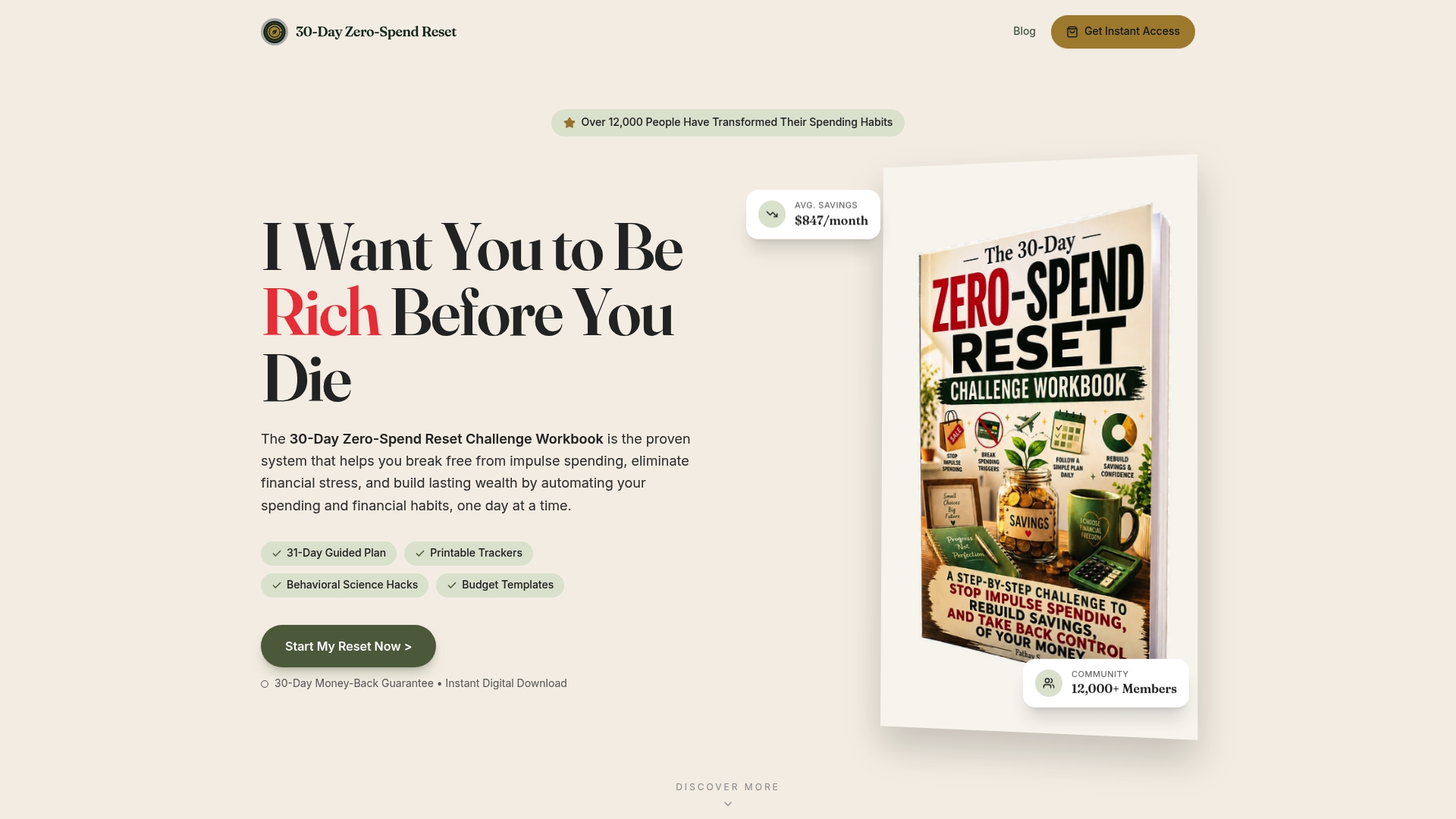
- Daily challenges that target impulse buying, subscription creep, and emotional spending one habit at a time.
- Printable trackers and budget templates to help organize your spending records.
- Access to a digital logging option for readers who prefer electronic methods over paper.
- Additional tools like social scripts for money conversations and meal planning guides to support reducing common spending triggers.
It fits best if you've tried tracking before and stalled, or if subscription creep and impulse purchases keep undoing your budget despite good intentions. Start with the workbook itself, or step up to the Zero-Spend Accelerator Vault if you want a deeper set of resources once the first 30 days are done.
Sources
For official guidance beyond this article, consumer.gov's budget worksheet and making a budget pages cover the planning side. The CFPB spending tracker offers a ready-made template with categories, and the BLS Consumer Expenditure Diary shows how researchers themselves record daily purchases.
- Consumer
- Spending tracker (CFPB Your Money Your Goals companion tool)
- Consumer Expenditure Diary Survey Form (BLS)
FAQ
How can I record my daily spending?
Pick one capture method, a notebook, receipt envelope, photo, or app, and log the date, item, amount, and category the same day you make the purchase. The CFPB spending tracker recommends tracking for a day, a week, two weeks, or a month, then using the results to decide what to change.
What is Dave Ramsey's 50/30/20 rule?
This article doesn't cover that specific framework in detail; definitions and percentages for budgeting splits vary by source. The classification this article recommends instead, needs, obligations, and wants, comes directly from the CFPB's tracker framework and serves the same purpose of prioritizing cuts.
What is the 70-10-10-10 budget rule?
This specific split isn't addressed by the sources behind this article, so a reliable answer isn't available here. For a documented approach to allocating income, the budget worksheet from consumer.gov walks through listing income and expenses to find money for saving or spending.
How to make a spending journal?
Choose a layout, paper notebook, printable template, bullet journal line entry, or a digital app, and include at minimum the date, item, amount, and category for every purchase. Review the entries weekly, reconcile against your budget monthly, and use the CFPB's needs, obligations, and wants framework to decide what to cut.
Ready to reset your spending?
Get the 30-Day Zero-Spend Reset Workbook and turn these ideas into a daily action plan.
Start the 30-Day ResetThis article is part of the 30-Day Zero-Spend Reset method. Explore the complete day-by-day system behind these ideas.
Read the full guideKeep reading



Join the conversation
Be the first to share your thoughts on this article.