
Behavior First Money Mindset Shift Using the Zero Spend Workbook
Pair behavior-first micro-actions with nervous-system calming steps in a 21 to 30 day plan. Use the Zero Spend workbook to build tracking, pause habits,...
Behavior First Money Mindset Shift Using the Zero Spend Workbook
A money mindset shift works, but only when it's paired with action, not affirmations alone. Start by reframing scarcity thoughts ("I can't afford it" becomes "how can I afford it?"), tracking every dollar for a set window, and running a short behavioral reset like a 21 to 30 day no-spend challenge. The Nospendreset workbook gives that reset structure, so belief change has something real to attach to.
TL;DR:
- Switching from a scarcity to an abundance mindset requires pairing belief changes with concrete daily actions like logging expenses or automating savings over three weeks.
- Deeply ingrained money scripts originate in childhood, with shame preventing progress; replacing judgment with curiosity and calming the nervous system enhances rewiring efforts.
- Focus on small, specific habit shifts such as pausing before spending, naming emotions during financial decisions, and scheduling regular money check-ins to build lasting change.
- A structured 30-day reset program with daily tasks can significantly boost savings and reduce anxiety, especially when followed consistently and supported by habit-tracking tools.
- Behavioral evidence of mindset shifts typically emerges within 21 to 30 days, but ongoing reinforcement is necessary to fully rewire beliefs and sustain healthier financial habits.
Table of Contents
- What Is a Money Mindset, and Why Does Scarcity Beat Abundance?
- Where Do Limiting Money Beliefs Actually Come From?
- The Core Money Mindset Shifts (and the Action That Makes Each One Stick)
- Why a Nervous-System-First Approach Actually Works
- A 21 to 30 Day Plan to Start Shifting Your Money Mindset Today
- How Culture and Society Shape What You Believe About Money
- Why Emotional Intelligence Matters More Than Financial IQ
- What to Do When You Slip Back Into Old Spending Habits
- What Successful Money Mindset Shifts Actually Look Like
- What to Actually Expect in the First 90 Days
- How the 30-Day Zero-Spend Reset Challenge Workbook Puts This Plan Into Action
- Sources
- FAQ
What Is a Money Mindset, and Why Does Scarcity Beat Abundance?
Your money mindset is the collection of beliefs, emotional reactions, and inherited assumptions that decide how you handle a dollar before you've consciously thought about it. Financial psychologist Brad Klontz calls these deep, often unconscious beliefs "money scripts," and his research at Creighton University shows they form in childhood and run quietly in the background of adult financial decisions for decades.
A scarcity mindset treats money as a finite, threatened resource. Someone operating from scarcity checks their balance and feels dread, avoids opening bills, or buys something the moment a bonus lands because deep down they don't trust the money to still be there next week. An abundance mindset, by contrast, treats money as something you can generate and direct. It doesn't mean pretending you have unlimited funds. It means believing you have options: you can earn more, cut a cost, negotiate a bill, or redirect spending toward a goal.
The difference shows up in daily behavior more than in bank balances. TD's research on financial beliefs found that shifting toward an intentionality-driven mindset, paired with concrete habits like recurring money check-ins, reduces financial anxiety and increases transparency, even before income changes at all.
A few markers separate the two mindsets in practice:
- Scarcity treats a big purchase as a threat; abundance treats it as a decision with tradeoffs.
- Scarcity avoids looking at account balances; abundance checks them on a schedule, calmly.
- Scarcity spends fast to escape discomfort; abundance pauses long enough to ask what the money is actually for.
None of this means abundance thinking alone fixes a shrinking bank account. It means the story you tell yourself about money shapes which actions feel possible, which is exactly why mindset work has to show up in a spending log, not just a journal.
Where Do Limiting Money Beliefs Actually Come From?
Most limiting beliefs about money were never chosen. They were absorbed, usually before age seven, from watching how parents or caregivers argued about bills, celebrated windfalls, or went silent when money got tight.
Klontz's money scripts framework groups the most common patterns into a few recognizable types:
- Money avoidance. The belief that money is bad or that rich people are corrupt, which leads to under-earning or refusing to track spending.
- Money worship. The belief that more money will finally fix unhappiness, which drives overspending and chasing income at the expense of everything else.
- Money status. The belief that net worth equals self-worth, often showing up as spending to keep up appearances.
- Money vigilance. A tendency toward secrecy and anxiety about finances, sometimes protective but often isolating for couples.
To trace your own script, ask a few direct questions: What did your parents say about money at the dinner table? Did anyone in your household hide purchases or lie about spending? Was money ever used as a reward or punishment? The answers usually point straight at the belief running your budget today.
Shame is the mechanism that keeps these scripts in place. According to a Forbes interview with a psychologist on financial behavior, shame causes avoidance: skipped bank logins, delayed retirement planning, unopened bills. The fix isn't harsher self-discipline. It's replacing judgment with curiosity, treating a bad spending week as data instead of proof you're broken. Rewiring intergenerational patterns generally requires naming the old script out loud, then practicing a present-tense replacement belief you can actually believe, not just repeat.
The Core Money Mindset Shifts (and the Action That Makes Each One Stick)
A belief doesn't change because you decided it should. It changes when your behavior gives it new evidence to work with. Here are the shifts that move the needle, each paired with something you actually do.
1. "I can't afford it" becomes "How can I afford it?" The first phrase closes the conversation, while the second opens a problem-solving question. Action: the next time you catch yourself saying you can't afford something, write down three ways you theoretically could. Track how often you complete this exercise per week.
2. "I'm bad with money" becomes "I'm learning how money works." Identity statements are sticky, and "I'm bad with money" becomes a self-fulfilling excuse to stop trying. Action: log one financial decision daily, good or bad, without judgment. Metric: consecutive days logged, not dollars saved.
3. "More income will fix this" becomes "My habits shape the outcome." Lifestyle creep eats raises fast, which is why Suze Orman's commentary on mindset shifts notes that psychological patterns, not income alone, dictate financial results. Action: before any raise or windfall, decide in writing where 50% goes before it hits your account. Metric: percentage of windfalls captured versus spent.
4. "Budgeting means deprivation" becomes "Budgeting means direction." Reframe the budget as a permission slip, not a leash. Action: name one category you get to spend on guilt-free each week. Metric: whether you feel resentment or relief when reviewing the week.
5. "I'll deal with it later" becomes "I check in on a schedule." Avoidance is comfortable until it isn't. Action: set a recurring 15-minute money meeting, weekly if solo, biweekly if partnered. Metric: meetings held versus skipped.
6. "Debt means I failed" becomes "Debt is a math problem with a plan." Shame around debt often causes people to stop opening statements entirely. Action: list every debt with balance and interest rate in one place. Metric: total debt tracked (not paid off yet, just visible).
7. "Saving is what's left over" becomes "Saving happens first." Automating this removes the willpower requirement entirely. Action: set an automatic transfer the day income arrives, even if it's $20. Metric: months with an automated transfer that wasn't reversed.
8. "I have to do this alone" becomes "I can name this out loud." Financial secrecy, especially in relationships, tends to compound shame. Action: have one honest money conversation this month using a simple script: "Here's where I'm at, here's what I want to change."
- Automated transfers remove daily decision fatigue from the saving habit.
- Recurring money meetings turn financial check-ins into a scheduled event instead of an emotional ambush.
- Micro-habits, like a one-minute daily spending log, build the tracking muscle without requiring a full budgeting overhaul.
Pro Tip: Pick two shifts from this list, not all eight. Trying to rewire every belief at once usually collapses within a week. Behavior change compounds faster when it's narrow.
Why a Nervous-System-First Approach Actually Works
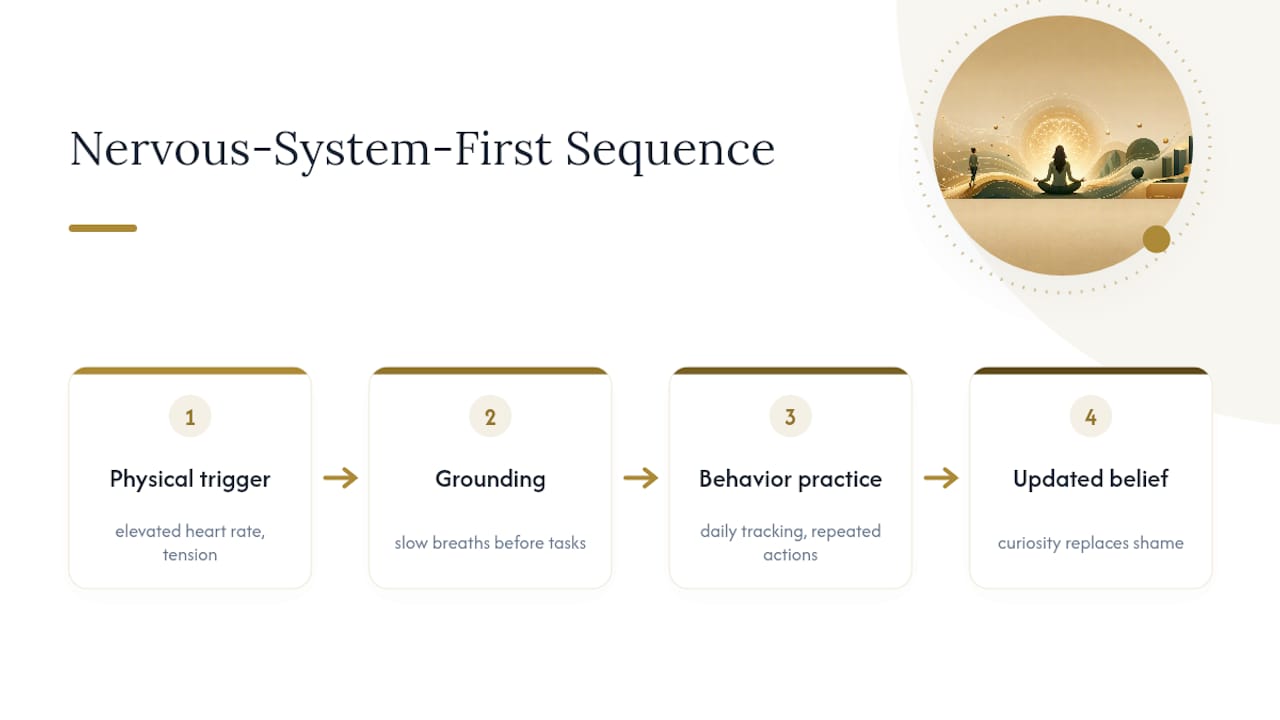
Money anxiety isn't purely psychological. It shows up physically, elevated heart rate, tightened chest, the urge to close the laptop before you've even opened the banking app. That physiological response happens before any cognitive reframe has a chance to land, which is why affirmations alone so often fail.
Financial psychologists increasingly argue that mindset work has to start with the body, not the belief. The Forbes piece on rebuilding a healthier money relationship notes that calming the nervous system, through something as simple as a few slow breaths before opening a bank statement, measurably increases how well a person can absorb a new financial habit. Practitioners report that identifying the physical signs of money stress, tension, shallow breathing, and pairing them with a short grounding practice before finance tasks speeds progress, because the nervous system stops amplifying the avoidance behavior.
Money shame drives avoidance: skipped logins, delayed planning, unopened bills. Replacing self-judgment with curiosity, alongside calming the nervous system before financial tasks, is what actually breaks the avoidance loop.
This is also why one-off affirmations rarely stick. Structured, repeated behavior gives the brain new evidence, and Creative Planning's research on mindset and finances points out that tracking and daily tasks outperform affirmations precisely because behavior generates proof a belief can update against. A thought you repeat in the mirror doesn't change your relationship with money. A spending log you actually complete for ten days straight does.
A 21 to 30 Day Plan to Start Shifting Your Money Mindset Today
You don't need a perfect plan, you need a bounded one. A fixed window with daily tasks and weekly checkpoints creates the start and end boundary that makes a habit stick, according to Creative Planning's behavior-change findings.
- Days 1 to 7: Journal one early money memory each morning, log every expense that evening, and complete a full subscription audit by day 5.
- Days 8 to 14: Add one delayed-gratification practice daily, wait 24 hours before any non-essential purchase over $20.
- Days 15 to 21: Introduce a weekly money meeting (solo or with a partner) to review the spending log and name one emotion tied to checking your balance that week.
- Days 22 to 30: Automate one savings transfer, then repeat the full cycle of tracking, journaling, and check-ins with the new habit added.
Track three numbers at each weekly checkpoint: dollars saved, impulse purchases resisted, and a 1 to 10 rating of how anxious checking your account made you feel. That third number often moves before the first one does. According to ChooseFI's guide to starting mindset work, naming a daily emotion and challenging one belief are consistently the easiest entry points for people who feel stuck before they even begin.
Adjust for your situation. Lower-income households may need to shrink the "non-essential purchase" threshold to $5. Couples should run the money meeting jointly from day one rather than merging solo tracking later. If debt payments are aggressive, slow the pace, add a rest week between the tracking phase and the automation phase so the habit doesn't collapse under pressure.
How Culture and Society Shape What You Believe About Money
Family isn't the only source of your money script. Culture writes plenty of the material too. Advertising sells the idea that spending signals success, social media turns other people's highlight reels into a false baseline for what "normal" spending looks like, and entire industries profit from keeping shoppers slightly dissatisfied with what they already own.
Cultural background also shapes which money behaviors feel acceptable to even discuss. Some households treat money as a taboo topic, never mentioned outside closed doors, while others treat financial success as a public scoreboard. Neither extreme is inherently healthier, but both shape how comfortable you are asking for help, negotiating a salary, or admitting you're behind on a bill.
Generational context matters too. Someone who came of age during a recession often carries a scarcity script even if their current income is stable, because the nervous system learned caution when caution was necessary for survival. Someone raised in relative financial ease may carry the opposite blind spot, underestimating how fragile a budget can get.
None of this means culture determines your financial future. It means the beliefs you're rewiring didn't come from nowhere, and recognizing the outside pressure (comparison, marketing, inherited taboo) makes it easier to separate what's actually true about your finances from what a culture of consumption wants you to feel.
Why Emotional Intelligence Matters More Than Financial IQ
Knowing the difference between a Roth IRA and a traditional one doesn't help much if you can't sit still long enough to open the account. Emotional intelligence, the ability to notice a feeling, name it, and choose a response instead of reacting, is often the missing piece in money mindset work.
Most financial mistakes aren't knowledge gaps. They're emotional reactions: panic-selling investments during a downturn, impulse-buying to soothe a bad day, freezing instead of negotiating a bill because conflict feels unbearable. The people who manage money well aren't necessarily smarter about spreadsheets. They're better at catching the emotional trigger before it turns into a transaction.
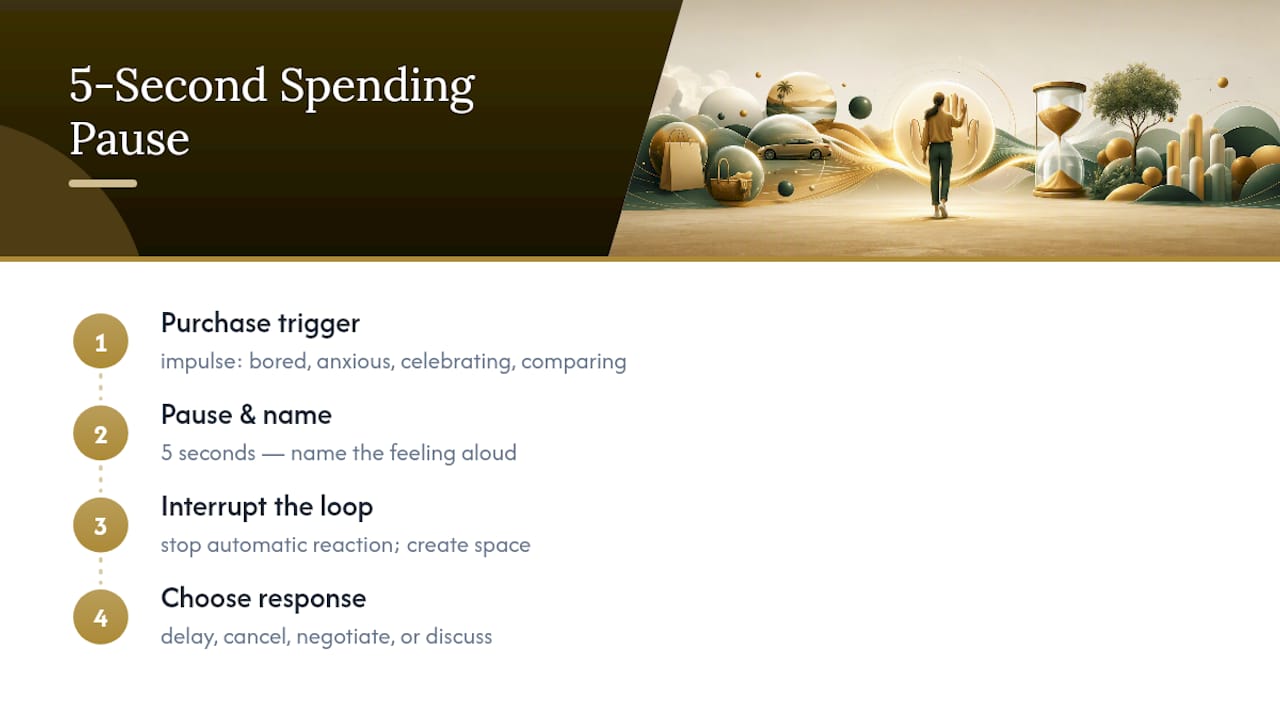
Building this skill starts small. Before a purchase over a certain threshold, pause and name the feeling driving it: bored, anxious, celebrating, comparing yourself to someone online. That single pause, five seconds of naming an emotion, interrupts the automatic behavior loop long enough for a different choice to surface.
Couples benefit especially. Money fights are rarely about the dollar amount. They're about what the spending represents, security, control, being seen. Naming the emotional stakes out loud, "I feel anxious when we don't talk about this," defuses more than any spreadsheet ever will.
What to Do When You Slip Back Into Old Spending Habits
A setback doesn't mean the mindset shift failed. It means the old script got triggered under stress, which is exactly what scripts are designed to do. The recovery matters more than the slip.
Start by separating the behavior from your identity. One overspent week is data, not a verdict on your character. Financial psychologists point to shame as the biggest obstacle to recovering from a setback, because shame drives people to avoid the very tracking that would help them course-correct. The fix is curiosity: what triggered this, what was I feeling right before, what would make the same choice less likely next time?
Anxiety around checking your accounts after a setback is common and usually temporary. A short grounding practice, a few slow breaths, a walk, before opening a banking app reduces the physical charge enough to look at numbers without spiraling. This isn't a workaround for weak willpower. It's a practical response to a nervous system that's been trained to treat financial information as a threat.
Rebuild momentum in small increments. Return to the daily spending log for three days before worrying about the full 30 day structure again. Debt loads and irregular income both call for slower, more forgiving checkpoints, weekly instead of daily tracking, a wider spending threshold, permission to miss a day without restarting the whole plan.
What Successful Money Mindset Shifts Actually Look Like
The people who successfully rewire their money mindset rarely describe a single dramatic breakthrough. They describe a pattern: a spending log that finally stuck past week two, a money meeting that stopped feeling like an ambush, a bill that got opened the same day it arrived instead of three weeks later.
One common thread among people who make it past the first month is that they stop treating the mindset shift as a one-time decision and start treating it as a maintained habit, the same way brushing your teeth isn't a decision you re-make every morning. The identity shift ("I'm someone who checks in on my money") follows the repeated behavior, not the other way around.
Another consistent pattern: the people who stick with it track something concrete. Not vague intentions to "be better with money," but a number, dollars saved, days logged, impulses paused. That specificity turns abstract progress into something the brain can register as a win, which reinforces the behavior loop that eventually reshapes the belief underneath it.
The transformation rarely looks like a straight line. It looks like three good weeks, one bad one, a return to the log, a slightly easier month after that. That uneven curve is normal, and expecting a straight line is usually what causes people to quit around week three.
What to Actually Expect in the First 90 Days
Real change in 30 to 90 days looks boring on paper: a spending log that survives past week two, a bill opened the same day it arrives, a pause before an impulse buy that didn't happen before. Those small behavioral shifts are the evidence a belief is actually updating, not just being repeated in a journal.
If anxiety around money keeps spiking despite consistent daily practice, or if shame is severe enough to stall the tracking itself, that's a signal to bring in a financial therapist or coach rather than pushing through alone. Self-guided tools like journaling prompts to surface spending triggers work well for steady progress; deeper trauma around money usually needs a trained professional.
, Omar
How the 30-Day Zero-Spend Reset Challenge Workbook Puts This Plan Into Action
Reading about mindset shifts is easy. Sticking to a spending log for three straight weeks is the hard part, and that's the exact gap the Nospendreset workbook was built to close: a structured 30-day path instead of a vague intention to "do better with money."
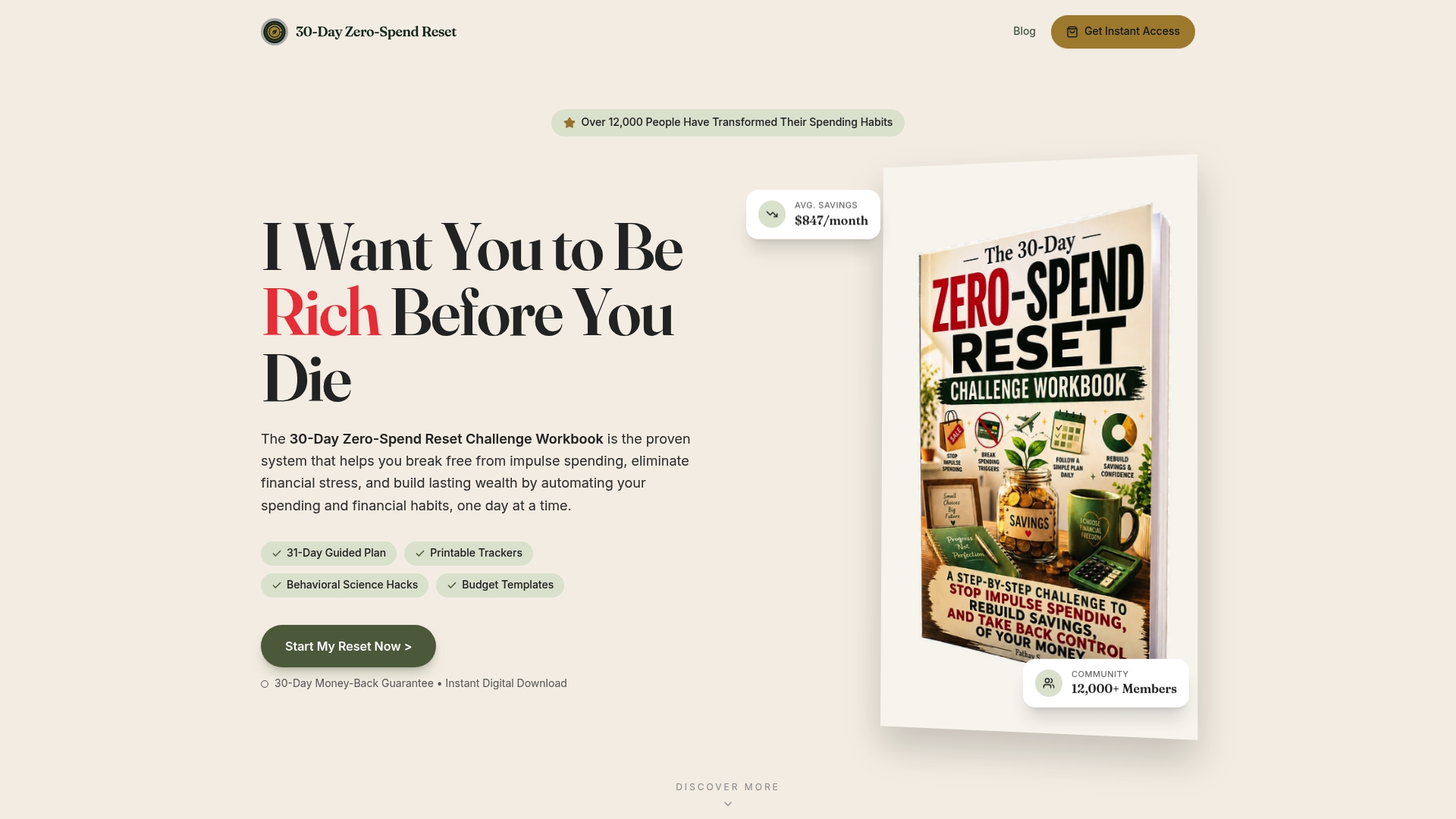
The program offers daily behavioral challenges, printable spending trackers, budget templates, social scripts for awkward money conversations, and meal-planning guides that address common impulse-spending categories. Every tool is built on the same behavior-first psychology covered above, pairing a belief reframe with a task you can actually check off. People who complete the reset have reported average savings of $847 per month, tracked through the workbook's own spending logs.
After purchase, you start with Day 1: a subscription audit and a single journaling prompt, not a 40-page manual to read first. If you want the daily structure and reminders built in rather than managed on paper, the companion webapp automates the tracking side so the habit survives past the motivated first week. Either way, the next step is the same: open the workbook and start Day 1 today.
Sources
Claims in this article draw on Creighton University's coverage of Brad Klontz's money scripts, Forbes' interview on money shame and nervous-system practices, and Creative Planning's behavior-change research. For faith-informed budgeting approaches, see this piece on debt and financial method.
- 3 Habits To Transform Your Relationship With Money, By A Psychologist, Forbes
- Why your money mindset matters more than you think, Creighton University (Brad Klontz)
FAQ
How Do You Shift Your Money Mindset?
Pair a belief reframe (like turning "I can't afford it" into "how can I afford it?") with a concrete daily action, such as logging every expense or automating a small savings transfer, for at least three consecutive weeks.
What Is the 7-7-7 Rule for Money?
Definitions of the 7-7-7 rule vary across financial blogs and aren't tied to a single verified source, so treat any specific version cautiously rather than as an established standard.
What Is the 3-6-9 Rule of Money?
Like the 7-7-7 rule, the 3-6 rule isn't a consistently defined financial principle, and no authoritative source establishes one canonical version, so it's best treated as informal advice rather than a fixed rule.
What Are Some Common Mindset Shifts for Money?
The most effective ones include moving from "I can't afford it" to "how can I afford it," from "I'm bad with money" to "I'm learning," and from budgeting as deprivation to budgeting as direction, each paired with a trackable daily action.
How Long Does a Money Mindset Shift Take?
Most people notice behavioral evidence, consistent tracking, and reduced anxiety when checking accounts within 21 to 30 days, though the underlying belief usually keeps strengthening with continued practice.
Recommended
Ready to reset your spending?
Get the 30-Day Zero-Spend Reset Workbook and turn these ideas into a daily action plan.
Start the 30-Day ResetThis article is part of the 30-Day Zero-Spend Reset method. Explore the complete day-by-day system behind these ideas.
Read the full guideKeep reading



Join the conversation
Be the first to share your thoughts on this article.