
Impulse Buying at Night? Stop the Sleepy Scroll Before Checkout

Sleepiness and social scrolling can fuel impulse buying at night. Use a checkout delay to interrupt the urge, then try an optional reset lasting 30 days.
Impulse Buying at Night? Stop the Sleepy Scroll Before Checkout
Late-night impulse buying is common, not a personal failing, and the fastest way to interrupt it is to force a short delay before checkout. Two signals usually come right before the purchase: feeling sleepy and scrolling social media instead of sleeping. If you notice either one, close the tab and wait.
TL;DR:
- Sleepiness is linked to weaker response inhibition and more decision errors; adults with ADHD symptoms also report impulsive buying, partly because delaying rewards is harder.
- Before buying, classify the item as pure, reminder, suggestion, or planned: wait on novel impulses, but use auto reorder for essentials you have run out of.
- Removing saved cards, signing out, or disabling one click checkout adds friction; a 1 to 24 hour wait can interrupt purchases without relying on willpower.
- Write down what you need and why before opening a shopping app; planning prompts reduce impulse buying most strongly for purchases driven by immediate gratification.
- Test one tactic, such as deleting saved cards, for 7 to 14 nights before adding another, and track whether your behavior changes.
Table of Contents
- How Common Is Late-Night Impulse Buying?
- Why Nighttime Reduces Your Self-Control
- How Shopping Apps Prime You to Buy at Night
- A Step-by-Step Plan to Stop Impulse Buying Tonight
- Why Structure Beats Willpower for Late-Night Spending
- How the 30-Day Zero-Spend Reset Addresses Late-Night Spending
- FAQ
- Sources
How Common Is Late-Night Impulse Buying?
Late-night impulse buying shows up across surveys as a near-universal habit rather than a rare lapse. Mobile shopping apps and retailers that optimize for after-hours browsing have stretched the shopping day well past midnight, and checkout now takes seconds instead of minutes.
Surveys indicate that a large majority of people who shop late at night report making unplanned purchases during those hours, a pattern researchers tie to both opportunity and reduced self-control. Younger shoppers, including Gen Z and millennial consumers, report higher rates of late-night buying and larger annual overspending than older age groups.
A few things make night shopping different from daytime browsing:
- Retailers push notifications and flash sales timed for evening hours when attention is idle.
- Mobile checkout removes the natural pauses that used to exist in store shopping.
- Boredom and winding-down routines overlap with the exact hours apps are optimized to capture.
Why Nighttime Reduces Your Self-Control
Sleepiness changes how your brain weighs decisions. A peer-reviewed study on sleepiness and impulsivity found that higher sleepiness scores line up with higher impulsivity scores and more problematic impulsive behavior, including weaker response inhibition and more decision-making errors. Your prefrontal cortex, the part of the brain that weighs consequences and resists short-term rewards, works less efficiently when you're tired, which is exactly the state most people are in by 11 p.m.

For some shoppers, there's an added layer. Research on impulsive buying and deferment of gratification among adults with ADHD found that adults with ADHD symptoms report more frequent impulsive buying and a lower ability to defer gratification. The study's mediation analysis showed that this reduced ability to delay reward, not ADHD symptoms alone, explains much of the link to impulsive spending.
Emotional states matter just as much as biology. Common triggers include:
- Boredom during downtime with nothing else to occupy attention.
- Loneliness or a need for connection that shopping temporarily fills.
- Reward-seeking after a stressful or draining day.
It helps to name the type of purchase you're making: a "pure" impulse buy (something novel you never planned to get), a "reminder" buy (you ran out of something), a "suggestion" buy (an algorithm showed you something new), or a "planned" buy you were already intending to make. Each type calls for a different fix.
Pro Tip: Before adding anything to your cart after 10 p.m., name which type of impulse it is. If you can't tell, treat it as a pure impulse and wait.
How Shopping Apps Prime You to Buy at Night
E-commerce design didn't happen by accident. Research on impulse buying design practices found that sites commonly rely on features built to increase immediacy and social pressure, and that users themselves report wanting tools that add friction or force a pause.
The features most often linked to impulse purchases include:
- Saved payment methods that skip the step of entering card details.
- One-click or express checkout that removes any pause between browsing and buying.
- Countdown timers and "only 2 left" messages that create urgency.
- Reviews and social proof that reduce the perceived risk of a purchase.
- Add-on recommendations shown right at checkout.
Same-day and next-day delivery options amplify all of this by making a 1 a.m. purchase feel almost as immediate as an in-store one. The same research found that small changes to checkout friction, like removing saved cards or disabling one-click buy, are often enough to stop a purchase without requiring heavy willpower. Turning off shopping app notifications and using a browser extension to hide countdown banners work the same way: they add just enough friction to break the automatic sequence.
A Step-by-Step Plan to Stop Impulse Buying Tonight
Fixing this doesn't require a personality overhaul. It requires removing the conditions that make impulse buying easy.
- Delete saved payment information from shopping apps and browsers so every purchase requires manually entering card details.
- Log out of shopping accounts after each session instead of staying signed in.
- Move anything you want to buy to a wish list or cart and leave it there for a set waiting period, between 1 and 24 hours, before deciding.
- Use a planning prompt before you open a shopping app: write down what you need and why, which research on planning prompts found reduces impulse buying, with the strongest effect on "vice" purchases bought mainly for immediate gratification.
- Set a precommitment budget for discretionary spending each month and treat it as a hard cap, not a suggestion.
- Tell a friend or partner your spending goal so you have someone to check in with, which adds social accountability to the delay.
- Use a spending-limit app or card control that blocks purchases above a set amount without manual approval.
- Schedule specific shopping windows during the day instead of allowing browsing at any hour.
- Protect your sleep since sleep deprivation is directly tied to higher impulsivity, so an earlier bedtime is also a spending tool.
Pro Tip: Pick one tactic from this list, not all nine, and run it for a week before adding another. Stacking too many changes at once usually causes all of them to fail.
Why Structure Beats Willpower for Late-Night Spending
Willpower fails predictably at night because that's when your self-control is already lowest. Structure doesn't rely on willpower being high in the moment, which is why it holds up better. If you try just one tactic, like deleting saved cards or adding a 24-hour wait, for 7 to 14 nights, you'll have real data on what actually changes your behavior rather than a guess. Small, measurable trials beat vague resolutions every time.
, Omar
How the 30-Day Zero-Spend Reset Addresses Late-Night Spending
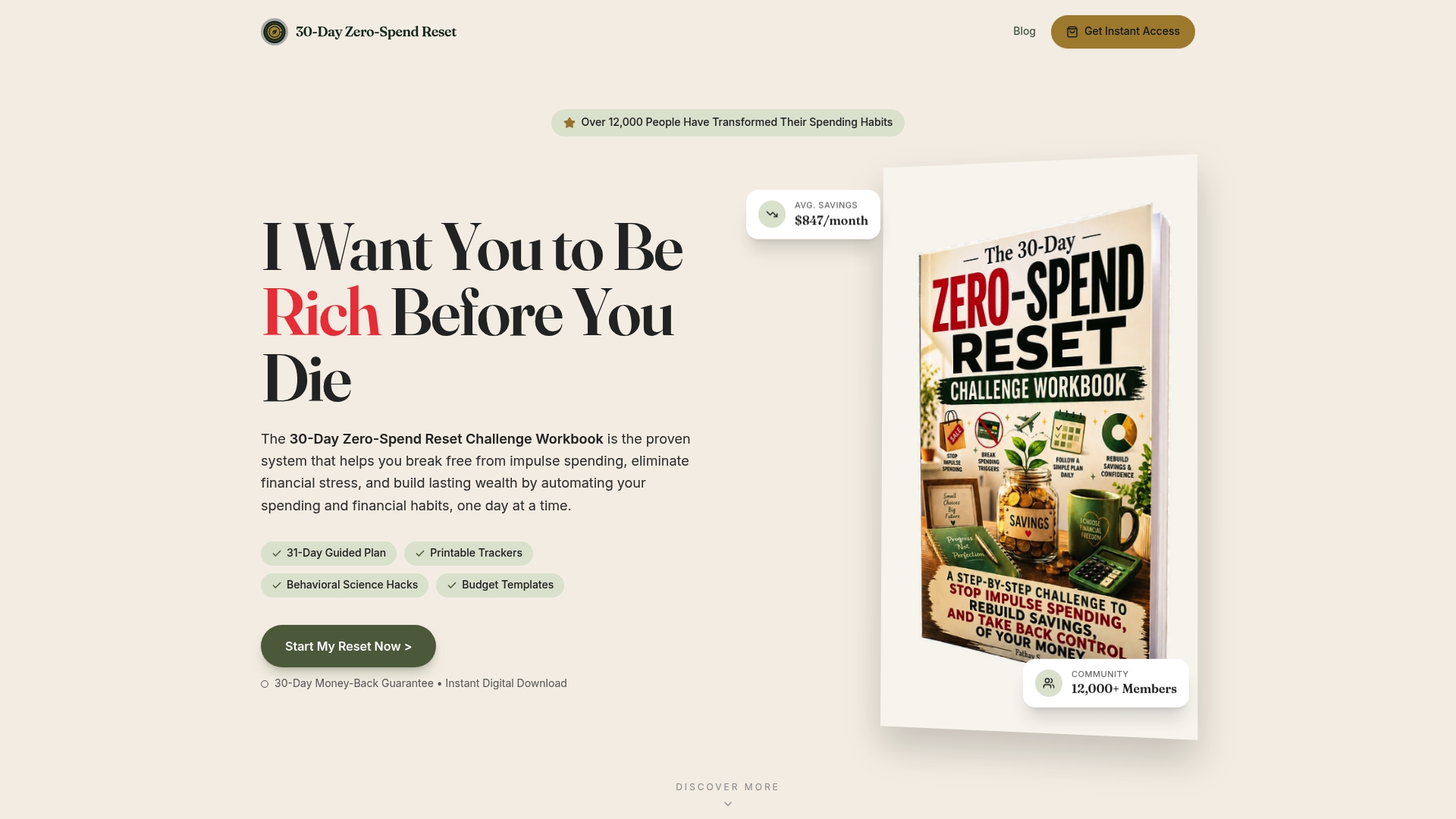
We built the 30-Day Zero-Spend Reset Challenge Workbook around the same mechanisms described above instead of relying on guilt or raw willpower. Each daily challenge works like a planning prompt, and the included trackers turn postponement into a habit you can see rather than just intend.
- Daily challenges build implementation intentions so pausing before a purchase becomes automatic.
- Printable trackers and budget templates make precommitment spending caps concrete instead of abstract.
- Social scripts help you set up the accountability check-ins that make a spending goal stick.
- The companion webapp gives you a guided version of the delay tactics above for anyone who wants more structure than a free checklist.
Users have reported saving money using this system. If you want a lower-commitment starting point, our free zero-spend guide walks through the basics before you decide whether the full challenge is right for you.
FAQ
What mental illness causes impulsive spending?
Impulsive spending isn't classified as its own mental illness, but it shows up as a symptom across several conditions, including ADHD, anxiety, and mood disorders. Research on ADHD and impulsive buying specifically found that reduced ability to defer gratification helps explain this link.
Do people with ADHD impulse buy?
Yes. A study using the Buying Impulsiveness Scale found that adults with ADHD symptoms report more frequent impulsive buying than adults without those symptoms, largely because of a reduced ability to delay gratification.
What is impulsive buying a symptom of?
Impulsive buying is often a symptom of low self-control in the moment rather than a single diagnosis, and that self-control dips further with sleepiness. Peer-reviewed research on sleepiness and impulsivity found that tiredness is directly associated with weaker impulse control.
What are the four types of impulse buying?
Impulse buys are often grouped into four types: pure impulse (an unplanned, novel purchase), reminder impulse (buying something you realized you're out of), suggestion impulse (discovering something new through a recommendation), and planned impulse (an intentional purchase made during a sale). Identifying which type you're experiencing helps you pick the right defense, such as auto-reorder for reminder buys or a waiting period for pure impulses.
Can shopping apps really make nighttime purchases more likely?
Yes. Design research on e-commerce impulse features found that saved payment details, one-click checkout, and urgency messaging are common features built to lower the friction of buying, which matters most when your self-control is already reduced at night.
Sources
- Sleepiness and impulsivity: Findings in non-treatment seeking young adults
- Impulsive buying and deferment of gratification among adults with ADHD
- Impulse Buying: Design Practices and Consumer Needs
Recommended
Ready to reset your spending?
Get the 30-Day Zero-Spend Reset Workbook and turn these ideas into a daily action plan.
Start the 30-Day ResetThis article is part of the 30-Day Zero-Spend Reset method. Explore the complete day-by-day system behind these ideas.
Read the full guideKeep reading





Join the conversation
Be the first to share your thoughts on this article.