
Stop Impulse Buying With A 30 Day Psychology First Reset, No Willpower
Stop impulse buying by using CBT urge surfing and simple money systems. Remove saved cards, use wish lists, and follow a 30 day reset to make the change...
Stop Impulse Buying With A 30 Day Psychology First Reset, No Willpower
Stop impulse buying today by pairing a short cooling-off rule with one systems change: move your saved card off every shopping app, and add the item to a wish list instead of the cart. That single combo forces a delay long enough for the urge to fade, which is the whole mechanism behind CBT-based impulse control. Everything else in this guide builds on that one move.
TL;DR:
- Applying a wait time before purchasing over $20, $20–$100, or above $100 significantly reduces impulsive buys by creating space for cravings to fade.
- Using cash envelopes and automating transfers into dedicated buckets prevents overspending and maintains discipline without relying solely on willpower.
- Removing stored payment details from shopping apps and uninstalling retail apps increase the friction needed to curb impulsive checkout habits effectively.
- Implementing a daily habit of logging purchases and creating if–then plans helps interrupt the impulse loop before action, especially when scripts are physically visible.
- Engaging in a 30-day structured reset and accountability practice, such as journaling or social support, rewires habits and can save hundreds of dollars monthly through gradual behavior change.
Table of Contents
- How Do You Stop Impulse Buying, Starting Today?
- What Actually Happens in Your Brain Before an Impulse Buy?
- How Do You Build a Money System That Prevents Impulse Buying?
- Why Does Making Payment Harder Actually Work?
- How Do You Cut Off Shopping Triggers Before They Start?
- How Does a 30-Day Reset Turn These Tips Into a Lasting Habit?
- Quick Checklist to Stop Your Next Impulse Buy
- What Replaces the Habit Once the Urge Fades?
- Why Perfectionism Is the Real Threat to This Whole Plan
- Ready to Turn These Tactics Into a 30-Day Habit?
- Sources
- FAQ
How Do You Stop Impulse Buying, Starting Today?
Most impulse buying isn't a willpower problem. It's a design problem. Your bank account, your phone, and your favorite stores are all built to make spending frictionless, so the fix has to add friction back on purpose.
Here's the sequence that actually moves the needle, in order of how fast you can start:
- Apply a waiting rule scaled to price. Under $20, wait an hour. Between $20 and $100, wait 24 hours. Above $100, wait 48 hours. A cooling-off window this short is enough to separate a genuine want from a momentary craving, and UNFCU's research on impulsive spending backs the 24 to 48 hour range as the sweet spot.
- Build a budget with a guilt-free line item. Give yourself a specific dollar amount each month for pure, no-questions-asked fun spending. American Express's guidance on impulse buying points out that a dedicated fun-money bucket removes the shame spiral that usually follows a splurge, because the splurge was already budgeted.
- Run a one-month impulse audit. Write down every unplanned purchase for 30 days, no matter how small. Experian's spending research found that simply tracking every unplanned buy for a month exposes patterns people had no idea existed, like a small coffee-app habit that adds up to a noticeable amount.
- Park every want on a running wish list. Set two fixed review days a month. If the item still feels worth it on review day, buy it deliberately. If it doesn't, you just avoided a purchase you'd have regretted.
A few smaller habits reinforce the big four:
- Screenshot sale emails instead of clicking through, then review them on your scheduled day.
- Ask "would I pay full price for this in three weeks?" before adding anything to a cart.
- Keep a running note of items you almost bought impulsively. Read it monthly. It's a surprisingly effective deterrent.
What Actually Happens in Your Brain Before an Impulse Buy?
Every impulse purchase follows a loop: a trigger (an ad, boredom, a bad day) sparks a thought ("I deserve this"), the thought produces a feeling (excitement, relief), and the feeling drives the action (checkout). Willpower tries to fight the action directly, which is why it usually loses. The smarter move is interrupting the loop earlier, at the thought or the feeling.
Urge surfing is the core technique. When an urge hits, don't fight it or give in. Notice it, rate its intensity from 1 to 10, and just watch it for 10 to 15 minutes. Urges behave like waves: they peak, then recede on their own if you don't feed them with action. This isn't a metaphor; it's the technique clinicians actually recommend for breaking the buying habit.
If–then planning gives you a script ready before the moment hits:
- If I feel bored and open a shopping app, then I put the phone down and do a two-minute task from my list instead.
- If I see a "flash sale" push notification, then I close the app and add the item to my wish list for later review.
- If I'm stressed and want to buy something to feel better, then I call a friend or take a 10-minute walk first.
Pro Tip: Write your if–then scripts on a sticky note on your card holder or wallet. Reading the plan physically, not just remembering it, makes you far more likely to follow it in the moment.
If you notice buying feels compulsive rather than occasional, if it's tied to hiding purchases or debt you can't explain, that's a signal worth bringing to a therapist or financial counselor rather than solving with tips alone.
How Do You Build a Money System That Prevents Impulse Buying?
Willpower fatigues by the end of the day, which is exactly when most impulse buying happens. A better fix is designing your accounts so the decision gets made once, on payday, instead of fifty times a month.
- Open separate labeled accounts or sub-accounts for essentials, savings, and guilt-free spending. Most banking apps now support this without extra fees.
- Automate transfers the day you get paid. Move money into each bucket immediately so what's left in your main checking account is truly discretionary, not a mystery number you're guessing at.
- Use cash envelopes for your worst category. If eating out or clothes shopping is your weak spot, withdraw that budget in cash and put the card away. Digital "buckets" work fine for categories you don't overspend on; cash works better where temptation is strongest, since running out of physical bills is a harder stop than a declined card.
- Do a 15-minute monthly review. Check what you actually spent against what you allocated, and adjust the buckets. This is where the pain of paying research matters most: reviewing real numbers restores the sting that swiping a card removes.
Setting a concrete savings goal alongside this system helps, too. A SMART goal template gives you a number to picture every time you're tempted to spend instead of save.
Why Does Making Payment Harder Actually Work?
Paying with cash or a card that requires typing in numbers every time restores what researchers call the "pain of paying," the small psychological sting that reminds you money is actually leaving your account. Saved card details erase that sting entirely, which is exactly why one-click checkout exists.
Add friction in stages, from easiest to most aggressive:
- Delete stored card numbers from every shopping app and browser autofill.
- Keep your physical card in a drawer in another room instead of your wallet.
- Switch to cash for categories where you overspend most.
- Log every purchase in a notes app before you check out, not after.
Removing saved payment details and choosing cash over stored cards is one of the most reliable low-cost friction tricks for cutting impulse completes, according to behavioral research on payment friction. If a store's app is your biggest trigger, uninstalling it entirely is the next step, though it does mean losing access to legitimate deals and order tracking.
How Do You Cut Off Shopping Triggers Before They Start?
Your environment is doing a lot of the persuading, often before you're consciously aware of it. Cutting the exposure is often easier than resisting the urge once it's triggered.
- Install an ad blocker on your main browser and phone.
- Unsubscribe from every promotional email in one sitting; use a bulk-unsubscribe tool rather than clicking through each one.
- Mute or unfollow accounts that push "haul" content or constant sale alerts.
- Never shop when you're tired, hungry, or emotionally drained. All three states measurably lower resistance to impulse.
- Replace instant checkout with the wish-list-and-review workflow described earlier, every time, no exceptions for "just this once."
How Does a 30-Day Reset Turn These Tips Into a Lasting Habit?
Reading tactics is one thing. Doing them daily, in order, for 30 straight days is what actually rewires the habit. That's the structure behind the No Spend Reset Challenge Workbook: daily micro-challenges, guided journaling prompts, printable trackers, and scripted conversations for talking money with a partner or roommate without the awkwardness.
The sequencing matters. Early days focus on friction (unstoring cards, deleting apps, setting up the wish list). Middle days introduce the CBT tools, urge surfing and if–then planning, once the friction is already in place. Later days lock in the systems changes: account separation, automated transfers, and the guilt-free budget line.
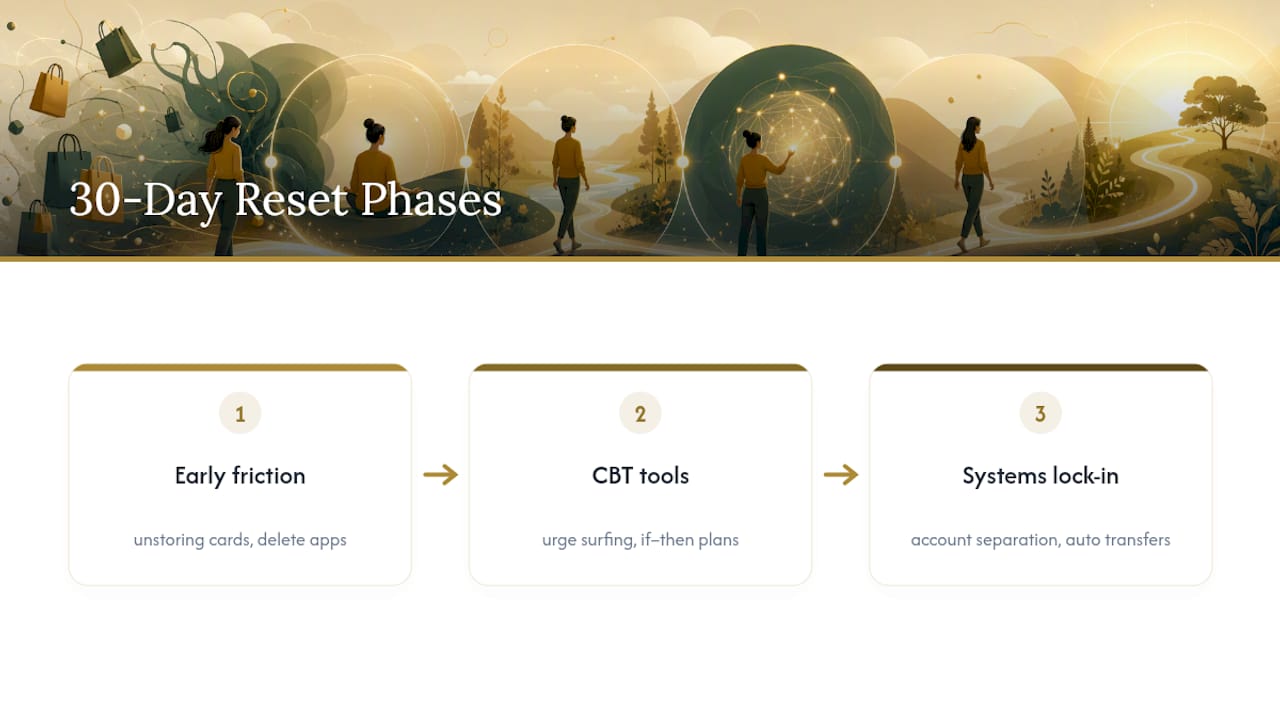
Users completing the program have reported saving an average of $847 per month, a number driven mostly by the compounding effect of removing dozens of small, unconscious purchases at once rather than any single big cut.
Pro Tip: If daily journaling feels like a chore, start with just one prompt a day from the spending-trigger journaling exercises instead of the full workbook page. Consistency beats completeness in the first week.
This structure fits best if you've already tried a few isolated tips and they fizzled out after a week. A guided 30-day sequence gives the habit enough runway to actually stick.
Quick Checklist to Stop Your Next Impulse Buy
- Wait 24 hours before buying anything over $20.
- Delete your saved card details from the app right now.
- Add the item to a wish list instead of the cart.
- Start logging every purchase this month, no exceptions.
- Automate one transfer into a guilt-free spending bucket today.
- Use one script: "I'm going to sit on this for a day" or "Not right now, I'll check back later."
What Replaces the Habit Once the Urge Fades?
Impulse buying often fills a gap: boredom, stress, or a need for a small dopamine hit. Cutting the buying without replacing what it was doing for you usually backfires within a few weeks.
Build a short list of two-minute substitutes you actually enjoy: a walk around the block, texting a friend, a quick sketch, five minutes of a hobby you've been neglecting. The goal isn't willpower, it's swapping one dopamine source for another that doesn't cost money.

Accountability multiplies the effect. Tell one person, a partner, a friend, or a group chat, what you're trying to do and ask them to check in weekly. Research on habit change consistently shows that behaviors tracked and reported to someone else stick longer than private resolutions. If you don't have a built-in accountability partner, an online forum or a structured group challenge works just as well; the mechanism is the same, just a witness to your progress.
Keep a small "wins" log alongside your spending log. Every day you skip an impulse buy, write it down. Watching that list grow does more for motivation than any budget spreadsheet ever will.
Why Perfectionism Is the Real Threat to This Whole Plan
The biggest way people derail this process isn't a big splurge, it's the guilt spiral after a small one. You'll slip. Everyone does. The people who actually change their spending long term are the ones who treat a slip as data, not a verdict on their character, and move on the same day.
Build in planned indulgences on purpose rather than pretending you'll never want anything again. And find one other person doing this alongside you. Accountability partners catch the moments you'd otherwise talk yourself out of noticing.
, Omar
Ready to Turn These Tactics Into a 30-Day Habit?
You've got the tactics: cooling-off rules, if-then scripts, cash envelopes, unsubscribing from every tempting email. What most people are missing isn't information, it's a sequence and a daily nudge to actually follow through on it. The No Spend Reset Challenge Workbook packages all of it into daily micro-challenges, printable trackers, CBT-based journaling prompts, meal planning guides to cut food-delivery impulse spending, and social scripts for the money conversations that usually get avoided.
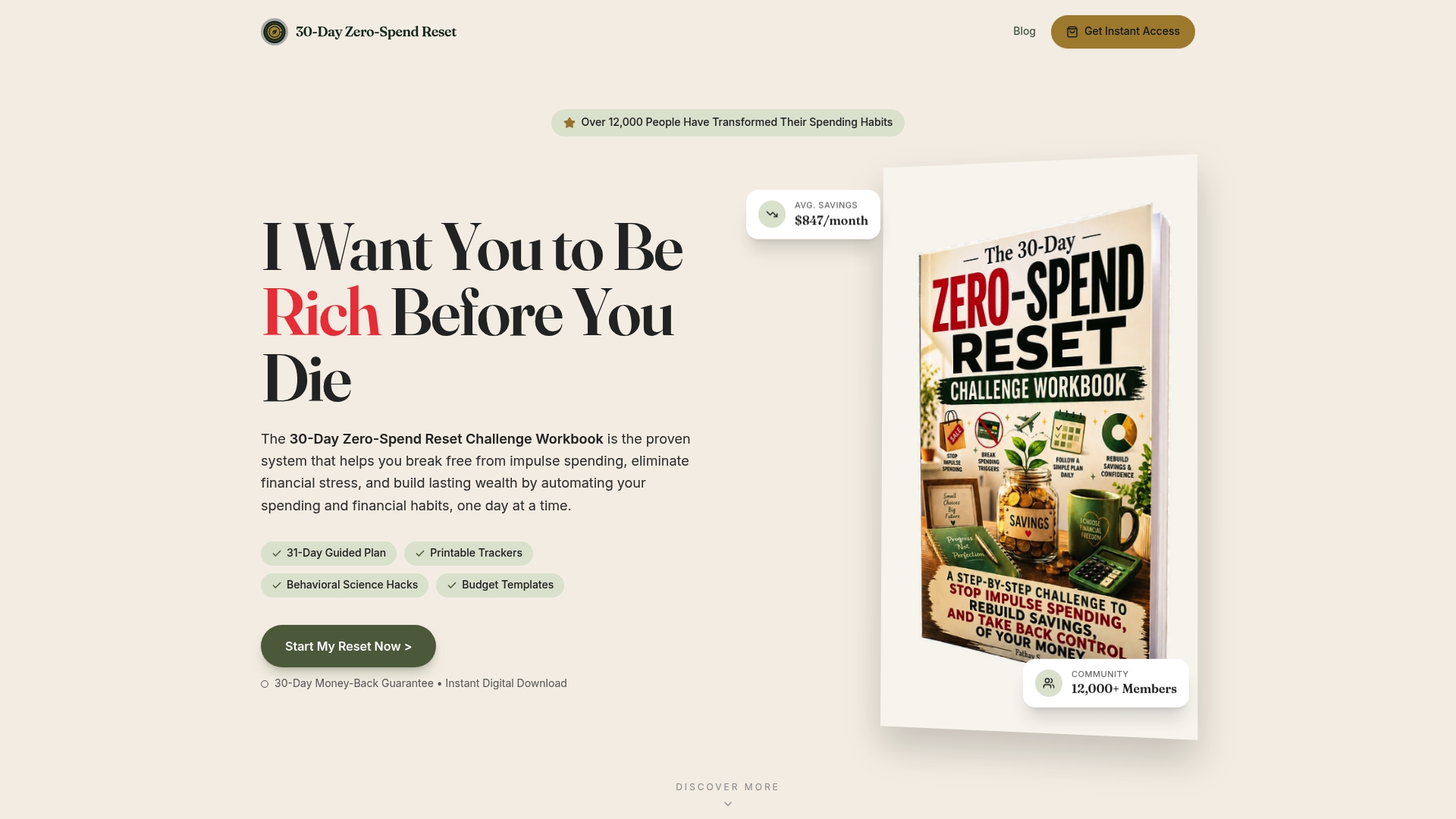
It's built for anyone who's tried a few isolated tips and watched them fade after a week, and wants a guided structure instead. If the full program feels like more than you need right now, the lower-cost starter option covers the core daily challenges without the full toolkit. Either way, the zero-spend guide is the place to see exactly what the 30 days look like before you commit.
Sources
For deeper study beyond this guide, the Beck Institute's CBT primer on impulse buying covers the clinical technique in full. Psychology Today's piece on the pain of paying explains the neuroscience behind payment friction, and Experian's guide to impulse spending offers practical budgeting angles worth reading alongside it.
- Break the Impulse Buying Habit with CBT Techniques | Beck Institute Cares
- Three Tricks to Control Your Shopping and Spending | Psychology Today
- How to stop impulse spending | Experian
FAQ
What Are the 7 Phases of Impulse Buying?
There's no single universally agreed-upon "7 phases" framework in clinical literature, but most CBT models describe impulse buying as a chain: a trigger, a thought, a rising urge, a peak, a decision point, the purchase, and the aftermath (relief or regret). Interrupting the chain at the thought or urge stage, rather than at the decision point, is what CBT techniques target.
Why Do I Keep Impulse Buying?
Impulse buying usually repeats because it's rewarded quickly: a small dopamine hit from the purchase, with the financial cost delayed until later. Removing payment friction, like saved cards and one-click checkout, strips out the natural pause that used to make people think twice, which is why restoring that friction is one of the most direct fixes.
Is Overspending an ADHD Response?
Impulsivity linked to ADHD can make spending urges harder to resist because the brain's reward-delay system processes cues differently, but overspending happens across all kinds of people for all kinds of reasons, including stress, boredom, and marketing exposure. If spending feels compulsive or out of your control regardless of the cause, a professional evaluation is worth pursuing rather than relying on general tips alone.
How Do I Avoid Compulsive Buying?
Start with the basics: a waiting rule scaled to price, removed saved payment details, and a logged record of every purchase for a month. If those steps don't reduce the behavior, or if buying is tied to hiding spending, debt you're avoiding facing, or emotional crises, that's a sign to loop in a therapist or a structured program like the No Spend Reset Challenge Workbook that sequences CBT tools with concrete money systems.
Recommended
Ready to reset your spending?
Get the 30-Day Zero-Spend Reset Workbook and turn these ideas into a daily action plan.
Start the 30-Day ResetThis article is part of the 30-Day Zero-Spend Reset method. Explore the complete day-by-day system behind these ideas.
Read the full guideKeep reading






Join the conversation
Be the first to share your thoughts on this article.