
Stop Impulse Buys in 30 Days With a Habit Focused Shopping Ban
Run a habit focused 30‑day shopping ban to stop impulse buying. Use prep checklists, temptation hacks, weekly tracking, and the guided workbook option to...
Stop Impulse Buys in 30 Days With a Habit Focused Shopping Ban
A shopping ban is a time-bound commitment to stop buying nonessential items so you can break impulse spending and rebuild your relationship with money. Most people run one for a weekend, 30 days, three months, or a full year, with housing, groceries, and other essentials left untouched. The goal isn't deprivation. It's a reset: fewer reflexive purchases, more cash in savings, and a clearer sense of what you actually value.
TL;DR:
- A shopping ban can lead to significant savings, with documented cases reaching five-figure amounts over extended periods.
- Setting specific, written rules for essentials and no-buy categories increases the success rate and prevents derailment.
- Removing shopping app access, unsubscribing from marketing emails, and building a no-spend kit are effective barriers against temptation.
- Tracking weekly savings and urges helps reinforce money discipline and automating transfers into savings turns effort into system.
- Shorter challenges and gradual re-entry strategies help maintain benefits and prevent old spending habits from resuming quickly.
Table of Contents
- Why Try a Shopping Ban? The Real Benefits
- How Do You Set Rules for a Shopping Ban?
- Prep Checklist Before You Start Your No-Buy Challenge
- Tactics to Avoid Temptation Mid-Ban
- How Do You Track Progress During a Spending Freeze?
- What Causes a Shopping Ban to Fail (And How to Recover)
- How to Re-Enter Spending Without Losing Your Progress
- What Actually Changes After a No-Buy Reset
- Run a Guided 30-Day Reset Instead of Building It From Scratch
- Where to Read More on Shopping Bans and No-Spend Challenges
- Sources
Why Try a Shopping Ban? The Real Benefits
The financial upside gets the headlines, but it's rarely the only reason people stick with a shopping ban. Case studies collected by NPR describe participants paying off debt faster and reporting five-figure savings over longer bans, alongside a noticeable drop in decision fatigue.
A few benefits show up again and again:
- Money saved fast: even a 30-day pause on nonessentials frees up cash that usually disappears into small, forgettable purchases.
- Broken dopamine loops: the urge to buy fades once the habit of buying stops getting reinforced.
- Less clutter, less waste: fewer purchases means less landfill-bound stuff and a smaller footprint.
- Sharper spending awareness: you start noticing exactly where your money leaks out.
Reported savings from documented no-buy challenges range from thousands of dollars to five-figure totals over extended bans, according to NPR's reporting on the trend. That range matters because it shows the payoff scales with commitment, not just willpower.
How Do You Set Rules for a Shopping Ban?
Vague rules are the fastest way to derail a shopping ban. You need a written yes list, a written no list, and a plan for the gray area before day one, not after you've already talked yourself into an exception.
- List your true essentials. Groceries, rent or mortgage, utilities, medication, and transportation to work stay on the yes list without debate.
- Name your specific no-buy categories. Clothing, gadgets, home décor, books, and takeout coffee are common targets. Be specific: "no clothing" is easier to follow than "less shopping."
- Pick a timeline that matches your experience level. A weekend or one week suits first-timers testing the waters; 30 days works for most beginners; three months or a full year suits people who've already run a shorter round, per guidance from Becoming Minimalist.
- Define your gray-area rule in advance. If an item is questionable, write down a single tiebreaker, like "wait 48 hours and ask if I'd buy this even on sale."
- Set emergency exceptions. Replacing a broken essential (a work laptop, a winter coat if you have none) is not a slip.
A minimal starter rule set: no clothing, no home décor, no takeout, no new subscriptions, yes to groceries, yes to existing bills, yes to true replacements.
Prep Checklist Before You Start Your No-Buy Challenge
Most shopping bans fail in the first two weeks, and the cause is usually logistics, not motivation. A short prep phase closes the gaps that would otherwise force you to break your own rules.
- Declutter and sell what you don't use. Turning unused items into cash gives you a small savings buffer before you even start.
- Stock your pantry and toiletries. Running out of shampoo mid ban is how "just this once" purchases sneak back in.
- Audit every subscription. Cancel or pause anything you can live without, and remove saved card details from shopping apps so a stray click can't turn into a checkout, a step AARP's shopping-detox reporting flags as one of the highest-leverage moves you can make.
- Plan for social events and gifts. Decide now how you'll handle a birthday or a wedding invite so you're not improvising under pressure.
- Build your yes/no lists (see above) and write them somewhere visible.
Pro Tip: Print your yes/no list and tape it inside a kitchen cabinet or your wallet. Decisions made in the moment, standing in a store aisle, are the ones that break bans. Decisions made in advance, on paper, hold up.
Tactics to Avoid Temptation Mid-Ban
Willpower alone rarely survives a determined algorithm. The retailers you shop with track your behavior and send reminders, abandoned-cart emails, and personalized ads specifically designed to pull you back, and AARP's detox research found that removing stored payment details and unsubscribing from marketing lists cuts those prompts dramatically. The fix isn't more discipline. It's fewer triggers.
Build these barriers before temptation hits, not during it:
- Delete shopping apps from your phone and use a site blocker on browsers.
- Unsubscribe from every retail email and mute brand accounts on social media.
- Apply a 24 to 48 hour wait rule to anything over a set dollar amount.
- Use the "touch before you buy" rule: if you can't physically hold or click on an item for two days, you don't need it today.
- Cap browsing to a scheduled window, once or twice a week, instead of scrolling on autopilot.
- Build a no-spend survival kit: a library card, a walking route, a favorite podcast, a stash of tea, anything that replaces the retail dopamine hit with something free.
Social pressure deserves its own script. A simple line like "I'm doing a money reset this month, next time is on me" closes most invitations without an awkward explanation, and Nospendreset's guide to declining expensive outings has more scripts for specific situations.
Pro Tip: Keep your no-spend survival kit somewhere you'll actually see it, not buried in a drawer. The point is to reach for it faster than you'd reach for your phone.
How Do You Track Progress During a Spending Freeze?
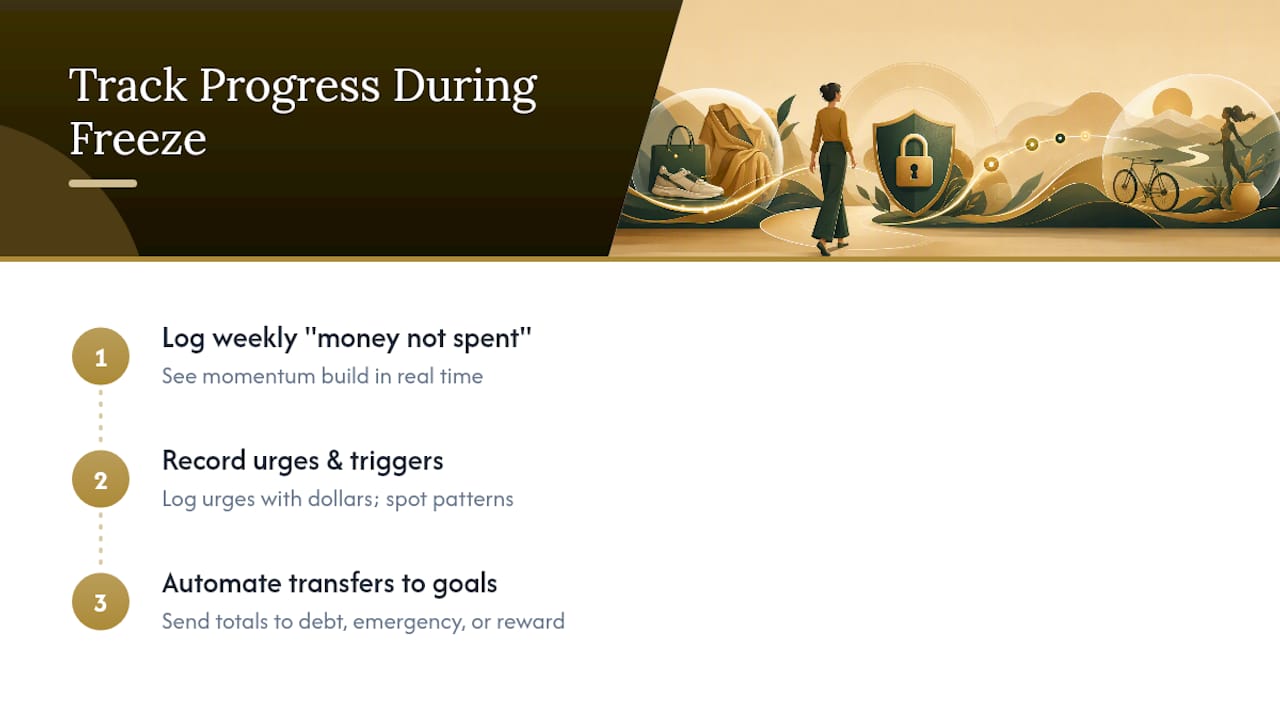
What gets tracked gets reinforced. Log your "money not spent" weekly, not just at the end, so you can see momentum build in real time rather than guessing at the finish line.
A simple weekly tracker keeps you honest:
Logging urges alongside dollars matters as much as the total. Patterns show up fast, boredom at night, sale emails, a specific friend's shopping habits, and once you see the pattern, you can plan around it.
Automating a transfer of every "money not spent" total straight into savings turns willpower into a system, a step I Will Teach You To Be Rich recommends specifically because it removes the temptation to quietly spend the surplus later. Point the total at something concrete: debt payoff, an emergency fund, or one planned reward you chose before the ban started.
What Causes a Shopping Ban to Fail (And How to Recover)
Slipping up doesn't mean the ban failed. Most breaks come from predictable causes: withdrawal from the dopamine hit of buying, an unplanned life event, or simply underpreparing for week one, according to lessons from Becoming Minimalist's six-month no-buy experiment.
- Assess what actually happened. Was it boredom, stress, a genuine emergency, or a gap in your rules?
- Return the item if you still can. Most retailers allow returns within a window; use it.
- Adjust the rule that broke, not the whole plan. If clothing was the leak, tighten that category instead of scrapping the ban.
- Restart with a shorter challenge. A fresh 7 day or 30-day round rebuilds confidence faster than trying to salvage a failed year.
- Simplify if the rules were too strict. A ban with three clear categories beats one with fifteen you can't remember.
If self-sabotage keeps showing up after real progress, the pattern may be bigger than shopping and worth addressing on its own.
How to Re-Enter Spending Without Losing Your Progress
Ending a shopping ban cold, with no guardrails, is how the old habits creep back within weeks. A gradual re-entry protects everything you built.
- Set a monthly allowance for the category you missed most, with a hard dollar cap.
- Keep the 24 to 48 hour wait rule permanently for any nonroutine purchase.
- Run one no-spend day every week, indefinitely, as a maintenance habit.
- Rebuild your budget around what you learned, not your old default categories.
- Keep automating transfers into savings so "money not spent" stays a habit, not a one time event.
The ban was never really the endpoint. It's the diagnostic that shows you which spending habits deserve to stay dead.
What Actually Changes After a No-Buy Reset
Thirty days without discretionary spending sounds simple until you actually try it, and the biggest surprise usually isn't the money saved, it's realizing how many purchases were filling time rather than a need. The categories that felt impossible to cut in week one (clothing, takeout, small "treat myself" buys) are usually the ones that quietly disappear by week three, once a replacement habit fills the gap.
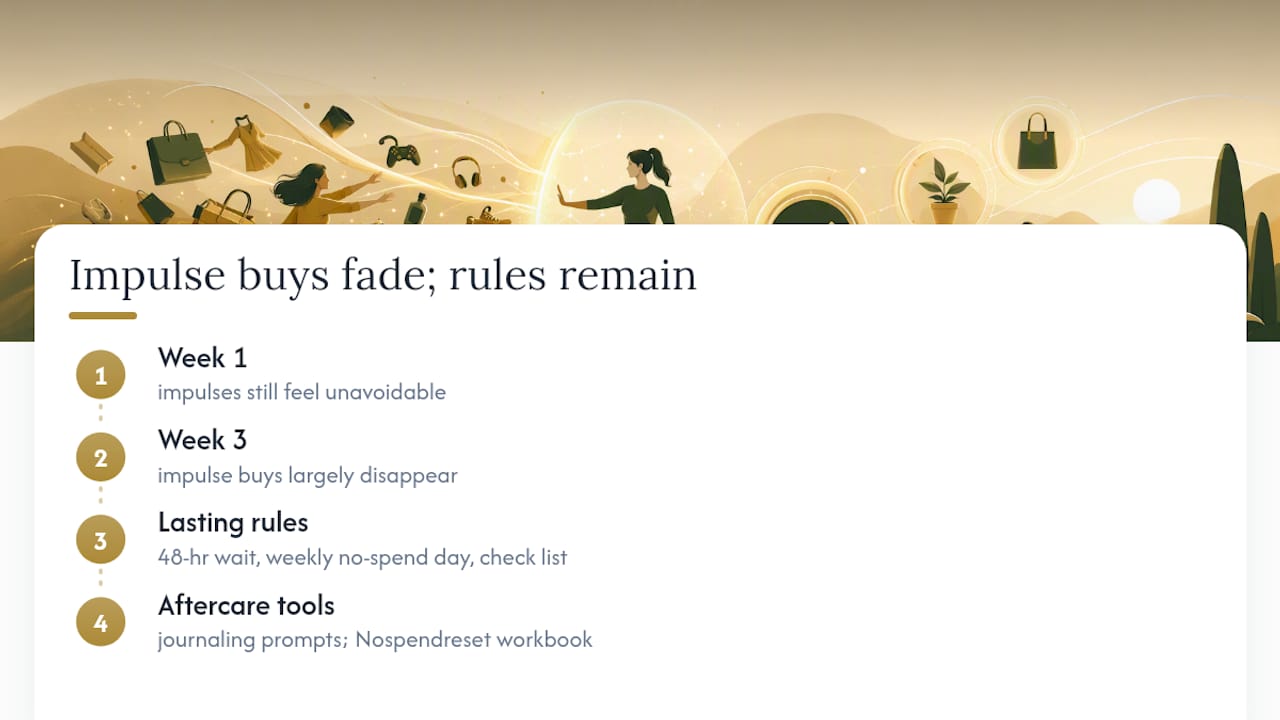
What tends to stick afterward isn't the ban itself but two or three small rules: a permanent 48-hour wait on anything over $50, one no-spend day a week, and a habit of checking a written list before opening a shopping app. Readers who want to track those triggers in more depth can use structured journaling prompts built specifically for spending patterns.
For anyone who wants the reset without building every rule and tracker from scratch, a structured system like Nospendreset's workbook exists for exactly that reason.
, Omar
Run a Guided 30-Day Reset Instead of Building It From Scratch
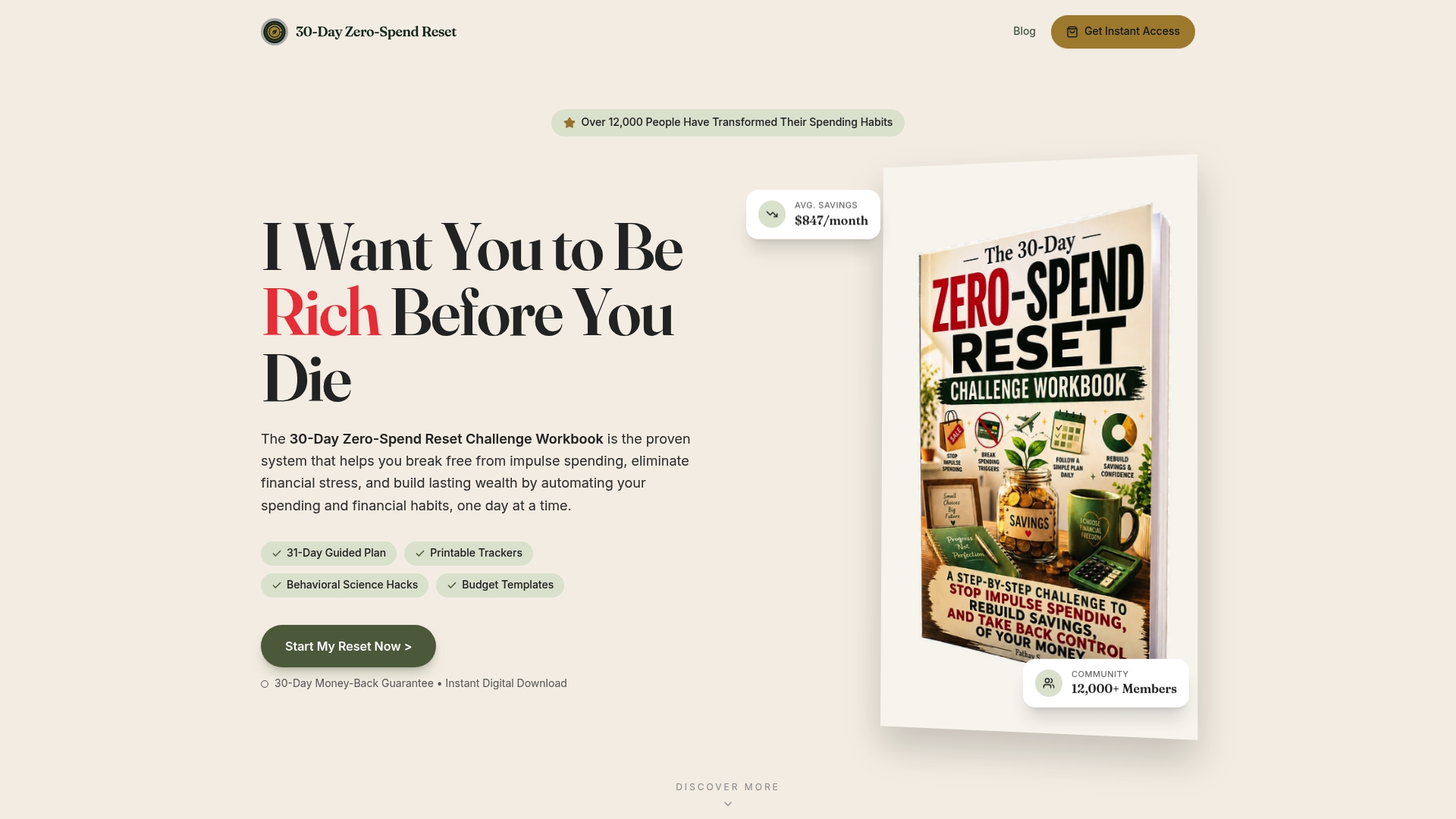
You've now got the framework for a shopping ban: rules, prep, temptation tactics, tracking, and a recovery plan for when you slip. Building all of that from scratch, on paper, in your own tracker, works, but it also means you're the one designing the system while you're also the one being tested by it. The 30-Day Zero-Spend Reset Challenge Workbook does the design work for you: daily behavioral challenges, printable trackers, social scripts for declining invitations, meal planning guides to cut grocery overspend, and subscription audit tools built around the same psychology this article covers, so you're following a sequence instead of inventing one under pressure.
People who complete similar financial reset programs often save substantial amounts monthly by replacing impulse and emotional spending patterns rather than cutting essentials. If you'd rather work from a printed plan, the downloadable guide covers the same 30-day structure on paper. Either way, the first move is simple: pick your format and start day one this week.
Where to Read More on Shopping Bans and No-Spend Challenges
- Investopedia's breakdown of the no-buy challenge covers standard durations and how the trend fits into broader wealth-building habits.
- NPR's reporting on the no-buy challenge documents real participant savings and the psychological shifts behind them.
- AARP's account of an online shopping detox digs into the digital triggers retailers use and how to disable them.
- Becoming Minimalist's six-month no-buy reflection is worth reading for its honest take on why longer bans fail and how to restart smarter.
Sources
Ready to reset your spending?
Get the 30-Day Zero-Spend Reset Workbook and turn these ideas into a daily action plan.
Start the 30-Day ResetThis article is part of the 30-Day Zero-Spend Reset method. Explore the complete day-by-day system behind these ideas.
Read the full guide