
30 Days to a Financial Reset: Polite Refund and Return Scripts
Polite, no guilt refund and return scripts for a 30 day financial reset. Ready email, chat, phone, and in store lines plus when to escalate.
30 Days to a Financial Reset: Polite Refund and Return Scripts
Send a short, factual email or website chat message today: name the order number, what you want (refund, return, or cancellation), and a deadline for a reply, then move to phone and finally certified mail only if you're ignored. Use email or chat first because it creates a written record. Before you send anything, pull together your order number, receipt, and any screenshots so the request takes five minutes, not an hour.
TL;DR:
- Using email or chat creates a written record that can speed up refund processing and help track your request.
- Selling a refund or return request should be straightforward and concise, with a clear desired outcome and supporting documentation ready.
- Federal rules grant a merchant 30 days to ship orders and seven business days to process refunds once approved, which serve as your benchmarks for follow-up.
- Disputing a charge directly with your credit card issuer is an option if the seller ignores refunds or continues billing beyond the legal window, especially for larger purchases.
- Building a system with prepared scripts and trackers helps reduce stress and increases the likelihood of successful refunds and cancellations over time.
Table of Contents
- Refund and Return Scripts for Every Channel
- What to Gather Before You Send Any Request
- How to Deliver the Message and Follow Up
- How the 30-Day Reset Workbook Builds This Into a Habit
- Author's Note: Using These Scripts Without Guilt
- Try the 30-Day Zero-Spend Reset Challenge for Yourself
- Where These Rules Come From
- Sources
- FAQ
Refund and Return Scripts for Every Channel
The channel you pick changes how fast you'll hear back. Chat and email create a paper trail automatically. Phone gets you a live answer but no proof unless you ask for a confirmation number. In person works only if you still have the item and the tags. Pick the one that matches the urgency of your situation, and don't be afraid to escalate from one to the next.
Email script for an online order:
Subject: Refund Request, Order #[number]
Hello, I'm writing about order #[number], placed on [date]. [Brief description of the issue, one sentence]. I'd like a full refund processed to my original payment method. Could you confirm the refund and expected timing by [date, roughly 5 business days out]? Thank you for your help.
That's it. No apology, no justification for wanting your money back. You bought something, it didn't work out, you want the refund.
Website chat or support form script:
Chat is the fastest lane for straightforward issues like a wrong size, a duplicate charge, or a simple change of mind within a stated return window. Open with: "I'd like to return order #[number] for a refund. Can you send me a prepaid label or confirm the return process?" Keep typing to a minimum. Agents on chat move fast when the request is this clean.
Phone script:
Open with, "Hi, I'm calling about order #[number]. I'd like to request a refund." Expect to verify your name, order number, and email. State your desired outcome once, clearly: "I'd like the full amount refunded to my card." Before hanging up, ask, "Can you send me a confirmation email with the refund amount and expected date?" Always get that written follow-up. A verbal "yes" with nothing in writing is worth very little if the refund doesn't show up.
In-store return script:
Bring the item, the receipt or packing slip, and the original packaging if you have it. Say: "I'd like to return this for a refund," not "I want to exchange this" if a refund is actually what you want. If the associate hesitates or cites a policy that doesn't match what you were told at purchase, ask politely: "Could I speak with a manager about this?" Escalating early and calmly usually resolves it faster than arguing with the first person you meet.
Subscription and free trial cancellation script:
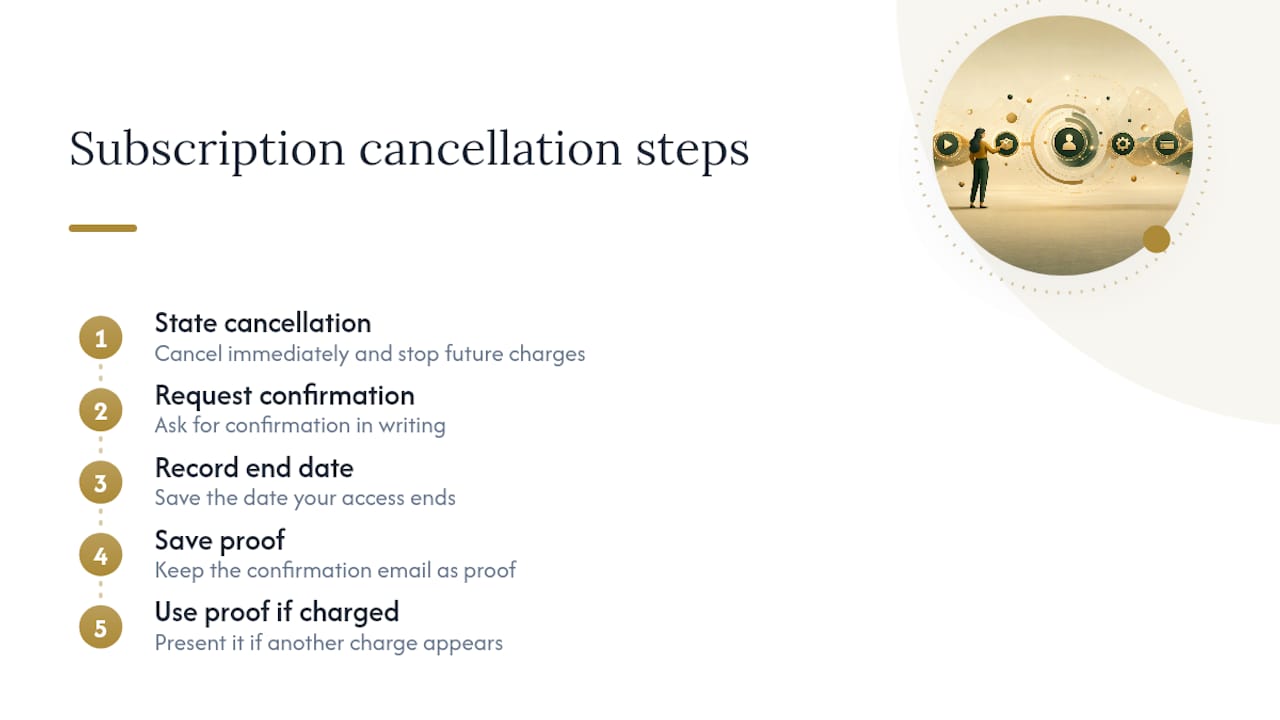
Vague cancellation requests get ignored or misread as pauses. Be explicit: "I want to cancel my subscription effective immediately and stop all future charges. Please confirm cancellation in writing and provide the date my access ends." Save that confirmation email. If a charge hits your card after that message, you now have documented proof the company was told to stop.
What to Gather Before You Send Any Request
A little prep work turns a stressful back and forth into a quick transaction. Before you write a word, collect:
- Order number or invoice number
- Receipt or emailed confirmation
- Photos of the product, packaging, or damage if relevant
- Tracking information showing delivery date
- Any prior email or chat threads about the issue
With that in hand, you're negotiating from a position of fact, not memory.
Federal rules give you real leverage here. Under CFR Part 435, the Mail, Internet, or Telephone Order Merchandise Rule, a seller must ship within the timeframe it promised, or within 30 days if it never gave one. The same rule generally defines a prompt refund as one processed within seven business days for many transactions. That's your benchmark: if a week has passed since a seller confirmed your refund and nothing has landed, you're not being impatient, you're past the standard window.
The 7-day and 30-day benchmarks: a merchant has 30 days to ship if it didn't promise a date, and many refunds are expected within seven business days once approved. Keep both numbers handy when you're deciding whether to follow up or escalate.
A few other things worth knowing before you write your script:
- The Cooling-Off Rule covers certain door-to-door and some other in-person sales, giving you a brief cancellation window, but coverage is narrower than people assume, and it doesn't apply to most online orders.
- State laws on refund policies vary widely. If a seller has no posted return policy where one is legally required, state law may set a default refund window, so check your state attorney general's site if a retailer stonewalls you.
- If a seller flatly refuses a refund you're owed, you can dispute the charge with your credit card issuer within 60 days of the statement showing the error. Debit card protections are weaker and vary by bank, which is one more reason to put subscriptions and larger purchases on credit whenever you can.
How to Deliver the Message and Follow Up
Keep it polite, factual, and short. Somewhere between 150 and 250 words is the sweet spot for an email: enough room to state the facts, not so much that a busy support agent skims past your actual request. Skip the backstory about why you're frustrated. State the order number, the problem, and the outcome you want. That's the whole message.
If you don't hear back in three to five business days, send a brief follow-up referencing your first message and restating the deadline. A second silence after that is your cue to escalate. The FTC's own guidance on resolving business disputes recommends certified mail with a return receipt once online and phone contact fail. That signed receipt becomes useful proof if you later need to file a dispute or a small claims case.
Pro Tip: Save every confirmation number, email, and screenshot in one folder as you go. If a company ever claims it "never received" your cancellation request, that folder is your entire case.
- Wait 3 to 5 business days before a first follow-up
- Escalate to a phone call or certified letter after a second missed deadline
- File a card dispute within 60 days if a refund never materializes
- Report repeat offenders to your state attorney general or the FTC
How the 30-Day Reset Workbook Builds This Into a Habit
Sending one good refund email is useful. Building a system so you stop needing to is the actual goal. The 30-Day Zero-Spend Reset Challenge Workbook was built around that gap, pairing daily behavioral prompts with the practical templates people actually need mid-reset.
Inside, you'll find:
- Social scripts for money conversations, including refund and cancellation language you can adapt on the spot
- Subscription audit templates to flag services you haven't used in weeks
- Printable trackers that log every cancellation and refund so nothing slips through
The daily structure matters because subscription creep and impulse repurchasing thrive on being forgotten, not fought.
Author's Note: Using These Scripts Without Guilt
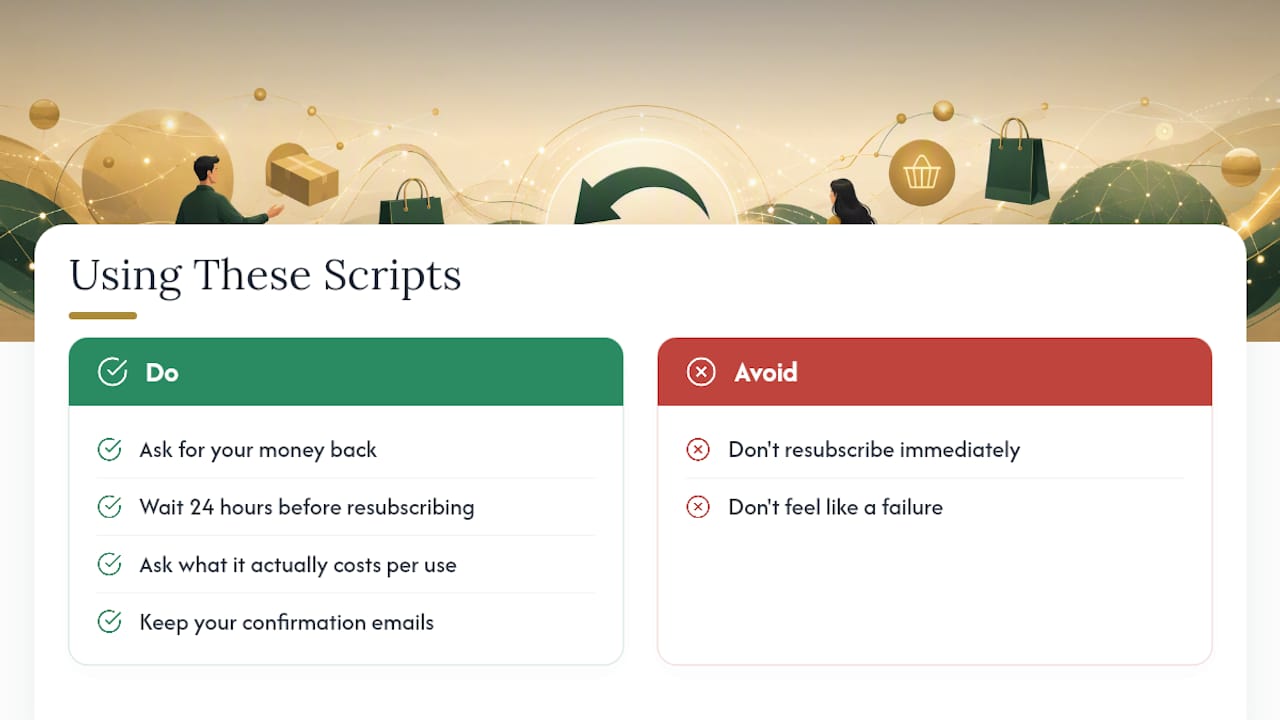
Asking for your money back isn't rude. It's a basic transaction, and companies build refund departments because people use them constantly. If you're canceling a subscription you forgot you had, you're not failing at anything. You're just catching up.
One habit worth adopting: before you resubscribe to anything, wait 24 hours and ask what it actually costs you per use. Keep your confirmation emails. Skip the guilt entirely.
, Omar
Try the 30-Day Zero-Spend Reset Challenge for Yourself
Reading a good script is one thing. Having a system that keeps you from needing it every month is another. The workbook gives you the same script banks and cancellation trackers covered above, built into a structured 30-day format instead of a one-off checklist you'll forget by next Tuesday.

Each day walks you through one behavioral shift, whether that's auditing a subscription, practicing a script before a real call, or logging a purchase you almost made on impulse. For readers who want the deeper toolkit, the Zero-Spend Accelerator Vault adds extra templates and tracking layers on top of the core program. If you'd rather start smaller, the Zero Spend Guide is a lighter entry point before committing to the full 30 days. Head to the workbook's main page to see what's included and get started this week.
Where These Rules Come From
The timing and dispute rules in this guide come straight from federal consumer protection sources: the FTC's Mail, Internet, or Telephone Order Merchandise Rule and its guidance on free trials and auto-renewals. If a seller refuses to cooperate after you've followed these steps, your state attorney general's office is the next stop.
Sources
- Mail, Internet, or Telephone Order Merchandise Rule (FTC / CFR Part 435)
- Using credit cards and disputing charges | FTC
FAQ
What's the fastest way to get a refund?
Email or website chat, paired with your order number and a clear one-sentence request, tends to move fastest because it's easy for an agent to process without a back and forth. Phone works when you need an immediate answer, but always ask for written confirmation before you hang up.
How long does a company have to process my refund?
Under CFR Part 435, many refunds are expected within seven business days once approved, and sellers generally must ship within 30 days if no date was promised. If you've waited past that window, it's reasonable to follow up or escalate.
What should I say to cancel a subscription for good?
Be explicit: state that you want to cancel immediately, stop all future charges, and receive written confirmation with your access end date. Vague language like "I'd like to pause this" often gets misread and can leave you billed again.
When should I dispute a charge with my card issuer instead of asking the merchant again?
If a seller ignores your refund request or continues billing after cancellation, you can dispute the charge with your card issuer within 60 days of the statement showing the error. Credit cards offer stronger protections here than debit cards, so paying with credit for anything you might need to dispute is worth considering.
Does Nospendreset provide refund and cancellation scripts?
Yes. The 30-Day Zero-Spend Reset Challenge Workbook includes social scripts for refund requests and subscription cancellations alongside trackers to help you follow through and build the habit long-term.
Recommended
Ready to reset your spending?
Get the 30-Day Zero-Spend Reset Workbook and turn these ideas into a daily action plan.
Start the 30-Day ResetThis article is part of the 30-Day Zero-Spend Reset method. Explore the complete day-by-day system behind these ideas.
Read the full guideKeep reading



Join the conversation
Be the first to share your thoughts on this article.