
End Late Night Shopping in 30 Days With a Psychology First Reset
Break late night shopping with a psychology first plan: five quick actions tonight, a 24 hour buying pause, and a structured 30 day reset.
End Late Night Shopping in 30 Days With a Psychology First Reset
Stop the purchase by adding friction, not willpower: delete saved cards, close the tab, and give yourself 24 hours before buying anything you find between 9 PM and sunrise. Do that tonight, then spend 30 days retraining the trigger with a structured reset instead of another budgeting app you'll abandon by Thursday.
TL;DR:
- Removing saved payment information and logging out of shopping apps significantly increase the effort required to make impulsive nighttime purchases.
- Implementing a strict 24-hour waiting period for small, frequent items helps distinguish between impulse and deliberate buying, reducing unplanned expenses.
- Decision fatigue and hedonic compensation during late hours weaken self-control, making evening shopping more susceptible to retailer-designed triggers.
- Structuring a 30-day reset with weekly goals, daily tracking, and setting a nightly spending cutoff can effectively break the cycle of late-night impulse buying.
- Tracking emotional triggers and adjusting your environment, like unsubscribing from retail emails, reduces exposure and reinforces the habits necessary to control nighttime spending.
Table of Contents
- Late Night Shopping: What's Really Happening When You Add to Cart at 11 PM
- Quick Action Plan: Five Things To Do Tonight
- Why Late Night Shopping Happens: Decision Fatigue and Hedonic Compensation
- Practical Tactics That Actually Work
- How To Run a 30-Day Zero-Spend Reset for Nighttime Impulses
- Measure Progress: The Morning-After Audit
- A Note on Slips, Systems, and Small Wins
- End Late-Night Impulse Buying With a Structured 30-Day Plan
- Sources
- FAQ
Late Night Shopping: What's Really Happening When You Add to Cart at 11 PM
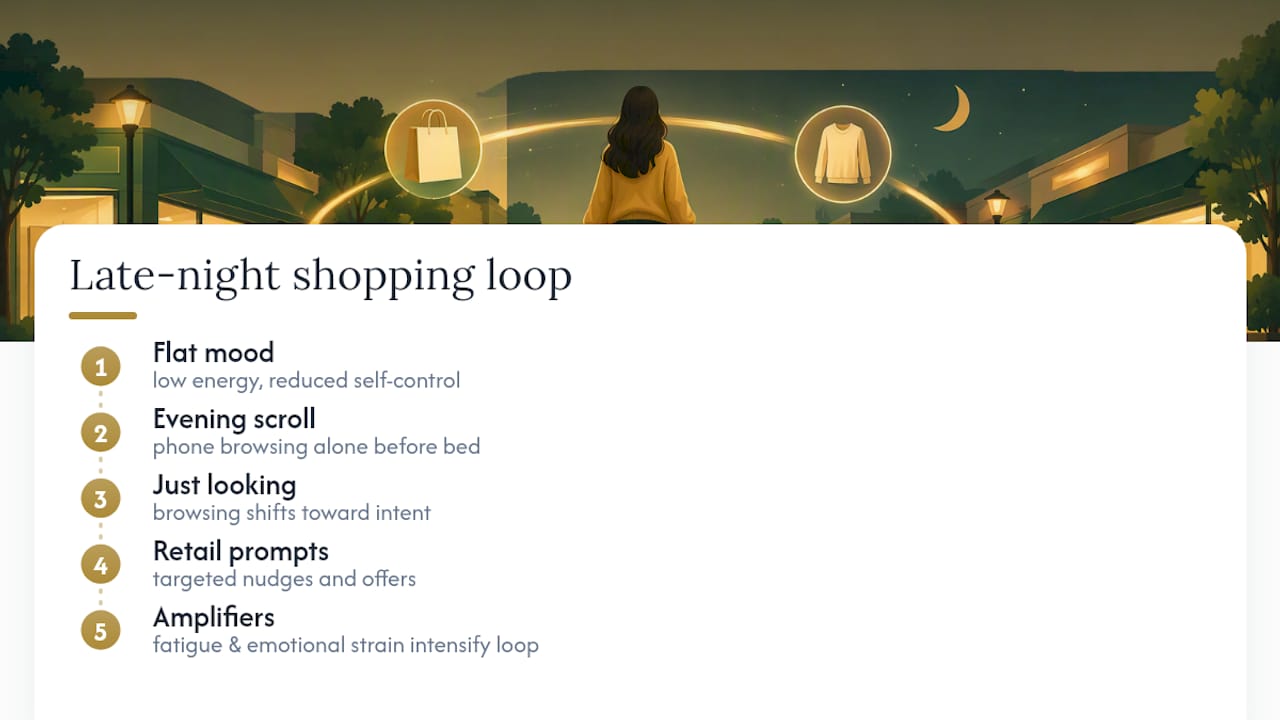
Late-night shopping, in this context, isn't about stores with extended hours. It's the pattern of impulse or emotional purchases made in the evening or overnight, usually on a phone, usually alone, usually right before bed. That distinction matters because the fix isn't "find better deals after hours." It's interrupting a specific behavioral loop that tends to fire hardest when your defenses are lowest.
The loop looks the same for almost everyone who falls into it: a flat mood, a scroll, a "just looking," and then a confirmation email you didn't expect to send. Research on impulsive buying shows self-control measurably drops at night, and fatigue plus emotional strain make you more vulnerable to the prompts retailers design specifically for that window, according to a journal review of impulsive buying's psychological components. You're not weak-willed at midnight. You're running on a depleted system that late-night retail interfaces are built to exploit.
Quick Action Plan: Five Things To Do Tonight
If you're mid-scroll right now, close this article and do these five things first. Speed matters more than perfection here.
- Remove saved payment info from every shopping app and browser autofill. Typing a full card number by hand is a small tax that stops a shocking number of impulse buys.
- Delete the apps, or at minimum log out, so the barrier is a fresh login instead of one tap.
- Turn off push notifications for retailers, especially "flash sale" and "cart reminder" alerts, which are engineered for exactly this hour.
- Set a spending-closed time, like 9 PM, after which no purchases happen regardless of how good the deal looks.
- Move anything tempting to a wishlist instead of a cart. A cart signals commitment. A wishlist signals "maybe later."
Set a personal dollar threshold to decide when to apply the 24-hour waiting rule to your purchases, focusing especially on small, frequent items that tend to add up unnoticed. The threshold isn't arbitrary. It targets the small, frequent purchases that add up fastest and go unnoticed the longest.
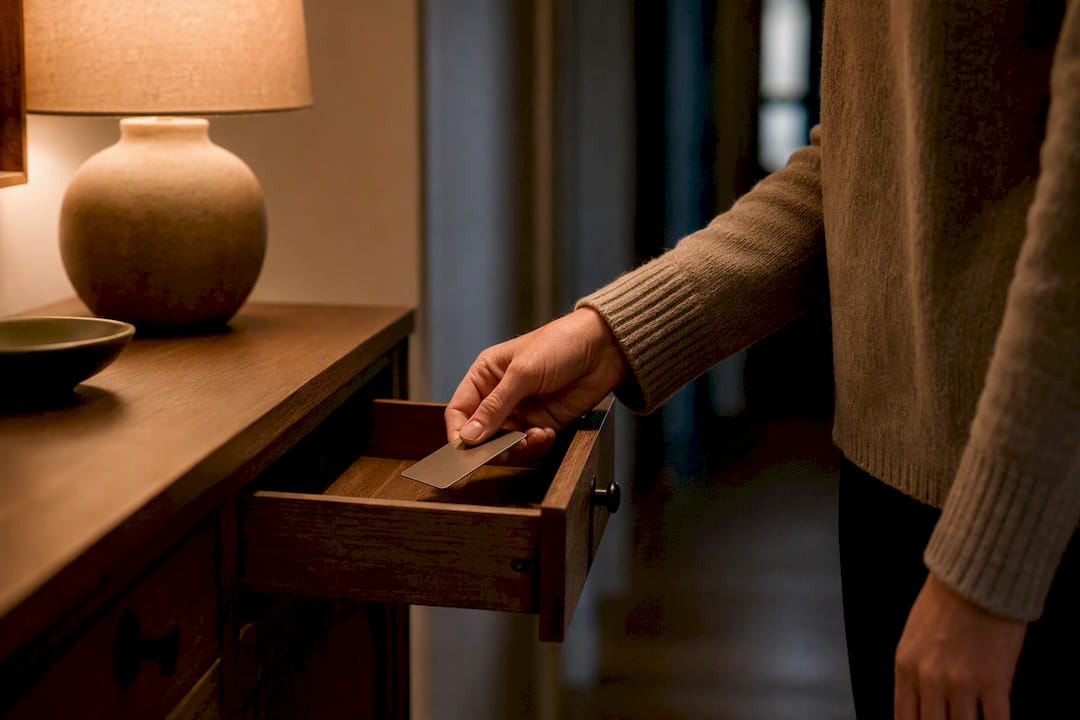
Pro Tip: Keep one physical card in a drawer in another room and require yourself to walk and get it for any purchase over your threshold. That short walk breaks the trance, and by the time you're back at the screen, a surprising number of "must-haves" no longer feel urgent.
Why Late Night Shopping Happens: Decision Fatigue and Hedonic Compensation
Decision fatigue is the biggest driver, and it's not a personality flaw. Every choice you make during the day, what to eat, what to say in that email, whether to answer the phone, draws from the same finite pool of self-regulation. By 10 PM, that pool is close to empty, which is exactly why nighttime impulsive buying correlates so strongly with lowered inhibitory control in behavioral research on purchasing patterns and psychological triggers.
There's a second, sneakier mechanism at work: hedonic compensation. When something distracts you from fully enjoying an experience, whether it's a show you half watch while scrolling, or a scroll session you half enjoy while distracted by something else, you get less satisfaction from it. That shortfall doesn't just disappear. It pushes you to seek a little more, a little longer, which is one reason a five-minute "just checking" session turns into forty-five minutes and a full cart, a pattern documented across more than 6,000 consumption episodes in research on hedonic compensation and overconsumption.
Retailers know this. One-click checkout, personalized evening push notifications, and countdown timers on "deals" all exist because content analyses of top e-commerce platforms show these features reliably increase impulsive buying, according to a study on e-commerce design and consumer-desired friction tools. The same research found something useful: shoppers who struggle with impulse buying actually want more friction in the checkout process, not less. They just don't get it by default.
Practical Tactics That Actually Work
Willpower alone loses to a well-designed checkout flow almost every time. What works is stacking small structural changes so the path from "urge" to "purchase" gets longer and less automatic.
- Build in friction on purpose. Remove saved cards, require manual entry, delete or log out of shopping apps, and consider a site blocker for retail domains after a set hour. Shoppers surveyed about impulse buying specifically asked for tools like these, according to the same e-commerce features study.
- Adopt the 24-hour rule as a hard rule, not a suggestion. Anything above your threshold sits in a wishlist for a full day. If you still want it tomorrow afternoon, in daylight, with a rested brain, that's a real decision instead of a nighttime reflex.
- Set a nightly "spending closed" time. Treat it like a store that locks its doors, because that's essentially what it is.
- Design a guilt-free fun-money budget. A small, pre-allocated amount you can spend on anything, no questions asked, removes the deprivation spiral that often triggers a bigger blowout later. Automate the transfer so it happens without a decision each week.
- Replace the habit, don't just block it. When the urge hits, try a two-minute substitute: journal one sentence about what you're feeling, take a short walk, or text a friend. Verywell Mind's guide to emotional spending notes that simply naming the emotion driving the urge creates enough of a pause to change the outcome.
- Fix your evening environment. Unsubscribe from retail emails, turn off notifications, and keep your phone out of bed. Reducing exposure to triggers is often more effective than trying to resist them in the moment.
- Know when this is bigger than a spending habit. If the urge is tied to grief, anxiety, or a pattern you can't interrupt with any of the above, a therapist or structured support program is the right next step, not another productivity hack.
Pro Tip: Pair the 24-hour rule with a specific replacement action, not a vague "just don't." "Don't shop" gives your brain nothing to do instead. "Text Sarah" does.
How To Run a 30-Day Zero-Spend Reset for Nighttime Impulses
A focused 30-day reset works better than an open-ended promise to "spend less," because it gives your brain a finish line and daily proof of progress.
- Week 1: Set your rules (spending-closed time, dollar threshold, wishlist habit) and practice one substitution each night you feel an urge. Track only two things: did an urge happen, and did a purchase happen.
- Week 2: Add the fun-money allowance and start logging urge intensity on a simple 1 to 10 scale, so you can see whether your tactics are actually lowering the pull, not just blocking the purchase.
- Week 3: Introduce a weekly accountability check, a friend, a partner, or a note to yourself, reviewing what worked and what didn't.
- Week 4: Tighten whatever rule is leaking. If the 24-hour rule keeps getting skipped, shorten your evening screen time instead of adding more rules on top.
Daily tracking is what separates a real reset from wishful thinking. A short, consistent log is more motivating than a vague goal to "stop spending," according to practical reporting on nighttime budget-blowing patterns. This is exactly where a structured tool earns its place. A printable daily tracker, a scripted response for when a partner asks why you canceled a subscription, or a meal plan that removes one more decision point in your day all reduce the number of moments where willpower has to carry the whole load. You can also lean on automating your savings during the reset so progress happens even on nights you forget to log anything.
Measure Progress: The Morning-After Audit
Every morning, before coffee, run a 60-second audit on anything you almost bought or did buy: the item, the price, the emotion you felt, the trigger that started it, and one honest question: would I still buy this tomorrow?
Track monthly totals too: nights without a purchase, total dollars saved, and number of urges resisted versus acted on. Momentary negative emotion strongly predicts craving, which in turn predicts uncontrolled buying later the same day, according to an ambulatory study on affect, craving, and consumption, which means a spike in bad-mood days should tell you exactly when to tighten your rules.
- If the same emotion (loneliness, boredom, stress) shows up repeatedly, your substitute activity needs to target that specific feeling.
- If purchases cluster around one platform or time window, that's where your friction needs reinforcement.
- If none of this budges after a real 30-day effort and the spending feels compulsive rather than habitual, that's a signal to bring in a therapist, not a signal that you failed the reset.
A Note on Slips, Systems, and Small Wins
Nobody runs a perfect 30 days. The point of the morning-after audit isn't to catch yourself failing. It's to collect data, without judgment, so you can see exactly which rule needs tightening. A slip on night 12 doesn't erase night 11. Systems beat guilt every time, because guilt just adds another negative emotion to the pile that started the spending in the first place. Track the small wins. They compound faster than most people expect.
, Omar
End Late-Night Impulse Buying With a Structured 30-Day Plan
Generic budgeting apps track what you already spent. They don't stop the 11 PM purchase before it happens, which is the actual problem this article has been solving. The 30-Day Zero-Spend Reset Challenge Workbook is built specifically around that gap: daily behavioral challenges targeting nighttime triggers, printable trackers for the morning-after audit, social scripts for the awkward "why did you cancel that subscription" conversations, and meal plans that remove one more decision point during your most vulnerable hours.
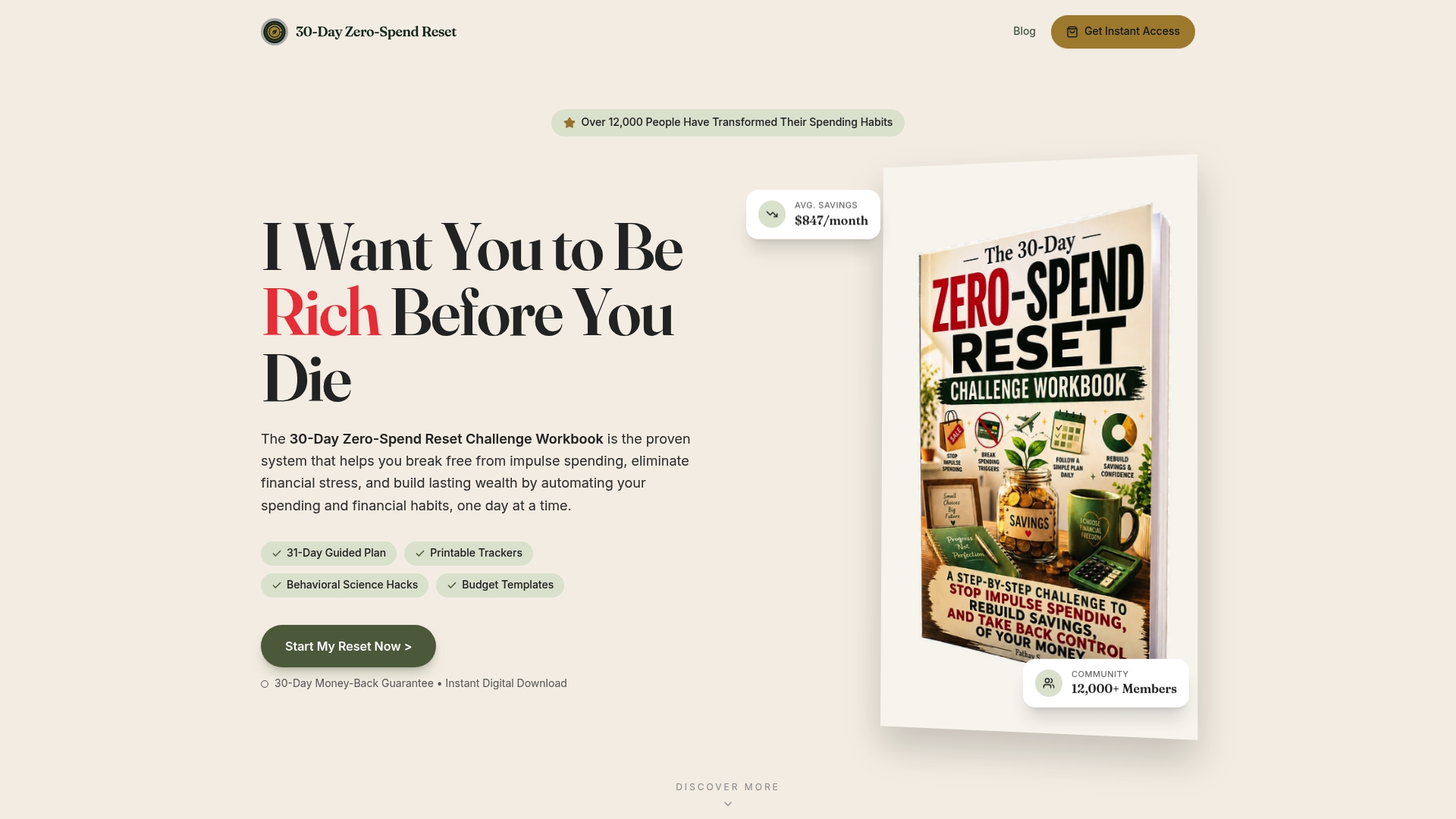
Such a program can be grounded in behavioral psychology rather than restriction, and may offer a private webapp companion to help with tracking during vulnerable times. It fits best if you've tried willpower-only budgeting and watched it fail the first stressful week. For readers who want deeper, guided support after finishing the initial reset, the Zero-Spend Accelerator Vault extends the same framework further. Start with the workbook, run the 30 days, and see what changes when the system does the remembering instead of you.
Sources
- Underwhelming pleasures: Toward a self-regulatory account of hedonic compensation and overconsumption (APA record)
- Verywell Mind, Emotional Spending: Why You Buy Things You Don't Need (And How to Stop)
- Study on e-commerce features that encourage impulse buying and desired friction tools
This article is general information, not a substitute for advice from a qualified financial advisor. Consult a qualified financial professional about your own circumstances before acting on anything here.
FAQ
What Counts as Late Night Shopping in This Context?
It refers to impulse or emotional purchases made in the evening or overnight, usually online, rather than shopping at physical stores with extended hours. The pattern is driven by decision fatigue and lowered self-control after dark, not by finding better deals.
Does the 24-Hour Rule Really Work?
Yes, because it separates the urge from the decision by letting the nighttime emotional spike pass before you commit money. Consumer guidance on emotional spending consistently recommends this pause as one of the most reliable tactics available, according to Verywell Mind.
How Long Should a Zero-Spend Reset Last?
A 30-day window gives enough time to break the automatic nighttime habit while staying short enough to stay motivated. Nospendreset's 30-Day Zero-Spend Reset Challenge Workbook structures that window into weekly goals and daily micro-challenges rather than one long, vague commitment.
What if I Slip and Buy Something Anyway?
Log it in your morning-after audit without judgment: the item, the emotion, and the trigger. A single slip is data, not proof the system failed, and the pattern it reveals usually points to exactly which rule needs tightening.
How Much Does the Workbook Cost?
Current pricing is available directly on the Nospendreset site. The companion Zero-Spend Accelerator Vault is offered separately for readers who want extended support after the initial 30 days.
Recommended
Ready to reset your spending?
Get the 30-Day Zero-Spend Reset Workbook and turn these ideas into a daily action plan.
Start the 30-Day ResetThis article is part of the 30-Day Zero-Spend Reset method. Explore the complete day-by-day system behind these ideas.
Read the full guideKeep reading

Join the conversation
Be the first to share your thoughts on this article.